Monday, August 10, 2015
Siggraph 2015 Notes
I just missed Joey Ito's Keynote speech. The MIT Media Lab space at Siggraph, as always, has excellent graphic design. I guess I would call it that MIT Press look.
It disappoints me that we do not have a message board. Yes, it was unwieldy and imperfect but it was often of use and now there is nothing to replace it.
Hotel Figueroa is no longer owned by Uno, the entertaining German who had bought it 20 plus years ago. It does not appear as though the Sunday Art Party poolside at the Hotel Figueroa is still in action.
At the dWi reunion party, perhaps half the people were unemployed, it seemed.
Sighted at Siggraph: Joan Collins, Mary Whitton, Michael Naimark, Jimbo Hillin, Joey Ito, Scott Fisher, two volunteers from Va. Commonwealth University, Marty Schindler, Rick Sayre, Ed Catmull, Pat Hanrahan, David Morin, David Naegel, Craig Reynolds, Kevin Bjorke, Ed Kramer, Scott Owen, Tom Duff, Henry Fuchs, Turner Whitted (now at Nvidia), Paul Debevec, Barton Gawboy, Jay Sloat, Kurt Fleisher.
Coons award winner Henry Fuchs.
Art achievement award went to Lillian Schwartz which is great, but I felt that Siggraph should have put more energy into explaining who Lillian is and how she came to be where and what she was. The thing that Lillian provided was addressed, I felt, to those already in the arts community who knew who she was and what the backstory was. I think.
A brief moment of cynicism about Siggraph papers from the point of view of two very jaded adults who have worked in the glamourous entertainment industry. A friend and I were discussing what sort of papers one saw at Siggraph, broken down by category: A. papers about techniques that we have been doing for years, B. papers about good ideas that are implemented in a way that is straightforward and obvious, C. Papers about problems or ideas where the author did not seem to understand that the problem had been solved for years, or did not know something about prior work that is very important. D. Papers about some idea that was really interesting and unexpected, however it was implemented, E. Papers about an idea that was well known (or a problem that was well known) but was solved in a way that was unexpected or really clever. Obviously what you want is more of categories D and E.
I had a crisis at home and had to leave Siggraph Monday evening through Tuesday unfortunately when most of the interesting parties were.

Thursday, August 6, 2015
Marketing, Mojo and Career Longevity
draft
An esteemed
colleague discussed in an email how, after years of having excellent
positions at important companies, that he could no longer seem to get
a job, that the “mojo” had gone away. I also experienced
something similar, may still be experiencing it, and so I want to
discuss my impressions of this phenomenon which is so frustrating and
confusing. Although I believe some of this may also apply to my
friend, that would be for him to say, this is all from my point of
view and based on my experience and impressions.
The argument goes
like this. In an earlier and more naive period, some of us who were pioneers in that field were able to achieve results that got us some notoriety and the perception that we were near the top of our field, which we may very well have been in one way or another. This notoriety was communicated to the field
through the normal course of attending certain conferences,
particularly SIGGRAPH, word of mouth and industry magazines. Just being asked to participate in a conference was a form of this, and a self fulling prophesy.
While we thought we
were building up long-term credibility, improved by working on
fundamental concepts and inventions at an earlier time, it turns out
that we were not. Because in America, long-term credibility is only
in the eyes of the beholder, and most people of the world do not
behold it. What we were benefiting from at the time was a. the
benefit of fashion, we were very fashionable, and b. short term
credibility as being near the forefront of the field, a field that
was very trendy but not with many practical applications.
Because of this
trendiness and because practical applications slowly started
appearing, there was a massive influx of new people. The new people
not only did not know the history, but could not care less. Those
who were responsible for awarding projects or hiring people for a
while were members of the class of people who were early in the
field, but as time passed there were less and less of them and more
of the newcomers. Not only were the newer people unaware of the
achievements, they classified them as ancient history and not
relevant to the modern world. There was no presumption that someone
who had done good work in the past would do good work in the future.
And there was the belief that things had changed so radically that
whatever skills were necessary to do good work today would not be
present in those who did good work then.
Furthermore, there
is the belief among many people that they do not want experienced and
acclaimed people among them, that this will cause competition and
quite possibly take away from their glory. And it might, it might
take away from their glory since most often people are vainglorious
and demand all the glory. I have seen this concern and its results
literally hundreds of times.
Finally, for a
variety of reasons, our more experienced player may not be in a position to do new work as that would be defined by the field. But our player has a tremendous need to demonstrate new work, as it is only through that new work (generally speaking) that he or she can renew the mandate that has allowed them to achieve what they have so far achieved. Without this renewal, any past accomplishment becomes less and
less relevant. But our experienced player may not be able to do new
work because of circumstances beyond his or her control, health
issues, or not being hired out of envy, or any of a number of
reasons. If a consultant, they may not be in a position to get
credit for their work, because it is the life of the consultant that,
in general, you can not get that credit without upsetting your client.
And here is the key
point: in the earlier period our player had benefited from marketing that happened more or less accidentally, by doing good work at the right time or place. The marketing happened for them and on their behalf but not because of any particular actions that they took. And our player may not in actual fact be necessarily talented at marketing, or even have the slightest
interest in it. They were interested in doing good work (which does sound pathetically naive and middle class, does it not?). Marketing is a
different thing. A different skill. A field that requires both talent and hard work like any other field. And so our player, who was the beneficiary of marketing that he had not done, gets less and less
benefit from past marketing as time goes by and yet new marketing is not
forthcoming because he is not providing it, and circumstances do not
allow it to happen as it did before, without his input.
The result is that
our player goes further out of fashion. And since for the most part
people were responding to fashion and not to anything else, certainly not merit or brilliance, something they would be quite unqualified to judge and could care less about, then our
player becomes less and less employable and we have the classic
downward spiral.
There are several
other issues that are contributory to this, self-marketing is not the
only factor. Fashion also applies to technology and for one reason or another our player may be associated with a specific technology, like motion capture or lisp, even if they are incidental. This is about perception as well as reality. Other companies may perceive that the technology that the player uses or used to use as being
old-fashioned, whether or not there is any technical basis for their
belief is irrelevant. This is another reason why the field of computer animation, with its wild turnover in companies, can result in unemployment for those who used those technologies at those companies. Fashion applies to everything and new companies have different fashions in technology that they use.
The conclusion that
I want to leave you with is that long term employability and presence
near the top of a field requires not only talent and accomplishment,
but marketing and the ability to present oneself as current.
Marketing may in fact be more important than talent and
accomplishment, but of course it is preferable if all elements are
present. Without marketing, for whatever reason, one will go out of
fashion and have to face the consequences that result.
There are many
nuances here that should be mentioned and I will mention a few. There are
many ways to achieve marketing and many reasons why this may apply
more to some people than to others. And none of this may be fair or
just. Someone who merely has a job at a well-known
company may have all the marketing that they need. Those who are
unemployed or freelance generally do not have that benefit. Or if
one is not seen as worthy to be included in an effort to create a new
standard for some technology, those who are included get a certain
level of marketing and those who are excluded do not. This list of nuances and exceptions goes on and on.
Again the nuances
aside, the thought I want to leave you with is that marketing is
important and it is an area that can not be ignored for the long run
without dire consequences. As evidence I propose that when you see people near the top of their field for a long time, inevitably it turns out that they are talented at self promotion, sometimes very talented.
Many people come to mind who have this skill, but discretion prevents me from mentioning them here.
Many people come to mind who have this skill, but discretion prevents me from mentioning them here.
Wednesday, August 5, 2015
A Little Personal Democracy and a Write In Campaign for SIGGRAPH in 2015
draft
I am now asking Siggraph for the details and deadlines associated with the process of getting write-in votes to be allowed to run for the Executive Committee of Siggraph.
I am now asking Siggraph for the details and deadlines associated with the process of getting write-in votes to be allowed to run for the Executive Committee of Siggraph.
I
am certain that I have missed the deadline for the next election, so
any signatures that I gather at Siggraph next week will presumably be
for the election after this one.
I
plan to run on a very specific platform and if I get elected, I will
consider that a mandate to research the state of non-academic employment in
computer graphics and animation in order to determine, or attempt to
determine, how many are employed and where, what the categories of
employment are, what the stability and projected future of these
positions are, to what extent are these positions overseas, and to
what extent unemployment has affected the field. And other issues
along the same lines as well. The general idea here is, what should we tell young people if they express a desire to go into this field? What should we tell them about the likelihood of employment and what terms and conditions come with that employment. Let me give you two examples: first everyone who comes into this field should understand that it is considered a niche field and no experience in it will qualify you for anything else and second, on the entertainment side of things, people are never hired for more than a project no matter what they are told.
These are very large issues and one person without resources is not likely to get definitive answers to these and related questions. However, I can use the position on the committee to get what information people are willing to share with me and write up whatever I learn.
These are very large issues and one person without resources is not likely to get definitive answers to these and related questions. However, I can use the position on the committee to get what information people are willing to share with me and write up whatever I learn.
I
also plan to report back to the membership the ideas, concerns, and
perceived limitations on the part of members of the committee, many
of whom have told me that there is nothing that Siggraph is empowered
to do on these issues. Although I may not agree with them, I can
certainly admit that they have much more experience than I do at that
level of the organization and I can, I think, be of help by reporting
to the membership what the concerns are and what people believe. I
would hope to do this in a professional and collaborative manner that
causes no concerns or offense to anyone to the best I can manage.
I
doubt that my efforts would result in any sort of official statement
or report from Siggraph on these topics, but maybe we can achieve
some lesser goals. At the least I would hope I could convince the
EC, or most of the EC, that we can not just encourage people to bet
their careers on this field without significant warnings and
statements of concern. It should not be all rah rah rah the future
is bright, which has been the story from Siggraph to date.
There
seem to be a lot of miserable and unemployed people out there. This
is guesswork on my part because no official or unofficial statistics
exist to the best of my knowledge. Yes there are many people who are
gainfully employed and doing good work, but I am also aware of many
who are constantly moving from project to project in a way that is
disruptive to their lives, and others who are not employed and have
not been for a while and wonder what they are going to do. No doubt
I have sampling error, how could I not? Yes maybe this is normal, or
the “new normal” and that could be the case. But if so, we
should make sure people know that.
Whether
we like it or not, Siggraph was part of the movement that created
this industry segment, the use of computer animation and synthetic
imagery in the creation of film and related media, both full length
computer animated films and live action films with visual effects.
This movement started in large part by idealists who used Siggraph as
a venue through the 1980s, when no one believed us, and the 1990s,
when they started to believe, into the next century when things
exploded. I was a part of this movement and I contributed and I was
there, so I know Siggraph helped. But now that the industry is very
large, and yet with so much turmoil, and so much unemployment, that
it is our responsibility to do what we can to make things better and
at the very least make it clear to those who would bet their lives
and their careers on the field what the situation is as we understand
it.
If
you are attending Siggraph next week and you are a member of
Siggraph, I hope you will find me and sign my petition so that I can
be considered for election to the EC.
You
should also feel free to send comments or concerns, hopefully in a
postive and cordial manner, by either leaving a comment here or
sending me email at the address below. If you do send email, please
put something in the subject field about what it is about so I know
to read it.
Thank
you.
M.
Wahrman
michael.wahrman
at gmail.com
On the Occasion of Siggraph 2015
draft
It is a fundamental
tenet of western civilization that one must present oneself with
confidence and style. No signs of weakness are permitted as it
causes the other biped mammals to see you as a potential meal, or the
other bipeds, whose support you need, to ignore you or dismiss you.
There are those I
suppose who benefit from being so pathetic that it attracts a certain
kind of person who likes doing rescues, but I don't think one wants
to count on that as a strategy.
I have become more
aware this year that my goals for the future are impractical based on
my current status, how I am perceived, the resources that I have, and
the competition.
Part of the problem
here is that in the past I worked with energy and what is, I hope,
talent and skill but was also nearly completely unaware of the odds
against me. And these efforts all led to great success and total
failure, accomplishment yet contempt from my peers, personal attacks
that are quite astounding, and generally everything that one would
expect from being poor in America, where talent and accomplishment
means nothing, only money matters and certain credentials as one gets
by being approved and anointed by those with power.
Why then, would I
expect things to be any different in the future, when in fact the
odds are only worse then they have ever been? They are worse
because in the past I was part of a community, now I am alone. They
are worse because in the past I had access to resources, now I have
no resources. They are worse because now this is an established
field and this implies both more competition, as well as competition
with access to both resources and those affiliations that I wish I
had but do not.
Not only may fools
go where wise people fear to tread, but in fact the earlier success
of the fool may not only be a result of their energy, talent and
ignorance but also because times were different.
There are deeper problems as well. A fundamental and well-reasoned concern that major elements on which we base our lives and our society are based on lies, or false premises. Not all, but many of them. And that our public servants know this and do nothing to correct it either because they feel they can't or because they do not care. I have become convinced that our government does not have our best interests at heart and that they are quite capable of cynically exalting the rich at the expense of the rest of the country. I have looked at some of the evidence, evidence that The Economist says does not exist, but it does exist. Too many lies, too much hypocrisy, too much swept under the rug, too much misery.
On the other hand, what is the alternative. Perhaps talent, hard work and experience and maybe a sense of humor about the situation, all of our situations, can make a difference. I guess I have to try again.
These are the
thoughts that occur to me on the occasion of a birthday and the
annual trial of Siggraph.
Tuesday, August 4, 2015
Design Your House to Accommodate the Slaves
I
have always wanted to be able to design and build my own house. Well
thats not quite true. Of course what I really want to do is to specify the big
ideas and have an architect and various craftsmen build the house.
How else am I going to get a minimum required number of secret
passages? If you want something done right, you have to do it
yourself, it seems.
It
is a common film school aphorism that everyone's first film is about
sex. I think that everyone's first house is about themselves. The
house reveals something about who they are, their values, their
beliefs, their interests all brought into physical reality in some
form. It is a statement about how they want to live their lives and
what they believe is important.
Houses
are often designed to be very boring in order to maintain resell
value. What a terrible idea that is! I would hope that all my
readers would strive against this horrible constraint on their
creativity and not worry too much about resale value. You must have
faith. It also helps to have money, of course.
A
friend of mine is able to build her own house in a very nice part of
Santa Barbara and in the hope that some of these ideas might be in
any way useful or interesting, I have compiled here some notes collected over the years, ideas I would consider if I ever built my house. None of these ideas are particularly original, in general they are ideas I have seen and liked, or read about, etc.
But
what is appealing to one person is not at all interesting to another.
And this is not my house, it is the house she is building for herself and presumably her partner who I have not even met. So this list may not be at all valuable to her. But maybe, I mean, who knows.
This
particular list is oriented towards ideas that have been around since
about the 4th century BC through the mid 19th
century or so.
Everything
old may yet be new again.
The following is in no particular order.
1.
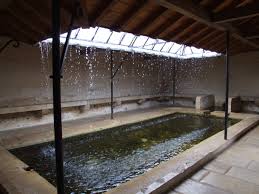
All upper class Roman houses were built around one of several water
collection designs, that would automatically collect the rainwater
from the room in an underground space, or impluvium. We would
probably call such a thing a cistern. In drought stricken
California, this would be an excellent way to get water for your
landscaping, for example.
This is a modern architects's interpretation of an impluvium. Although a pool is nice, I was thinking more about just storing the water underground in a cistern.
2.
The Romans built their homes to have layers of public and private
space. Any upper class Roman was a patron and would greet clients
every day in their home. So a big part of the Roman home was
designed to admit the clients into an outer part of the house where
they were formally greeted and often received a gift. This might be the first atrium of the house, a rather large space. Then there
would be other social spaces further in the house for those few
admitted within. Beyond that would be private places for the house
where the owners and family slept. Then above or below would be
cubicles for the servants and slaves. The idea I want to emphasize
was that even the public spaces had a hierarchy to them.
3.
My father used to struggle heating a home in Virginia that was
designed to be wasteful of energy. We put in insulation in the attic and a heat barrier (basically a door) to the basement and reduced our heating bill by half. This is a well
understood topic in America today, that there are much better ways to
heat and/or cool our homes.
I spent one winter at 8000
feet in Colorado in a large house that was entirely heated by one
freestanding wood fireplace with an exhaust chimney made of metal
that extended through the air
for 10 feet on its way to the outside. There are particulate (e.g.
smog) issues if everyone burns wood, but there are ways to mitigate
this problem if one wants to. Am
I suggesting that you heat your house with wood? I dont know, I am
just pointing out how well it worked in a really cold environment and
how economical it was.
On
another occasion, I spent
some time in the traditional
adobe house of a friend of mine in Taos, NM. It
was about 1/3 underground and the walls were very thick and
made of some sort of compressed earth and straw, I think, and then covered with plaster. It was
completely astonishing how
well it kept the house cool during the very hot days and warm during
the very cold nights.
The point here is not that one should heat ones house with a wooden stove or build an adobe or even that one might build the main level of the house such that 1/3 of it is below the ground, although one might do any of these things. The point is that these ideas have real merit and are not hard to implement if one wanted to and designed it in from the beginning.
4. Not only is building underground a good use of the available space, it is especially well suited for things that should remain relatively cool and with a stable temperature. Which is why most older American homes in the east coast and the midwest would have a basement for storage. We would expect to use the basement for food storage, wine storage, but also computer media, storage of film, and possibly also the location of other types of house infrastructure that does not have to be upstairs in the main living, entertainment or working spaces, such as computer servers.
5. I have always tried to keep a spare bedroom or
at least a couch and made it available to friends from out of town.
In Manhattan, I was very well set up for that, which is very unusual
there and I wish more friends had taken advantage of it. One of the lessons of that space is that one can accommodate guests in a way that is completely unintrusive into the rest of one's life. When one reads novels or sees plays set in England, one often reads about families that extended hospitality to friends and family for long periods of time, years at a time. You might have a distant cousin or the son or nephew of an old friend who graduated from Cambridge and has no way to make a living. So you put him up in a guest house and he tutors your daughter in mathematics. That sort of thing. (Arcadia).
6.
Castles in parts of Europe were built with access passages such that
fireplaces in guest rooms could be lit without actually going into
the room. There was a whole infrastructure behind the scenes for the
servants which allowed them to come and go without disturbing the
rest of the house. This also provided storage spaces for artwork
that was not currently being used. The big idea is to consider
building such passages, whether overt or covert, into your house for
a variety of reasons and purposes. This might be special access from
the kitchen to the outside entertainment area. Or it might be
dumbwaiters between levels for various functional rooms of the house.
7.
I recently spent the night at
a hotel where I was given a room that was built to ADA standards. I
loved it. The bathroom was one huge shower stall, nothing to trip
over, and a nice seat to sit on while showering. There was nothing
to trip over in the entire room.
8.
A variety of techniques can be used to blur the outside with the
inside. A good skylight or series of mezzanines can completely open
up a space. A projection system designed for
screenings in the house could perhaps also be designed to be
redirected to project on an outside screen for those parties and
events on a warm evening. In this way one can also entertain the
whole neighborhood in the same way drive in movies used to. A friend
of friends has built their master bedroom in Telluride such that the
bed is mounted on rails and can be easily be moved outside to sleep
under the stars or pushed inside out of the rain.
9.
Wherever possible, combine functionality with character. The classic
door knocker is of course a lion or some other creature. I always
thought gargoyles were just decorative, but no, they are used to
redirect water away from the stone cathedrals.

10.
The Romans often built interior design into the s tructure of their
homes. A painting might be implemented as a fresco and last for
much longer than merely being painted. A floor was usually a mosaic
made of stone.


11.
The British and the Italians were particularly active in building
formal gardens. There are some great books on this.
12.
All Roman houses in the country were really working farms. I am not
sure you want to go that far, but a nice greenhouse or container
garden would be useful. Maybe make your own olive oil?
13.
All homes should have an observatory of some sort to check out the
countryside for hostile forces or perhaps to observe the universe.
14.
All homes should have major built in bookcases, perhaps used as
entrance ways into storage or corridor areas.
15.
Of course we have to consider how to hide the computer infrastructure
so it is not intrusive.
16.
And it would be only sensible in 21st century America to
consider how we house the slaves. No need to go overboard here, a
little cubicle with a stone bed was enough for the Romans and it
should be enough for us.
17. One of the odd triumphs of S. California was the Arts and Crafts Movement of the early 20th century. One might consider recreating some of their designs or setting up a workshop to do so on site or in some way to feed into your house construction.
18. One might research current artists and workshops capable of creating decorative stone or bronze work. And select an artist or two to work from their workshop or at a workshop you create to feed decorative elements into the house. If one did create frescos one would need to find artists capable of working under those very wonderful and strange constraints (the key to a fresco is to paint it while the plaster is wet, and essentially without making any mistakes).
20. One could set up to do bronzes with the lost wax method but use 3D printing (there I go with these modern techniques again) to create the molds.
21. One might want to create and store spare parts for the house from the very beginning. It would be easier to make spare parts, tiles, sculptures, etc while the workshops that are creating them are building things for the house and just put them underground and wait the 10 or 20 or 50 years until they need replacement.
22. If you do use concrete, recall that Roman concrete is better than Portland cement and that there should be a discussion here.
23. If you do build mosaics, consider designing them with a computer and using some sort of automatic stone cutter or even 3D printer to create elements. Remember a key to a mosaic is longevity, so it might be better to automatically cut stone or tile than to print with modern materials.
24. When working at Robert Abel & Associates, I would often walk down Romaine to visit Opamp books, which is now out of business after a long decline. On the way there I would pass a building that was a ruin, uninhabited, that fascinated me. At some point I noticed some sort of ironwork railings, and older leaden glass in the windows. I eventually discovered that this was the old Hollywood headquarters of Howard Hughes in the period when he made movies. The older glass was fascinating. Consider using handmade or leaden glass, even consider stained glass. Glass does not have to be boring.
and finally,
25 A carillon is a series of bells, usually played by a kind of keyboard that is below it, that has at least 24 bells or three octaves. A chime is the same sort of thing but with at least one octave or 8 bells, but not as many as a carillon. There is a famous chime at Hollywood Forever but it is not playable and would need restoration. Maybe you can buy it? I have always wanted a carillon! See https://en.wikipedia.org/wiki/Carillon

17. One of the odd triumphs of S. California was the Arts and Crafts Movement of the early 20th century. One might consider recreating some of their designs or setting up a workshop to do so on site or in some way to feed into your house construction.
18. One might research current artists and workshops capable of creating decorative stone or bronze work. And select an artist or two to work from their workshop or at a workshop you create to feed decorative elements into the house. If one did create frescos one would need to find artists capable of working under those very wonderful and strange constraints (the key to a fresco is to paint it while the plaster is wet, and essentially without making any mistakes).
20. One could set up to do bronzes with the lost wax method but use 3D printing (there I go with these modern techniques again) to create the molds.
21. One might want to create and store spare parts for the house from the very beginning. It would be easier to make spare parts, tiles, sculptures, etc while the workshops that are creating them are building things for the house and just put them underground and wait the 10 or 20 or 50 years until they need replacement.
22. If you do use concrete, recall that Roman concrete is better than Portland cement and that there should be a discussion here.
23. If you do build mosaics, consider designing them with a computer and using some sort of automatic stone cutter or even 3D printer to create elements. Remember a key to a mosaic is longevity, so it might be better to automatically cut stone or tile than to print with modern materials.
24. When working at Robert Abel & Associates, I would often walk down Romaine to visit Opamp books, which is now out of business after a long decline. On the way there I would pass a building that was a ruin, uninhabited, that fascinated me. At some point I noticed some sort of ironwork railings, and older leaden glass in the windows. I eventually discovered that this was the old Hollywood headquarters of Howard Hughes in the period when he made movies. The older glass was fascinating. Consider using handmade or leaden glass, even consider stained glass. Glass does not have to be boring.
and finally,
25 A carillon is a series of bells, usually played by a kind of keyboard that is below it, that has at least 24 bells or three octaves. A chime is the same sort of thing but with at least one octave or 8 bells, but not as many as a carillon. There is a famous chime at Hollywood Forever but it is not playable and would need restoration. Maybe you can buy it? I have always wanted a carillon! See https://en.wikipedia.org/wiki/Carillon

The carillon in St. Petersburg, Russia.
[By the way, if you look closely at the bells above, you will see that there is type extruded on the surface. Do you have any idea how hard that is to do? Its amazingly difficult if it was put there as part of the pouring process, which I think it must have been. This was an aside.]
That
is enough for now.
This
needs to be rewritten.
UC
Berkely article on Research into Roman Concrete
Cistern
on Wikipedia
Moat
on Wikipedia
Fresco
on Wikipedia
Sunset
Magazine reprint on making your own olive oil
An
entertaining narrative by someone who ended up with an olive grove in
New Zealand
Sunday, August 2, 2015
Administrative Notes 8/2/2015
One purpose of this
blog was to write down my thoughts about the process of writing it in
the hope that this might in some way be useful either to readers of
this blog or possibly to those of you who are considering writing one
yourself.
Mostly this blog is
accomplishing what it was intended to accomplish even though nothing
is really finished yet, there has been good progress in a variety of
areas. It was not a total surprise how long it takes to write a good
post that has some substance to it. It was a surprise however to see
how many drafts never see the light of day and are generally
rewritten at a later time.
What has been
surprising to me is how I have taken to writing this blog as a form
of positive procrastination, more positive than many other things I
could be spending my time on. As I type this, I have unfinished posts on our performance character animation at Siggraph in 1988, a post on the recent Marlon Brando documentary, a post on design ideas for a house, a post on what we do know about the Southern Reach trilogy by Vandermeer, a post on using techniques from Nostradamus to write a genre of entertainment fiction, and several other besides.
But right now I am a
week away from Siggraph and I am way behind on things that need to
get done now, and by the end of the year. I have to focus and that
has often been a problem for me. Thus it turns out that at various
times writing for this blog has become an activity I can do to avoid
doing things that are more time critical.
This further
supports the idea that when someone is sincere about procrastination
that he or she will find a way to procrastinate in spite of the
obstacles. There is always a way to avoid doing what really needs to
be done if you put your mind to it.
Wednesday, July 29, 2015
Has One of John Holland's Submarines Been Found?
One
of the problems with being mortal is that you do not know how some
stories end and one might really want to know. In science of
course, this is obvious but maybe more dramatic than people realize.
For those of us of a romantic nature, in the classical sense of
romance, there are an amazing number of such stories. Where lies a
missing ship? What happened to that expedition. For those of us
with a particular interest in matters that involve what is called
“intelligence”, then we are well aware that it is unrealistic to
expect to know the real story for at least 50 years or more and most of us
will not be alive by then.
The
age of exploration, however you might define it, is filled with such
stories. War, for better or worse, is filled with such stories.
Sometimes no one survived to tell what happened. A missing platoon,
a missing airplane, no one knows what happened or where. Then 50 or
100 years later a wrecked airplane is found in a field in the middle
of the Ukraine or at the bottom of a lake and we have closure.
Some
mysteries are partially solved, of course. If an airliner goes
missing for over a year and no person or piece of that airplane is
found, then you can be quite sure that a tragedy has happened even if
we do not know what it was, where, when or why. If a ship goes on
patrol and is never heard from again, then unless it really did go to
the Twilight Zone or on vacation with the Space Aliens then something
very bad has happened.
Sometimes
you know in general what happened but not exactly where, and the
bodies of your friends are never recovered.
Last
week something happened off the coast of Sweden that helps to
complete one of these stories. It happened in a somewhat amusing way
(assuming the death of sailors can ever be said to be amusing).
Sweden has recently been troubled by what they believe are incursions
by Russian submarines up to some mysterious activities in Swedish
waters. Their Navy believes that they tracked such a submarine for
quite a while and that it may have escaped. The defense budget has
been increased, people are on the lookout, there have been all kinds
of false sightings.
Then,
a week or so ago, a diver found a wrecked submarine off the coast
within Sweden territory. A private firm was engaged by Sweden to
investigate and found the wreck of a Russian submarine which went
down with all hands. They thought the submarine looked modern, and
they assumed it was a modern Russian midget / spy submarine, perhaps
on a mission, perhaps being tested, and that it had experienced some
disaster.
They
were right that the submarine was Russian and that it had gone down
with all hands. Two officers and 16 crew. Furthermore, the submarine was approximately 20 meters by 3 meters in size, very cramped quarters.
But
it was not a modern Russian submarine. It is almost certainly a
submarine in the Imperial Russian Navy which went down and which was
lost with all hands in 1916. Not only that, but this may be a very
famous submarine.


A model of the Royal Navy's Holland 1. This would not be the same submarine design as the one that has been found, but it would be similar. .
As
readers of my blog know, the history of submarines is deeply
interconnected with our culture, especially the tradition of American
Musical Theatre. What you may not realize is that the people who
built the original Russian submarines were Americans (well, immigrants to America) from Connecticut. Designed in America, the first of class was built by Holland's Electric Boat Company, shipped to Russia, and assembled there.
To briefly recap the history of submarines, they were a technology that came to fruition very early in the 20th century and which saw a lot of contributions from all over the world. One of the pioneers of this field was John Holland, an immigrant to America from Ireland, who designed and built what is recognized as the first modern submarine. That is, it was the first to have the important design elements that a modern submarine would have for the next 50 years. Furthermore, he founded the company that built these submarines for many different countries, including the United States, Great Britain, and Imperial Russia.
In many ways the development of the submarine was similar to the development of the airplane. It was an international development that achieved success at the beginning of the 20th century and was being used in a major war within a decade. Airplane use has wildly expanded of course but submarine use, although in most navies worldwide, remain an eclectic tool used mostly for military and research purposes.
Here is a biography of John Holland in the US Navy's Undersea Warfare magazine:
http://www.navy.mil/navydata/cno/n87/usw/issue_19/holland.htm
The
first of the Som class was built in Connecticut, shipped to Russia, and
assembled there. This may be that submarine. If so, there is other history here as this submarine may be the repurposed Fulton, an early Holland design that was built and then sold to Russia. The articles suggest
that is the case, but I am withholding judgment until we know more.
The
sailors who manned that submarine are almost certainly still inside
having gone down with the ship. In a submarine, this is fairly easy to determine without looking very hard. If a submarine is at the bottom of the sea and its hatches are still closed, then very likely no one got out. When leaving a distressed submarine, very few sailors bother to close the hatch behind them.
_________________________________________
Wikipedia
articles on the discovery and the Som Class of Submarines
News
story on a possible fragment from Amelia Earhart's plane
Tuesday, July 28, 2015
Lions and Tigers and the LAPD, Oh My
One
of the great advantages of using mass transit, or at least transit,
in this case Amtrak, to go back and forth between LA and Oceanside is
that the process throws you in with a lot of other people, and
sometimes you end up talking to them while you are waiting for your
train. But if you do that, you might learn something and that might be annoying or unfortunate depending on what it is that you learn.
So
here I am minding my own business, waiting for the last train to
Oceanside from Los Angeles. It is maybe 9:30 PM at night at Union
Station and I am waiting on the platform with about four other people
one of them a nice man under 30 or so with his son (who knows, maybe
the boy is 8 years old, its really hard for me to tell).
And
the nice young man is talking to his son and he says “See that
building over there? Thats the big house.”
“Actually”,
I say, for some reason adding my two cents worth, “If you mean the
jail, I am pretty sure that it is on the other side of the tracks,
around the corner. The building you are pointing to is far too nice
to be the jail, and besides, it has windows”. So my new friend
laughs and looks closer (this is night you understand), and says,
“hmmm, you are right, it is too nice and it does have windows”.
“I
am pretty sure that the jail”, I say, “ is about a block away on
the right side of the train as we leave. I had been trying to figure
out what building would be that big but not have any windows, just
apparently slits for light, and I am guessing that is the city jail.”
So
my new friend and I started talking while his son amused himself with
a video game. He had his son for the weekend and was just coming
back from San Luis Obispo where his son lived with his mother. And
he started entertaining me with stories about life inside the jail,
something he knew first hand as it turned out that he had a complicated legal history due to his tendency to drink and drive on occasion.
And
in the next 30 minutes or so I learned a lot about what the
difference was between jail and prison, and what life was like inside
the Los Angeles City jail, run as it is by those stalwart defenders of peace and justice, the LAPD. And what he told me was bad, really actually kind of bad.
You will notice that I am not going to be specific about what it is he told me. I am not going to be specific here in print. You can talk to me in person or over the phone if you want more details.
I asked my new friend whether he understood that what he had experienced was, as
far as I know, completely against the law and violated his civil
rights. That if his experiences were publicized in the press that
there would be a brief expression of outrage, some pious promises by our politicians to “get to the bottom of the story” and maybe
a scapegoat or two, but that of course nothing would change.
I also asked him, who knows about this? And he says that as far as he can
tell, anyone who wants to know about it knows. All the prisoners
know, all police officers know because they are required to work at
the jail for their first two years on the LAPD, and he presumes that
any politician who cares to know, knows. How about rights groups, I
asked. He laughs, oh they are easy to fool. They come in and as
they walk through the jail things are fixed up while they are there
and as they move on, things revert to normal.
By
the way, in case you did not know this, jail is different from
prison. You can not be in jail for longer than one year or 18 months
(I forget which) and therefore have to be transferred to prison. Prison
is apparently nicer than jail because it is run by outside
contractors and those contractors are afraid that the former
prisoners will kill them if they do shit like the LAPD does in the LA
jail. But the LAPD is not concerned with that because everyone
knows that anyone who fucks with an LAPD officer in any way is
killed.
So
where is the ACLU when all this is going on? Where are our Los Angeles political leaders?
Now
here is something you might want to know that many people who are white and middle class do not know. It turns out that the
LAPD has a well-known reputation for, well, bad behavior, and that reputation is long standing and non-subtle. What is odd about this
reputation is that the only people who don't seem to realize this are
my middle class, privileged white friends. Every black person who
lives in LA has a story to tell, they are not all making these
stories up. It is only my white friends, well off by the standards
of most Americans, who seem to be in complete denial
about the LAPD reputation.
Are
the rumors true? The rumors are always true, at least as far as they
go.
So
whats my point? I am not in a position to do anything about what I
learned. What, are you crazy? I have more than enough problems just trying to figure out whether or not I have a career. I dont need to make an enemy of the LAPD. That would be quite self-destructive.
You on the other hand, my well-off, successful friends, who laugh at the stupidity of the people who live in the south and point the finger at Kansas City or Charleston S. C., it seems to me that you are just the right person to go out there and organize and end this injustice. Why not clean up your own hometown first?
You on the other hand, my well-off, successful friends, who laugh at the stupidity of the people who live in the south and point the finger at Kansas City or Charleston S. C., it seems to me that you are just the right person to go out there and organize and end this injustice. Why not clean up your own hometown first?
One day this will all come out in the press I think, at least I hope it will. Hey for all I know it already has and I just didnt notice. Trust me, when you hear the details of the bad behavior I am referring to, you will not be
amused and you will not think it is subtle.
Why do we permit any of this to go on in American in 2015? Surely we know better by now.
Of course it could be that my friend was just making all this up.
Of course it could be that my friend was just making all this up.
Sunday, July 26, 2015
Proposed Naming Convention for Random Acts of Violence
If
you are like me, you are confused by the different random acts of
violence in this country. Who can remember if the murders were
committed by an extreme Muslim, a right wing nut trying to cause a
race war, a local police force who traditionally murders black people
to keep then in line, murder by special teams of major city police
forces, murder by pretend-suicide in jail? And whether they used an automatic weapon, ran into them with their HUMVEE or dropped a piano on their head. Nobody can remember, its too confusing.
I
think that we need to have a good naming convention, or at least a
naming convention of some type in order to keep things straight.
When the time comes to build your digital studio, naming conventions will also be very important so this is good practice for you. Naming conventions bring order out of chaos, give meaning to otherwise random strings of letters, and help you to find things both during a project or later, when the project is long over. Because when a project is over, the project isn't over and very often a project needs to be revisited years later.
When the time comes to build your digital studio, naming conventions will also be very important so this is good practice for you. Naming conventions bring order out of chaos, give meaning to otherwise random strings of letters, and help you to find things both during a project or later, when the project is long over. Because when a project is over, the project isn't over and very often a project needs to be revisited years later.
In this case, I propose that each random act of violence (RAV) have two names: a short one that is easy to remember, and a long one with all kinds of information.
The short one might be something like ELIJAH-2015-3, meaning the third RAV of 2015, named for the prophet Elijah.
The long name would be something like ELIJAH-2015-3-<type of violence>-<weapon>-
<number dead>-<number wounded>-<location type>
<location by name>
So it might be something like ELIJAH-2015-3-INDIVIDUAL-SEMIAUTOMATIC-5-8-
MOVIE THEATRE-COLORADOSPRINGS
Of course we could come up with clever abbreviations to make things more obscure.
I am not sure if I really like this naming convention, but maybe with more thought we can come up with something that would work for us and help us to remember and keep separate the various criminals, nuts, insane and other people who are running around in America these days.
The short one might be something like ELIJAH-2015-3, meaning the third RAV of 2015, named for the prophet Elijah.
The long name would be something like ELIJAH-2015-3-<type of violence>-<weapon>-
<number dead>-<number wounded>-<location type>
<location by name>
So it might be something like ELIJAH-2015-3-INDIVIDUAL-SEMIAUTOMATIC-5-8-
MOVIE THEATRE-COLORADOSPRINGS
Of course we could come up with clever abbreviations to make things more obscure.
I am not sure if I really like this naming convention, but maybe with more thought we can come up with something that would work for us and help us to remember and keep separate the various criminals, nuts, insane and other people who are running around in America these days.
Wednesday, July 22, 2015
Thomas Piketty and the New Celebrity Economics
You know that things are going to hell in a handbasket when Economists become cultural heroes. When America, the ultimate anti-intellectual state, starts reading and discussing economics, then that is all the evidence you need that things must be bad, really bad.
For decades even centuries, the only economist that Americans needed was Adam Smith and a Cliff Notes for The Wealth of Nations. But now not even Adam Smith is proof against revisionist Economics.
And Piketty has been particularly vicious and non traditional. Looking for any evidence that the free market results in increased wealth for everyone, he discovered that, whoopsie, there was no evidence. You mean that all that crap about capitalism and the free market has no evidence to support it? Thats a bummer, dont you think?
See
http://www.theguardian.com/books/2014/apr/13/occupy-right-capitalism-failed-world-french-economist-thomas-piketty
Subscribe to:
Posts (Atom)