Showing posts with label writing technique. Show all posts

Friday, April 15, 2022

Rejected Opening to an Essay on Policy Regarding Ukraine

 draft
 
How do you open an essay which one is totally unqualified to write?  Well, one approach is to just go completely and volcanicly over the top.  The following is from an essay in progress on what we should do in Ukraine. 

"At the request of one of my subjects who must remain nameless, We have consented to suggest a policy or approach for the situation in Ukraine to defeat the False Vladimir, the so-called "Vladimir the Bringer of Peace", and encourage him and his degraded Boyars to reenter civilization and turn away from their bloodthirsty celebration of the most hateful of pagan devils: Belobog and Cznerobog with their obscene hand gestures in defiance of the True Way of Our Savior who died on the Cross, the murdered God of Two Natures, indivisible, who opened the Door back to God.  May the Blessed Virgin, Immaculate and Chaste, preserve us!"


Saturday, June 15, 2013

The Suspension of Disbelief, James Bond and Skyfall


In an economy destroyed by globalization, the formerly prosperous citizens must look to entertainment of various forms to distract themselves from the poverty and despair of their lives. That is one of the reasons why such entertainment has an importance far beyond its nominal place in society. Thus the failure of a film to properly entertain must be seen as not merely a disappointment but a form of betrayal.

All fiction requires some "willing suspension of disbelief" in the audience to be effective. This by itself is not a problem. That the spaceships in Star Wars made whooshing noises as they went by never caused me the least concern. The audience wants to work with the filmmaker and be entertained. We want to believe that the mysterious "man in black" can climb the Cliffs of Insanity and win a duel with the fabulous swordsman Inigo Montoya, all in the name of true love. But when the authors of a piece go too far and stretch our credibility, then the suspension of disbelief may be revoked by the audience and the film may fail to serve its designated role in our formerly great society. That is a terrible fate for any work of fiction, and is to be avoided.

Everyone in the world knows that James Bond is fiction, not reality. The author, Ian Fleming, and his imitators, was writing entertainment fiction, occassionally informed by the author's experience in Naval Intelligence during the war, but not too often. Unlike LeCarre's George Smiley, Bond is intentionally the slightly disreputable scion of a noble family who drinks too much, sleeps around too much, and works as an elite operative of the double-nought section of British Foreign Intelligence. Although the original novels vary in their believability, only occassionally do they throw reality completely out the window, and when they do, they make up for it with colorful villains and so forth.  No, I never believed that Honor Blackman was really going to be able to take Fort Knox, but I was willing to go with it.  

There are no hard and fast rules here. The line between belief and disbelief in fiction is a fuzzy one, but when one steps over it, then the road to hell is slippery and the fall is complete.

Expectations may lead to an even greater fall from grace, and that was the case with me and Skyfall. I had heard generally very good things about this film, and I expected a lot. I had heard that the new villain was very interesting, and he is/was. The performance by the Komodo dragon was exceptional as well. Even Q was generally amusing. But one is asked to suspend a lot of disbelief here, an awful lot, and I just couldn't do it.


The Komodo dragon may be simulated but at least is not completely unrealistic.  I think they toned down the blood in this scene. 


1. Nobody survives that fall

The fact of the matter is, when you are shot with a high powered rifle and fall off a moving train 200 or so feet into a rocky stream, you are extremely unlikely to live. Every bone in your body will be broken, you will have internal bleeding, you will probably be unconscious and you will drown, assuming you are still alive. You will not be able to pull yourself out of the water, nor will you be able to make it to a nearby town. Even if there was a rescue team at the bottom ready to apply critical aid and care and rush you to a hospital, you are unlikely to make it. 

2. There is no reason for Q and Bond to meet in a museum

They are in London. They should meet in a safe house or other secure facility. If for no other reason than they will have to adjust the biometric sensor on the revolver. Its not as if they have to do the handoff in Moscow or something. Also, most museum galleries these days have guards and/or surveillance. Why bother ? 

3. There is no reason to send Bond out alone if he is not in good shape.

If he doesn't pass the tests, he will know it. If they want to send him out anyway, then generally you team these people up, rather than send them out as a loner (which you never do anyway but which is part of the conceit of a double-nought agent). There is no reason to lie to him about his condition. But most of all, there is no reason for M to violate rules to send him out. If something goes wrong, she is vulnerable to criticism. MI6 is not a little terrorist group reliant on a single person. If they need to borrow someone from the SAS then they will. 

4. Helicopters are very noisy.

All of a sudden we are subjected to an immense number of plot holes. First, I don't know where MI6 got 3 helicopters worth of special forces in a hurry, unless they planned this, but lets go with that, because worse is coming. Helicopters are noisy, and they are on an island. I live near two Marine Corps bases here in Rincon del Diablo, and they are very noisy.  Oh are you saying that they did not have a lookout posted? And even if they did not notice those incredibly noisy helicopters flying over the water in daytime towards them, his many guards are armed with machine guns and I would not be surprised if they did not have an RPG or two in their facility. I certainly would. You can do a lot of damage with some machine guns and a few RPGs on those big helicopters just hovering there.


Or maybe you think he, the bad guy, wanted to be captured so he could confront M with her crimes. Sure, that would make sense, except it doesn't. Once you put yourself in your enemy's power, anything could happen. Someone could put a revolver to your head and shoot. Its a terrible idea. There are lots of other ways of confronting M, if that is what you want to do. 

5. M turned Silva over to the enemy.

This is just crazy. No matter how fucked up someone might be, he's your guy and he knows all kinds of stuff about your organization that you don't want the other people to know. He was your station chief in Hong Kong for Christ's sake. They turn him and he could make your life hell. No, you recall him and put him in a dark hole for the rest of his life.

6. Silva is so fucking brilliant that he thinks its a good idea to get into a gun fight in Parliament?

I mean what the fuck? Manipulate a jetliner to fall on them sure, but a gun fight? 

7. What is this about the train crash ?

Huh ?

8. Attack Scotland with a crew ?

Why bother. Go home. Enjoy life. M will come after you and then you will be in your place and they can find whatever you want them to find. You don't really care about M anyway, you have all that money to manage, and that takes time in this volatile market.

9. Password in the Encrypted Text

But worst of all, in this day when cybercrime is so important, the idea of finding the password in the clear in the bad guys encrypted data is just laughable.  That is too stupid, I am sorry.

I just don't buy it. I love secret tunnels and old mansions but I just dont buy it. And why is it called Skyfall? Is the sky fallling? Did I miss something?  I must have missed something.

I loved the villain, I love the homosexual seduction scene, but it was not enough.

Not nearly enough, Mr. Bond.

I hope you will do better next time. If you need a script consultant, do not hesitate to call.
­
___________________________________________

For more about Ian Fleming and his fabulously wealthy family see:


Tuesday, February 19, 2013

Totoro and the Absence of Traditional Story Structure


As anyone who has tried to finance a film knows, Hollywood has very clear ideas about what sort of film is marketable in this country. And very, very clear ideas of what sort of ANIMATED film makes money in this country. And since they are very specifically in that business to make money, they attach a lot of importance to these rules.

Among the rules are these: (a) an animated film will have frequent breaks with music for the small children in the audience, (b) an animated film will not be over a certain length, and (c) an animated film will rarely if ever have a female protagonist, and if it does, she shares center stage with a male protagonist. From there, Hollywood goes on and applies a number of other rules and requirements about story structure, most of these ae applicable to other types of films as well, and includes certain things about the types of conflict in the film, the pacing, the reversals, the climax, etc. Hollywood has a strong opinion on these matters. It is one reason so many Hollywood films seem the same, one giant robot or alien invasion after another. That is because they are the same at one level of abstraction.

My favorite animated film however follows none of those rules. It has no happy songs, it is much longer than average, and the protagonists are two little girls, one about three years old. It goes on from there in its eccentricity. It is not clear that there is a villain in the film, except perhaps whatever it is that is making their mother sick such that she must stay in a hospital. There is one homage to standard story structure: the climax of the film involves the youngest girl running away to see her mother, and the effort to find her.  This could be seen as a classic 3rd act rescue mission.


What's up in the scary attic?

The film did not do well at first in the Far East, where it was made. But eventually the toys got marketed and that fed back to the film until it became successful there. The film found no distribution in this country (1) until, unusually, a firm with no experience in this genre picked it up, added English subtitles and tried a theatrical release in N. America. I believe it did not do well, and the film disappeared, except to the few who knew of it and loved it, until Disney, at John Lasseter's urging, picked up all the films of this director and started marketing them in this country.

The director of course is Hayao Miyizaki and the film is My Neighbor Totoro (1988).


This is my corn and you are not going to take it from me

The company that attempted the distribution was Troma, a firm better known for making and distributing films such as "Surf Nazis Must Die" and "The Toxic Avenger". But in this case, they spent their own money bringing Totoro to the notice of Americans and, I think, lost their money. I happened to see it because my friend Chris Casady, owner of Roto Efx of America, had worked for Troma in the past and was invited to the screening at the DGA and invited me along.

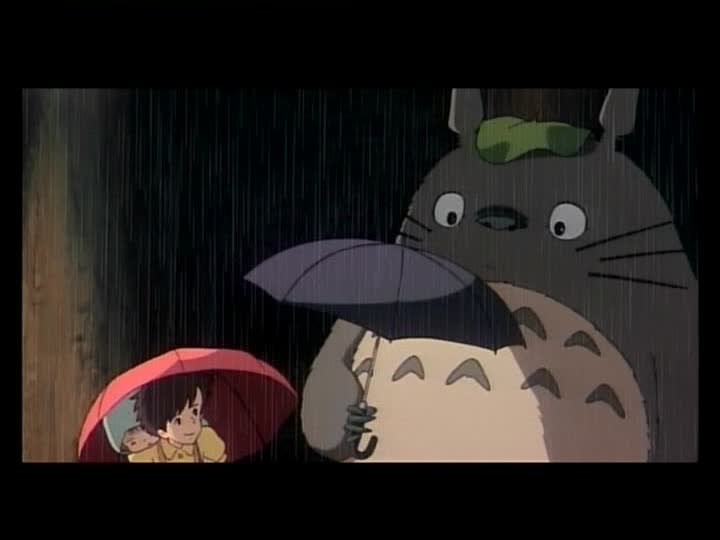
I have excerpted my favorite scene from this film and put it at Youtube.  Well, I had put it on Youtube but it seems that someone is blocking it.  So you will have to review the pictures below, or of course, rent the video, which is what they want you to do which is fine with me.


Its an umbrella

On another occassion we will discuss the issues of trying to make a 3D character from one designed for 2D and review all the reasons that is hard, using two characters from this movie: the dust spirits and Totoro himself. Here are some images of these characters which I hope will set you thinking about why doing them in some sense in 3D (as in modelled in geometry) would be very difficult if you wanted to keep the essence and charm of the characters. And if you would not want to keep their charm, then why oh why would you even bother?


My Neighbor Totoro on IMDB

Miyazaki on Wikipedia

____________________________________________________

1. Most animated films, indeed most films, made in the Far East never see formal distribution in this country or North America. There have been a few exceptions and some of them are quite notable, e.g. many Kurosawa films would find some independent distribution here. This is especially true for animation made in the Far East, where many of their best and most successful films traditionally never made it over here, except in a very limited form marketed directly to fans of the various genres.

By way of counterexample, Bruno Bozzetto's Allegro Non Troppo did get distribution of some sort in this country.  I am not sure how that happened, but that does show that it is possible.

Tuesday, October 30, 2012

Process Notes for Global Wahrman 10/30/2012


These are some notes on the process of writing Global Wahrman, and some thoughts to myself on how things are organized and where things are going. Some of you may find the meta posts more interesting than the posts themselves. But mostly this and similar "administrative posts" are written for myself, so I can recall what it was I was thinking at the time.

1. The process of creating the post online

I write these things offline, but I edit them online, that is, after they are published. Otherwise, I will never finish them, I will just rewrite them, forever.  But as I edit and reread things to check what I just published, I find mistakes and make minor changes. But one thing leads to another and the entire post may be rewritten, after it has been published, in place.   Also, I have a new anomaly in my writing style, one I have not noticed before, that of being so intent on what I am saying, that I do not notice how I spell it, and can not see the mistake until enough time has passed to be able to see it fresh.    In at least one case I think we have a situation where I made a mistake because of my own denial of the passage of time and mortality, or that is what I suspect.  I dated the release of The Bourne Identity to 1992 instead of 2002 which is the correct release year.   For all these reasons, a newly published post may be revised, sometimes in its entirety, over the first few days, then it seems to stabilize.

2. The "Selected Posts" list

This list, on the right hand side of the blog, is an index of the "best of" posts, or the posts most likely to be of interest to someone new to the blog, or the posts I want to use as writing samples. 

3. End of the first phase

We are through the first period of the blog and now enter into the second period, which I suspect will last about a year, more or less.  The first phase was to get some experience with the process.  In this upcoming phase we will introduce many of the themes of the blog.   You can already see a few of the themes emerging by seeing which labels have the most posts.   The highest count is "sarcasm" with 30 posts.

4. The easy versus the difficult topics

Some of the most interesting topics have not been posted because they have proven to be too hard to write about, and so I abandon them and do something easier to maintain some sort of rhythm of the posts to the blog (e.g. approx 1 / day).  This is one reason of many why this kind of writing is easier than the task of a professional, in many circumstances the professional can not choose the topic, but has to write to an assigned topic.

5. The genre of the self-published journal

It is not a surprise to those who helped create the Internet and related technologies that the genre of the self-published journal, a genre which is many centuries old, has been enhanced and given new life. It is a surprise to me however that I find the process of creating such a journal so useful. How many of these journals will survive the great destruction and "end of history" as Ken Perlin and others put it, is not clear.

6. The labels will change

The labels are a mess today and will be restructured. The labels will be one of the tools to structure the topics of the blog in a non-obvious fashion. We may need some other tools as well, as yet unwritten, to help put together the twisty logic of topics being assembled.

7. Existential Crisis

See the post on "Shakespeare in Doubt" for one major existential crisis.  See the post on the death of Elizabeth McKenney for another.

8. "Analytics"

"Analytics" is the term used for the statistics provided about who is reading the blog.  I have my doubts about the accuracy of these numbers, for a variety of reasons.    We are slowly building a daily audience it seems. It may not be coincidence that the two posts with the highest read count (e.g. the count that each post gets when someone goes directly to that post rather than just reading the blog in general from front to back) are the TRW / Robert Abel post and the Josh Pines Job Interview post. Both of these were "marketed" by mentioning them on Facebook which seems to have increased the audience to the right people as well as generating good comments (on Facebook, comments will have to be moved over by hand, I think).


Saturday, October 13, 2012

Shakespeare in Doubt (also The Setup & the Payoff)

[One more time, we have two different blog posts inappropriately combined into one.  In the first one we have a discussion of how do we know anything is real, and using the case study of truth and otherwise in "Shakespeare in Love" and the crisis it is has generated.  In the second part, we have a discussion of the comedy writing technique of "setup and payoff" that Shakespeare in Love uses to great effect. Two different posts.  One of these days I have to get my shit together.]

This has been a day from hell for me. I spent several hours trying to write up a post about what was and was not true in Shakespeare in Love (1998) and discovered, through further research, that what I thought I knew here was far more ambiguous or worse. Somehow I had read an article (or more than one) somewhere in some reasonable place and it turns out to be wrong. Of course society is full of such things and belief systems that are incorrect, but it is both annoying and scary to run into one yourself that you were completely unaware of. Of course I can't remember where I read this article or who wrote it. Maybe I just dreamed that I read such an article. Once you start doubting there is no end to the depths that doubt can take you.

To give just one example, I thought I knew very clearly that there was a major scandal involving either the first performance or an early performance of Romeo and Juliet involving a woman playing the role of Juliet because of a last minute disaster involving the boy who had been expected to play the role. It was Elizabethan practice for boys to play the role of women, supposedly this was a way of avoiding licentiousness in the theatre. And since using women on the stage at the time was illegal, the theatre and the play were temporarily shut down. Thus I thought that this incident in the movie was based, loosely, on something that had happened in reality with this play. God only knows what I read or where to think that this was true, but I have known this story wrong as it may be for decades, well before Shakespeare in Love came out but I can find no evidence of any such story on the bold new internet paradigm and if this story had been true or even rumored, it is likely I would find a reference to it without much problem on the internet. But I don't find any such reference. So either I am psychic and somehow channeled from the future this plot point from a movie yet to be made, or I was just wrong.

This is just one example, there are others, and I am now spooked and wish to retreat to safety.

Fortunately, there are a few topics associated with this movie that I can talk about and have some hope that they are true and correct. One of them is how I happened to see this film, the second is to discuss a topic in the writing of comedy which this film demonstrates with great skill referred to as "the setup and the payoff" or words to that effect.

But first, how I happened to see this film.  

Arguably one of the best complements you can give an artist or someone you know is to view their work without realizing who did it. So, for example, say you see the work of a friend without knowing it was your friend, really like the work, and only later discover that your friend did it. Its really nice when that happens, or so I think. Well, Tom Stoppard is not a friend of mine, but obviously I knew of him, but somehow had not realized that he had written (or co-written) Shakespeare in Love.

When Shakespeare in Love came out in 1998, I really did not want to see it. The reasons for this are complicated but it mostly had to do with my contrarian nature responding negatively to the glowing effusions of praise that this film seemed to generate, and because I doubted very much whether someone was going to do an interesting film that I would want to see about Wm. Shakespeare's love life. On top of that, I hated the title. So I planned to miss this one.

But fate had other plans for me and sometime later I was on a plane between NY and LA and this was the movie they were showing. So after the movie started, I broke down and bought a headset and started listening as well as watching. And as I watched I started to wonder who had written this thing. It was being very clever, and I am not used to clever in successful films, I am more likely to think "stupid" than I am to think "clever", generally speaking. But as I watched this movie, I kept thinking: whoever wrote this has done a very good job here, I wonder what happened?

What had happened of course is that I was one of the few people in North America who did not know that this film had been co-written by Tom Stoppard. Oh, I thought, when I found out. That would explain it. Oops.

So now I want to seque to an important non-sequitor, the comedy technique of "setup and payoff." Setup and payoff works like this. You set up in the audience's mind some situation or idea so that they know that something is coming but the main character, generally, does not. Then in the course of time of course something happens that you expected but the characters didn't, and it is often very funny. I realize it does not sound funny at first glance, these things rarely do, but some examples will illustrate this.   First from a different movie that also uses this technique well, and then from Shakespeare in Love.

In the important film, Galaxyquest (1999), we have several completely excellent examples of this technique. The one that jumps right out at you of course is at the basic premise of the movie. A group of former TV actors who had experienced fame once by being on a TV series about a starship going around visiting various alien planets (e.g. Star Trek) get involved with a real group of aliens, the Thermians, who have also seen the show but believe it is real, and try to get our protagonists to save them from a real alien menace. So we know that these are real aliens and real spaceships, but our heroes don't but at various times discover the truth. And the inverse is true, the "good aliens", the Thermians, have to discover that the people they think are space heroes are really television actors who have seen better days. So we have the setup, and then we have a series of payoffs.

I have put on youtube an example payoff from the film.  In this sequence the crew of the TV series think they are trying to join their colleague for some sort of paid fan experience, or job.  They think these geeky looking "Thermians" are just badly adjusted fans of the TV series.
http://youtu.be/3yCFKT633j0

While we are on the subject of Galaxyquest, here is a link to a post by Ken Perlin in which he discusses a way to quantitatively rate a movie which is based on his experience of first seeing Galaxyquest.  His post is not about setup and payoff per se, its about the bigger questions that this movie raises.
http://blog.kenperlin.com/?p=163


The supporting actors learn the truth about the Thermians

Getting back to Shakespeare in Love, pretty much anyone who sees a film with a title like that, will know that Wm. Shakespeare did not, in fact, write a comedy with the title "Romeo and Ethyl, the Pirate's Daughter". But everyone does know that Shakespeare wrote a tragedy called "Romeo and Juliet". If they know nothing else about Shakespeare and his plays, they know that much at least. And so we have a perfect setup for a series of gags where Shakespeare is struggling with both the story and the title as it evolves into a tragedy called "Romeo and Juliet". The way Stoppard drags this out is spectacular, and also has elements of the running gag to it. I do not have a copy of the movie here so I can not count how many intermediate forms we have to go through on our way to the final, but its a lot, and every one is a payoff. And of course the audience knows where this is going and feels a sense of relief, or at least I did, when we finally get there. Although a "running gag" is a different technique of writing comedy, this particular example also has a sense of that going on as well. Its essentially setup and payoff combined with a running gag (or so I think).

In a future post I hope to get to the bottom of the real topic of this post, which is why I believed what I did, but I can not write that today, because I do not know the answer.

<ip>