The train from Escondido to Oceanside leaves every half an hour. That means I need to allow an hour to get to Oceanside. Then catch Amtrak that runs every two hours or so to LA. Then take the Expo line that runs every 1/2 hour to Culver City. A taxi on either side of this adventure so 4 taxi rides. That will add up to about 10 + 2 + 60 + 5 + 10 + 10 + 2 + 10 = $109 round trip to LA.
Car battery is charging even if I could drive.
Should take all day and be home by midnight.
All this for one half hour appointment.
Wish me luck!
Showing posts with label transportation. Show all posts
Showing posts with label transportation. Show all posts
Thursday, March 13, 2014

Monday, February 3, 2014
Notes on Taking the Train from Oceanside to Culver City 1/31/14
In order to understand the context of this post, its important to know that when the City of Los Angeles planned the Red Line into Hollywood, then down to Wilshire Blvd and out west to Santa Monica, that Rep Waxman got federal legislation passed that declared a "methane zone" and prevented the planned subway from getting federal money. Its a complicated story (at least to me) but it is widely believed that we have a classic case of corruption and the influence of the rich. There is also the issue of the Red vs the Purple line not to mention the Orange line. In any case, the line(s) was/were rerouted and ended up on Hollywood Blvd which is, oh by the way, not entirely stupid but mostly stupid. (1) The furthest west one of the lines came was Highland (and Hollywood) and another line ended at Wilshire and Western. In both cases, they are far east of where they need to be, which is, ultimately, the beach.
A metropolitan transit system is only as good as the parts of town it connects to. It needs to achieve a critical mass before people feel able to give up their cars and take the train. If they know they can not get to Westwood and they know they *might* need to go there, then it does them no good if the train goes to Hollywood, they will still need their car to get to Westwood.
This was about 1990 when this happened. LA has been scrambling ever since to find a way to get rail out to the westside in any way that they can. So finally they ended up using an old right of way, the original Exposition Line, destroyed many decades ago with the rest of LA mass transit, which runs through some very bad parts of LA but ends up in Culver City which is a reasonable place to be. They called it the Expo Line and it started running out to Culver City about six months ago. Waxman has also repealed his own legislation and plans are being made to extend the Purple line along Wilshire to Westwood by 2035 or so.
But in the meantime, we do have the Expo line to go from downtown LA to Culver City.
I come to LA about once or twice a month to deal with my various medical overhead. I would prefer not to drive if I can avoid it, its boring and stupid. But ending up at Hollywood and Highland, which was as close as I could get to Beverly Hills before, meant taking a $40 ++ cab ride each way after arriving. So if the train is $56 round trip, the metro is $5 and the cab is $80, thats $135 vs driving your car and spending maybe $40 on gas, or a little less.
But with the Expo line, I could take the train to Culver City and back again for $56 + $5. And I have a friend who lives and works in Culver City and who was able to drive me the three miles from the train stop to the doctors office in Beverly Hills.
It all worked fine.
It was moderately convenient and there are a few things to know which I have itemized below in case you are thinking of doing something similar. The big problem, as always with these systems, is your schedule and how it interacts with theirs. And that becomes more of a problem the more you need to go (or in this case return) after 6PM. This is normal in one way or another in most mass transit systems, even ones that are 24 hour a day. The question is whether you can live with what is there or if the schedule makes it impossible.
Here are some notes of the trip from Oceanside to Culver City and back again. The total fee was $61 including the Metro day pass. It took about 3 hours including waiting for my connection to the Red line and then to the Expo line. The trip from the 7th and Metro station to Culver City takes about 1/2 hour. This total of three hours is about the same as driving but less tiring. On most trips one runs into traffic and therefore driving can take up to 5 hours on the return trip.
Whether taking the train or driving one is essentially spending all day getting to and from Los Angeles.
Notes.
1. The trains in
Oceanside all leave/depart from one area called the Oceanside Transit Center. It
has a nice sign, but if you are looking for the Amtrak Station you
have to know that it is the transit center that you want, and that is
not at all clear from the Internet or the ground. You can look for
100 years for the Amtrak Station and never find it. 2. Parking at
Oceanside is free (amazing). 3. There are four different train
systems using that transit center, believe it or not, and three of
them use the same lines north and south. Amtrak and Metrolink both
go to LA, and they do not seem to communicate. I took Amtrak. There
is also Metrolink, and God only knows which one you should use. 4.
When you arrive at Union Station, you are expected to know that you
need to take the Red line to the 7th & Metro stop to take the
Expo line. 5. The Expo line has one color of blue dot and the Long
Beach train has another color of blue dot. So all trains at 7th &
Metro outside the Red line have blue dots. Ignore the dots and take
the Culver City train. 6. It is not clear (to me anyway) how often
the Expo line runs. Maybe every half an hour is my guess but it is
just a guess. 7. Because there are no attendents you can ask
questions of, you have to use the other passengers and the
maintenance (janitorial) and security people to find out where to go.
8. The transfer from the Red line to the Expo line is not a transfer
really, it is a new fare entirely. But since you bought a day pass
you do not really care. 9. There is no where to really meet anyone
at the arrival in Culver City. You just show up and are dumped into
a parking lot. You basically have to get people to pick you up by
stopping in the middle of the street. I think that is weird. 10. The biggest issue with using these
trains is that they run less often outside the prime commuter times.
So, there are two trains south from LA after 6pm. A roughly 7 pm
train and a 10 pm train. If you miss your 7pm train, you have one
more option, and that is the 10pm. This means that you either have
to leave work relatively close to 5 pm, or take a taxi, or take the
10 pm train and get home at midnight. It would be nice if there
were a few more trains in the evening. It is extremely conceivable
the way things are set up that you could be stuck for the night.
I would call the current situation a major improvement. One day LA may have a mass transit system. Just in time for autonomous vehicles and other new technologies, I presume.
Wikipedia page on the promising Purple Line Extension
Wikipedia page on the promising Purple Line Extension
http://en.wikipedia.org/wiki/Westside_Subway_Extension_(Los_Angeles_Metro)
______________________________________________
1. I know that some of the very few people who read this blog think I am overstating the case, being paranoid, etc. Guess what, I'm not. Don't believe me, do your research and then come back and apologize. It is well known what happened here.
______________________________________________
1. I know that some of the very few people who read this blog think I am overstating the case, being paranoid, etc. Guess what, I'm not. Don't believe me, do your research and then come back and apologize. It is well known what happened here.
Sunday, September 22, 2013
Evidence of Vast Improvement in Los Angeles Mass Transit
I have recently been shown evidence
that we are on the verge of a vast change in the way we do mass
transit in this country. Well maybe that is a little bold and overreaching. The evidence relates to Los Angeles specifically, not very well known for being progressive in this area.
In order to understand this evidence we first have to discuss certain techniques used to predict the future and also certain aspects of the history of the topic as it relates to the evidence. But don't worry we will get there.
In order to understand this evidence we first have to discuss certain techniques used to predict the future and also certain aspects of the history of the topic as it relates to the evidence. But don't worry we will get there.
It is a theme of this blog that
predicting the future is sometimes easy and sometimes very hard if
not completely impossible, but that it is always entertaining. One
complicating factor in predicting the future of course is predicting
when it will happen. Predicting what will happen is not enough.
When is just as important as what.
One technique used is a concept known
as the "indicator". The indicator, stolen from the fields
of National Security and Economics, is nothing more than a carefully
chosen event or trend that is used as a signal that something of
greater scope is happening. The price of corn, the temperature of
sea water, and whether a nation's troops are mobilized are all
examples of indicators.
Recently I have come across solid
evidence that we may be on the verge of a genuine revolution in how
we do mass transit in urban areas. I suspect that this might be
autonomous vehicles, which I discuss briefly below, but it might be
something else. The evidence is not too specific although it is
clear that something is coming.


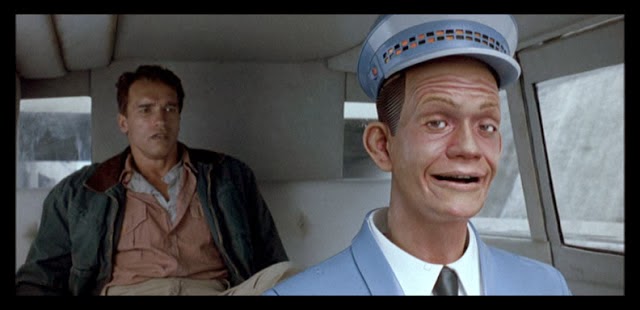

Autonomous Taxicab, the JohnnyCab, from the original Total Recall. If its good enough for Arnold, it should be good enough for us.
I am a firm believer that autonomous
vehicles are in our future and that this is a good thing. I think
that they have the potential of changing many things about how we
deal with transit in an urban and non-urban environment and that many
of these changes will be somewhat unexpected. Maybe we will not own
cars, maybe we will just call one up from a pool when we need one.
People may never have to worry about parking again and a host of
other possible changes.
But being certain when this change will
happen is less clear. There have been a lot of promising
technologies in the past that have never been deployed in real life:
people movers, monorails, levitating trains, not to mention personal
airplanes and jet packs. And there are many obstacles in the way of
deploying autonomous vehicles beyond the merely technical ones. I
will mention just two which are daunting: the greed of the insurance
industry and the stupidity of local city governments. Just
navigating those two barriers will require more skill and probably
more money than solving the technological issues.
Consider the following evidence of
imminent change.
Slowly, and without a lot of fanfare,
Los Angeles is in the process of building two mass transit systems
that will reach the west side of Los Angeles. One is light rail, the
Exposition Line, and it is well along and already reaches Robertson
near Culver City. The other is a subway down Wilshire and it is in
the early stages of construction. The estimated completion of all
this work is a date well beyond 20 years from now. But there will be
incremental deliverables and parts of the system will be in
production sooner than other parts.


The Expo Line actually runs to Culver City. Its like a Miracle from God that they built this thing.
To understand why this matters you have
to realize that mass transit in Los Angeles is different from other
places. In other places, mass transit may be controversial, it may
be a compromise, it may be expensive, it may be bankrupt, but it
proceeds. But in Los Angeles, you literally have world class crime,
political malfeasance, and fraud not to mention racism and major lawsuits. Volumes have been written about the stupidity, short-sightedness and corruption (e.g. bribery). But most of all, this is an area where the politicians and the civic community failed together to find a solution to a problem that was clearly going to get worse. In other words, they "kicked the can down the road" and hoped that others would solve it.
The problem is that in this area, as in others as well but this is an excellent test case, solving the problems require capital investment, tremendous political will, short-term grief, and a lot of time to execute. It is an excellent example where naive, one might say, stupid, reliance on "free market solutions" is obviously a failure. The benefits of mass transit take many forms, but several of them require the system to be planned and executed and in place for a period of time so that things can be built around it and make it all the more useful. In other words, the transit system may have to be there for 20 years before all the benefits accrue to the investment (through the placement of hotels, universities, theatres, etc).
To ask politicians and citizens in LA to face a problem 20 years in the future and a benefit also 20 years or so in the future is so far beyond their limited intelligence and wisdom as to be beyond funny into farce. Los Angeles was built for a reason, and that reason resounds in every decision that the civic body makes. Los Angeles is built on a desire to steal money and fuck people right now, not on stealing money and fucking people in some future day. This is obvious in the cheap architecture, the lack of zoning to control cheap real estate development, the dumping of wastes into the water system, the failure to control pollution generated by container ships at the Port of LA that causes a substantial percentage of the air pollution in the LA basin (is it 30% ? 40% ? No one knows).
The point is this: it isn't possible or plausible that LA would just get around to fixing this problem, or at least some of this problem, by building a transit system, eventually. I don't buy it. If something like this is happening, it is an indicator, as previously described, of a larger process that is taking place behind the scenes, even if the people executing this idea are not aware of it. I think that the will of the people and the force of shame and the collapse of the transit system in Los Angeles over the last 15 years or so has finally caused the City of LA and related areas to finally move in an area that should have been addressed 50 years ago and therefore there is no possibility of this being a wise move. By the time it is done, something will have happened to expose why this was at best a very late decision for LA to make.
Therefore I am very optimistic that we will see a sea-change in urban transit technology in the near future, as these things are measured. Its about time.
In a later post I will discuss why I am holding back my real feelings here about Los Angeles and their failure to deal with fundamental issues. The problem is that in this area, as in others as well but this is an excellent test case, solving the problems require capital investment, tremendous political will, short-term grief, and a lot of time to execute. It is an excellent example where naive, one might say, stupid, reliance on "free market solutions" is obviously a failure. The benefits of mass transit take many forms, but several of them require the system to be planned and executed and in place for a period of time so that things can be built around it and make it all the more useful. In other words, the transit system may have to be there for 20 years before all the benefits accrue to the investment (through the placement of hotels, universities, theatres, etc).
To ask politicians and citizens in LA to face a problem 20 years in the future and a benefit also 20 years or so in the future is so far beyond their limited intelligence and wisdom as to be beyond funny into farce. Los Angeles was built for a reason, and that reason resounds in every decision that the civic body makes. Los Angeles is built on a desire to steal money and fuck people right now, not on stealing money and fucking people in some future day. This is obvious in the cheap architecture, the lack of zoning to control cheap real estate development, the dumping of wastes into the water system, the failure to control pollution generated by container ships at the Port of LA that causes a substantial percentage of the air pollution in the LA basin (is it 30% ? 40% ? No one knows).
The point is this: it isn't possible or plausible that LA would just get around to fixing this problem, or at least some of this problem, by building a transit system, eventually. I don't buy it. If something like this is happening, it is an indicator, as previously described, of a larger process that is taking place behind the scenes, even if the people executing this idea are not aware of it. I think that the will of the people and the force of shame and the collapse of the transit system in Los Angeles over the last 15 years or so has finally caused the City of LA and related areas to finally move in an area that should have been addressed 50 years ago and therefore there is no possibility of this being a wise move. By the time it is done, something will have happened to expose why this was at best a very late decision for LA to make.
Therefore I am very optimistic that we will see a sea-change in urban transit technology in the near future, as these things are measured. Its about time.
I grew up here. I know where some of the bodies are buried.
Links:
Ancient History of the Expo Line
http://www.kcet.org/updaily/socal_focus/history/la-as-subject/rail-to-the-westside-the-expo-lines-historical-precursors.html
Ancient History of the Expo Line
http://www.kcet.org/updaily/socal_focus/history/la-as-subject/rail-to-the-westside-the-expo-lines-historical-precursors.html
Subscribe to:
Posts (Atom)