Showing posts with label aesthetics of sword fights. Show all posts

Monday, April 25, 2016

The Sword of Hillary


I have recently experienced on Facebook the fate of anyone in this society who would dare to question Hillary Clinton's right to be the next president. The abuse from people that I would normally consider friends who happen to be female is quite, well, extreme.

For example, I researched on the various Hillary sites what her position was on such things as minimum wage and H1B visas.  And I reported what I learned on Facebook and was told that it was "all lies" and that, by implication, I was a liar.

There are other examples as well.  It seems to be a general phenomenon.  I suspect that it is caused by a generation of women who woke up one day and realized that Hillary Clinton was their best chance for getting a woman as president in their lifetime.  And they went on the warpath such that anyone who would dare doubt Hillary's perfection had their ethics, morality, intelligence and experience attacked.

I call these people "The Sword of Hillary", soldiers whose self-appointed job is to attack and destroy anyone who does not confess to the true faith.


Well, we all have our own road to take, and choose how we express our opinions. I think it is a good thing for people to get involved in the political process, and work for the candidate(s) of their choice.

But consider, always beating up the opposition may not be the best way to get their support when the Primary season is over and we approach the general election.  Engaging in a discussion where people are treated with respect and where the facts are reviewed and discussed is one thing. Hitting them with a big rock and trying to knock their brains out is not the same thing.

As of now, I think it is pretty clear that Hillary will be the Democratic nominee, although that is not absolutely certain, but it is likely.  And ideally the party would pull together and work to get her elected.  But to do that, people have to be comfortable with the candidate and believe that voting for her is not voting against their interests.

Beating people up and slandering anyone who dares run against Queen Hillary is not the best way to do this, in my humble opinion.

Some of this is not Hillary's fault by the way, exactly.  Some of my dissatisfaction with Ms. Clinton's position comes from the last 8 years of the Obama administration.  Obama is, I think, the best we can expect from a middle of the road, well-meaning, Democrat.  While I appreciate his efforts, his administration has also convinced me that this is not enough to begin to fix the problems that this country faces. And I do not expect that Hillary will be as good as Obama, even. So instead of attacking me or others who doubt HRC will be the “president from heaven”, who will bring about the new Millennium, that in fact she is the second coming of The Christ or, depending on your point of view, even the first coming of the Messiah, your efforts would be better used to understand why people doubt her and work to improve both her positions and any democratic platform.

Tuesday, July 22, 2014

Pacific Grim


Warning: This essay contains spoilers for the film Pacific Rim (2013).


Some are born great and some have the mantle of greatness put upon them.

In our world there is mere craftsmanship, then art, then great art, then movies with giant robots.

But not everyone who is called to the altar of greatness is up to the challenge or in some way evil or circumstance interferes with its realization, and we experience the tragedy of a movie that could have been important but that fails and lives down to our worst expectations.

Such is the case with Pacific Rim (2013).  I had seen the effects reel at the Academy Bake Off and I was looking forward to the director's take on the critically important sub-genre of fiction: giant robots beating the shit out of alien and hostile ocean monsters.  But the great concept for the movie was let down by a truly puerile script and shallow characters. The humans were so stereotyped and uninteresting that even the giant alien monsters seemed more richly drawn, realistic and authentic in comparison.

Lucas claims that a movie is binary, that it either works for the audience and they ignore the flaws, or it does not work for them and the flaws are completely annoying.   I think that this principle of all or nothing has merit.   For example, I did not notice many of the flaws in Edge of Tomorrow (2014) when watching the film and when they eventually did occur to me it did not really bother me.

The flaws were made less important because the film was so entertaining.


A mashup between a German scientist and a Cambridge University mathematician, or something.


But not so for Pacific Rim, at least not for me.  There were so many problems and all of them attached to a very obvious and banal plot.   Not even giant robots could save this movie from its plot.   Here is a short list of just some of the problems in no particular order of importance:  1. If you are dying of radiation poisoning, you don't just get a nose bleed, or rather if you do, its because you are bleeding at all your orifices.   But none of that really matters because the radiation has probably killed all your blood stem cells and you will be dead in less than a week, horribly, and wont have the time to lead a group of desperate men and women in a last chance struggle to save humanity.   2. I found the cultural stereotypes of the German/Cambridge scientist to be offensive, although it was supposed to be funny, 3. The mind melt with the alien thing, aside from being improbable, is just confusing. Do the bad aliens read the stupid little scientist mind or not?  4. Umbilical cords are generally for mammals, as I understand it. Are the filmmakers saying that these hideous underwater alien monsters are descended from mammals? That doesn't seem very likely from what we know of them.  5. This may sound silly, but what is the motivation of our alien menace and the big fellows on the other side of the breach?   I mean what is going on?   Are they just attacking because they think its fun? Are they after our women?  What?  6. These big aliens although they are impressive looking seem rather average in terms of construction.   If they can be filleted with (for example) giant spinning sushi knives or a sock to the jaw then it seems logical that they would respond well to a couple of dozen standard, stand-off, air-to-air missiles, not to mention MK48 torpedoes.   7. Its all very well to throw around words like "analog" in regards to EMP, but for that to work that would mean that all the control systems of the adorable Gypsy Danger would have to be analog computers, etc, and I kind of doubt it.


Open wide and stick out your tongue... 


Ok, enough.

It is a principle of visual effects that great visual effects will not save a bad movie.   That is certainly true in this case, but there are some things to note about the film that are positive, in terms of cost reduction, costume design, production design and, of course, visual effects.   

1. They probably saved a lot of money on the writer.

Many people feel that having a script in a visual effects movie is just throwing good money after bad. Certainly, Michael Bay has never been held back by not having a writer on his films.  They probably saved several hundred thousand dollars on this one item, which would leave them more money for visual effects. 

2. The female lead was given an excellent costume.

Movies of this type are often calculated to appeal to adolescent boys of all ages, and one way to get their attention is to put your female lead, suitably cast, into a skintight and/or polyethylene outfit. Actress Rinko Kikuchi plays the role of Mako Mori, the spunky and strong female technocrat and martial arts specialist. I think that the rubber/latex outfit that they have her wear while controlling the giant robot in partnership with our hero is very practical and shows off her intelligence among other attributes very well.   I am still looking for the right single frame to show you what I mean, this image is a standin for now.


The properly sexist still of Mako in her latex jumpsuit has eluded me so far.  


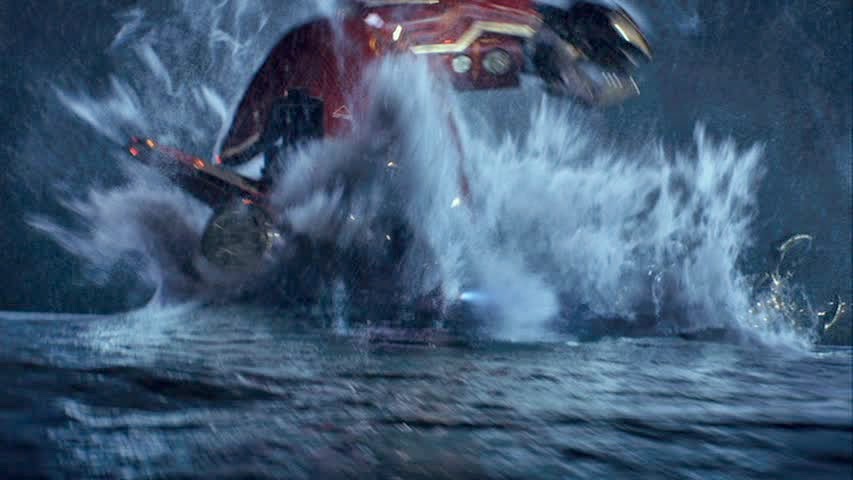
3. In visual effects, objects interacting with water is very difficult to achieve in a realistic manner.

4. One reason that water generally looks fake in earlier visual effects (see WW2 movies or pirate movies with ships generated with model photography on a pond or swimming pool) is how off the sense of scale is, no matter what the visual effects people did.   We get an excellent sensation of scale for most of the important fight scenes of the film which either take place in shallow water or under water.

5. Finally, it is a non-trivial thing to give these 3D models a sense of scale while they are beating the shit out of each other.   And most of the shots, although often ridiculous, were also dramatic and did have good scale to them.   I was very impressed.  

ILM did all these things very well.   Have a look at some of these stills and remember that IMHO the only way to really judge the work is in motion and on a big screen.


6. Very few movies get to show what it is like on the other side: to show the unspeakable and unknowable alien world. This movie did that acceptably I thought, the pacing was good and the reveal of the horror that is the vast and evil alien intelligence is suspensful... Of course the implacable menace is just beginning to understand that they are doomed as disaster overwhelms them.


Pleasantly abstract, the alien menace sees their doom approach.


Its the stories and the characters and the details that let them down. The movie feels like it was written for 10 year olds, and maybe it was. Only a 10 year old could go with the hackneyed characterizations and the stupid plot points. And of course the whole premise is ridiculous. Although it would be moderately expensive (1) and messy to turn these monsters into shredded fish food, it would be straightforward to do so with the weapons at hand in any modern air force or navy.  I mean they are big and ugly and spray acid and look pretty mean, but it seems to me that they blowup pretty much like normal flesh and blood, alien though they may be.


The other scientist stupidly visits the alien fishbait abortion.  Nice eyes.


But I prefer to emphasize the positive about this movie and hope that something better will happen next time. Good art direction and creature animation does not a good monster movie make. del Toro has the capability of doing great work, I hope we will see better and more moving, plausible, end of the world implacable monster movies from him in the future.

________________________________________________

Notes:

1. The cost of a Hellfire missile is roughly $70K but I think that is a little underpowered for this activity.  A Tomahawk missile from Raytheon is about $600K - $1M depending on how you look at the accounting. A Mark 48 torpedo is roughly a million a pop, I think.   Delivering these munitions is not cheap either.  We are talking about flying F-18 Super Hornets off of aircraft carriers or of attack submarines delivering many torpedoes as suitably modified for this application.   So it would be completely plausible for the destruction of one giant alien sea monster to cost at least $50M and probably more like $100M  if not more per critter.   Not cheap, but immensely cheaper than what is portrayed in the movie as the last hope of mankind.  No nuclear weapons would be necessary.

Tomahawk Missile
http://en.wikipedia.org/wiki/Tomahawk_(missile)

Mark 48 Torpedo
Pacific Rim on IMDB


Thursday, January 16, 2014

The "Rhetoric of the Introduction" at the VFX Bakeoff


This is my report on the Academy VFX Bakeoff.  This year I was accompanied by Jon Snoddy and his friend Allison.  Their presence kept me in my seat for the whole affair, one of the first times that has ever happened.

Here are some notes.

A. Male to Female Ratio

Between Pam Hogarth, Rhonda Gunter, Phoebe Zerouni and the afore-mentioned Allison, all of whom sat close to each other, they substantially affected the M to F ratio at this screening.   I know that Nancy St. John and at least one other woman was also there in the audience, somewhere.  Yes, VFX is still nearly completely male.

B. Elitism

This is the first year that the subsection members had their own private reception, eliminating any unnecessary contact with people in the field who are not part of their group. 

C. Rhetoric

I paid particular attention this year to the rhetoric of the 3-5 minute introduction of each film. I have always noticed a pattern in the past but this year it became completely clear in my mind, probably because I was willing to listen to all 10 introductions (in the past I have gotten bored and gone to the lobby).

The structure seems to be this: (a) express humble gratitude that their film was worthy of consideration, (b) describe the genius and vision of the director and producer of the film and acknowledge that all ideas came from them, without them, there would be no visual effects nor any ideas of merit, (c) state the total number of shots and any special constraints such as deadline, (d) then, with the deadline and total shots in mind, discuss elements of the film that are featured in the effects reel that they believe gives them the best shot at being nominated. If they needed 43 special versions of the stupid talking dog, 3 of them physical, discuss this. If they had to put up 53 projectors in a helix or some other weirdness, mention it.   (e)  acknowledge the facilities that worked on the project, so they don't all kill you later. (f)  make a special last ditch desperate appeal for sympathy because of some horrible thing that happened during production that only other visual effects professionals will relate to (g) ignore the red light, (h) conclude that you really ought to have the nomination because of the brilliance and stamina demonstrated by this reel, and (i)  thank the audience and beg for votes.

D. Projection and Stereo

All films were projected digitally. Three were stereo, seven were flat. The Dolby 3D system was used.

E. Sound

The sound was not excessive this year, and there were less explosions over all.  This turns out to be a mistake.  The subsection has an apparent weakness for and love of the tradition of gratuitous loud noises as demonstrated by the nomination of Iron Man 3.

F. Scope of Work

Many of the films screened claimed to have 1600-1800 shots in their movie. A small effects film might have a mere 700-800 shots. Recall that Star Wars had approximately 300+ shots. The amount of work this represents is amazing.   Some people believe that there is an inverse relationship between the number of shots and the quality of the story.

G. The Year of Albert or Alfred or Something

More than any other year I can remember, the name of the renderer was dropped, and it was "Albert" / Alfred / Whatever. I doubt most of the people on stage would recognize a renderer if they tripped over one.  I believe that the choice of renderer is just as important to the quality of the visual effects as the choice of film stock is to a brilliant photographer: both very important and not important at all.

H. Water, Water Everywhere

But Pacific Rim's water looked much better than everyone else's. Go, ILM.

I. Its not the Effects that Stinks, its the Movie

Iron Man 3 was the canonical, too-stupid-to-live, visual effects for morons sort of movie. Come on everybody, lets hold hands because we can defeat gravity that way ! Well, you wont defeat Gravity or gravity, either one.   But it will get you nominated. 

J. Gravity... the triumph of Lights in Space

Did they composite, or did they rerender the face, only her effects company will know for sure.

K. Best Introduction

John Knoll's for Pacific Rim. Informative, interesting about scale, and within the time limit specified.

L. Dragons

Dragons are difficult and WETA's dragon was acceptable. I think people are confusing visual effects with animation. As an animated dragon it was fine, as a real visual effects dragon, not so much.

M. The Movie vs The Effects Reel

Gravity may be the classic case of where the movie is much more interesting than the effects reel.   The counter example for me was the case of Pearl Harbor, there the effects reel was better than the movie.

N. The Lone Ranger was out by itself

All by itself, The Lone Ranger maintained the traditions of models and physical effects.   The Subsection recognized their efforts with a nomination.   However, I can not understand nor forgive the travesty of the musical interpretation of Rossini's great finale.  Some things can not be randomly fucked with, even in Hollywood.

O.  The Nominees Are ...

Gravity,  Hobbitt/Smaug, Lone Ranger, Iron Man 3, Star Trek.

I will do a post on why I think this is weird.


Monday, October 22, 2012

Aesthetics of the Sword Fight in Cinema: Realism is Not The Point


This is the third post on this blog that discusses the aesthetics of sword fights in cinema, a topic that I had absolutely no intention of writing about when I started this blog.   But I came across an odd fact that helped me to understand something about cinematic sword fights, so I am writing about it here.

It won't surprise you to learn that a sword fight in a film, at least a western film, is not realistic. But it might surprise you as it surprised me to learn that Samurai movies are often more realistic. And that is because, in real life, back when swords were used as the primary personal weapon, a sword fight was generally very brief and nearly always fatal. There would not be enough time to say much more than perhaps "Die You Scum" and maybe not even the time to say that. And even if they had enough time to say more, they probably wouldn't, because they would be out of breathe from trying to beat the other person to death with a piece of metal.

The fights were brief for a number of possible reasons and here are a few of them: (a) one party was able to get a blow in before the other party was ready, or (b) one party was that much stronger or that much more skilled than the other party that he was able to get a blow in first in spite of the other party being prepared, or (c) the two parties would fight for a few seconds, perhaps for a minute, but then one party or the other would get a blow in and one blow was all you needed in most cases. Depending on the nature of the first blow, the party who had received one was at a serious disadvantage. Occasionally when both parties were evenly matched, both parties might receive blows before one was disabled and killed.

Also, in a real sword fight they were not fighting by Olympics fencing rules. Better to think about a man in a slaughterhouse with an axe to get more of a feel for the situation. Once the other party was seriously hit, a blow or two and it was over. They were either dead, would be dead in a few minutes from the bleeding, or would be dead in a few days from infection.

Or possibly, one of the parties would avoid the fight or break it off, perhaps by running away. Then both might live, but that was one of the very few ways that both parties could survive a sword fight.

This has a number of implications for understanding the authenticity of certain genres of film:

1. I always thought that the incredible speed of the sword fight in a samurai movie was a way of expressing the skill and zen spirit of the warriors. That might be true as well, but it was the case that such fights were generally over very fast. A real fight from the period had more blood than you normally see in most Samurai movies, I think.

The following is an excellent example of what I think of as a somewhat realistic samurai sword fight, with blood.  This scene is probably from Zatoichi by Takeshi Kitano.  Three blows parried and one blow not parried, and the fight is over.

http://www.youtube.com/watch?v=q6SbihSMbPs&feature=related

2. There is actually one use of a light saber in the Star Wars films that was more authentic by this standard than the others. And that was the very brief use by Obi-Wan in the cantina in the first Star Wars film, where Luke gets into a fight with a patron who pulls a gun. It is over in less than a second and the character with the gun loses the arm that was holding the weapon.  The fight is over nearly instantly, but Obi-Wan poses for the camera and dramatic effect.


3. It is an interesting detail of light sabers that they have several advantages over a steel sword for the person who loses a fight. First a light saber is self-cauterizing, so there is no bleeding. Second, in the process the wound is also disinfected from the heat, so there is much less danger of infection. A third advantage from a cinematic point of view is that there is essentially no blood, and the amount of blood is a very important criteria in determining what sort of rating your film receives (e.g. G, PG or R).

4. With this new information, we can probably say that the sword fight and duel in Rob Roy (1995) is the most realistic sword fight in western film that I am aware of. It takes place over a few minutes, but in that few minutes there is perhaps 20-30 seconds of actual sword fighting (e.g. when blows are exchanged), it is physically very demanding, and there is very little talking.


Why do you keep pointing at my nose?  It is so very rude to point!


You can see this fight here:

5. What we learn from this information,  is that the centrally important conversation that the two parties have during a sword fight, discussing good and evil, and raising the fight from a mere battle of steel to metaphorical importance, is not realistic or authentic. It never happened and it would never happen in real life.  The fight is not a fight for its own sake, it is there to advance the story.  The sword fight is the colorful and drama filled activity that is taking place while we are advancing the story.

I doubt that many people will be surprised to hear that a cinematic sword fight is not realistic, but the important point to take away is that it was never intended to be.

The same criteria should be applied to visual effects, whether what is being shown appears to be realistic or not, the important question is how does it serve or advance the story?

To read all the posts on the subject of the aesthetics of sword fights, click here.

Thursday, September 13, 2012

Does Star Wars Have a Line of Dialog With a Double Meaning?


With this post we now broach a topic of central importance to all of us: the role of ambiguity in cinematic Space Opera.

Near the end of the final Star Wars film, Obi-Wan says something that set me back a moment and made me think. Is it possible that a character in a Star Wars film said something that was layered with meaning? Actually having one meaning on the surface and another at a different level? Could this be?

Arguably there is one other potential case of a double meaning in Star Wars, that being the sequence where Obi-Wan famously tells Luke something about his father, but certainly not everything.   He says that his father was a good friend, a great pilot, fought in the clone wars but had been "murdered and betrayed by Darth Vader", failing to mention that Luke's father and Darth were the same person. Now maybe that qualifies as a double meaning, or maybe its just plain old lying by omission, and that is not quite the same thing.

The case I am referring to is different. It takes place during the the climactic fight between Obi-Wan and his former pupil, Anakin, the proto-Darth. They are fighting over a lava field and of course have time to have a discussion while they try to kill each other.


So Obi-Wan and Anakin are fighting and talking, and they say things like this

Anakin: If you are not with me, then you are my enemy.
Obi-Wan: Only a Sith deals in absolutes. I will do what I must.
Anakin: You will try.

They fight for a few minutes, then Obi-Wan says

Obi-Wan: I have failed you, Anakin. I have failed you.
Anakin: I should have known the Jedi were plotting to take over.
Obi-Wan: Anakin! Chancellor Palpatine is evil!
Anakin: From my point of view, the Jedi are evil.
Obi-Wan: Well then you are lost!
Anakin: This is the end for you, my master.

Then they fight some more when suddenly Obi-Wan jumps to a nearby ridge, looks down at Anakin and says ...

Obi-Wan: It's over, Anakin!  I have the high ground.


You see, it seems to me that Obi-Wan is actually saying something here that is both literally true and metaphorically true. He has the high ground, standing on a ridge and all, but he also has the high moral ground. Is this possible, could it be that a Star Wars character would say such a thing?

Well, if it is true, it doesn't last very long.   The next lines of dialog are:

Anakin: You underestimate my power!
Obi-Wan: Don't try it.

But of course, Anakin does try it, and for the first time in the history of the cinema, someone who does a stupid move in a sword fight (like spinning around or jumping over someone) is rewarded as they should be rewarded: they are cut off at the knees. Or worse.

Of course, I can't be sure that I am right about Obi-Wan and his high moral ground but nevertheless I wanted to alert you to this exciting possibility.

The scene itself is located on Youtube at the following location.

Thursday, August 30, 2012

The Sword Fight in The Princess Bride (1987)


Before we discuss the evidence for currently operational secret aerospace projects, we will briefly digress to a seemingly unrelated topic: the sword fight in cinema.

Although very little can compare to the sheer drama and subtlety inherent in a fight between giant robots, arguably the most important contribution of visual effects filmmaking in history, there have in the past been other conventions to demonstrate conflict and skill between characters.  At one point in the history of filmmaking  the sword fight was a required scene, a platform for good and evil to metaphorically struggle against each other and settle the matter once and for all time which of the two will triumph.

Although fans of fencing and students of fencing argue constantly about what would constitute a decent fencing scene in cinema, and whether any exist at all, there is general agreement that the sword fight in The Princess Bride (1987) between Inigo Montoya and the mysterious "Man in Black" is a cut above (as they say in the fencing world) most of the others in the genre.

If you do not know this sequence, or if you haven't seen it recently, here is a link to a decent version on youtube.       http://www.youtube.com/watch?v=lC6dgtBU6Gs


The scene was choreographed by the late Bob Anderson, Hollywood's most famous sword fight coach, and the uncredited fencing double for Darth Vader in the early Star Wars films.  It features a dialogue between our two characters that, to a student of fencing, is apparently completely hilarious.  But most amazing of all for those knowledgeable about some of the techniques of fighting with swords, although the fight itself is not realistic per se, it does at least actually use genuine fencing technique most of the time.  Inconceivable!

As I mentioned above, the dialog is something of an in joke for those who know the history of fencing.  

Montoya: You are using Bonnetti's Defense against me, ha !
Wesley: I thought it fitting considering the rocky terrain.
Montoya: Naturally you must expect me to attack with Capo Ferro.
Wesley: Naturally. But I find that Thibault cancels out Capo Ferro, don't you ?
Montoya: Unless the enemy has studied his Agrippa... which I have !
Montoya: You are wonderful !
Wesley: Thank you, I have worked hard to become so.
Montoya: I admit it, you are better than I am.
Wesley: Then why are you smiling?
Montoya: Because I know something that you do not know.
Wesley: And what is that?
Montoya: I am not left-handed.

These are not the names of real techniques in fencing, but they are the names of well-known people in the history of fencing: Rocco Bonnetti, Ridolfo Capo Ferro, and so forth. See this link for a full discussion of who these people were.

The Association for Renaissance Martial Arts has a good collection of essays on various topics of classic sword fighting.
http://www.thearma.org/essays.htm