And so in a minor way I was involved in the internet and computer animation. To have killed off newspapers and drawn animation to have been participated in that in any way is a horrible sin I can not be forgiven for.
Showing posts with label animation. Show all posts
Showing posts with label animation. Show all posts
Sunday, October 22, 2023

Saturday, May 27, 2023
Yellow Submarine (1968) and The Assyrian Winged God
Reviewing the movie Yellow Submarine and I came across this famous image. But wait, I thought, is this not a homage to the ancient Assyrian Winged God? The original did not have an ice cream cone, of course.


Saturday, October 16, 2021
Incident in Westlake Village
So I am on my back, breathing nitrous oxide, while the dentist uses a hammer and chisel on my teeth, unable to talk, barely even mumble, and the assistants are discussing Halloween movies, and in particular Nightmare Before Christmas. I try to talk but the dentist / torturer tells me to lie still or I will regret it, and when it is over and I can almost talk although its more of a mumble I try to tell them that friends of mine worked on the movie, and that I consider the opening to be among the best openings of any film, animated or live, and how proud I was of them. And one of the assistants says that she was born the month the movie came out and I thought to myself, what should it be, pistols at dawn, or should I just commit ritual suicide right here. Pardon me, but could I borrow that very sharp knife? Thank you. Goodbye cruel world!

Saturday, August 7, 2021
Suicide Squad and Behavioral Animation
draft


Behavioral animation in Suicide Squad. Go rats, go! Save the world!


Suicide Squad and Little Birdies
draft


If you look carefully, you will find little animated birdies in the scenes with Harley Quinn exterminating the soldiers of the presidential palace.


Its attention to the details that can make a film great.
Saturday, March 19, 2016
Kinky Sex and the Dream of a Regional Film Community in SF Fulfilled
This summary is not available. Please
click here to view the post.
Monday, September 7, 2015
Mythopolis
First animated film
that I have seen in years that I loved. A story of very appealing characters drawn from Greek mythology in daily life.

Sunday, March 1, 2015
Animation and Genre
draft
Apparently
someone at the Academy Awards referred to animation as a genre and
this provoked a large negative response from many of my friends of
friends on Facebook who are animators or in the animation business.
They all unanimously thought that animation was not a genre. The
person who made this comment originally during award coverage may
have been an actor.
Remember,
before we begin, that the motion picture industry, like many other
industries, feels perfectly entitled to take any word in any language
and give it a new meaning when it is convenient. So what genre means
to someone in the motion picture industry might be very different
from what genre might mean to a film studies professor at the
university.
In
film criticism, a genre generally refers to similar story elements
and conventions that are common between films which are said to be a
genre. For example, most westerns have a climactic shootout in
which good confronts evil and the matter is decided by a gunfight.
In most spy movies with an evil genius, there is often a scene in
which the evil genius explains to our hero their plan for world
domination. In certain fantasy quest stories, the plot often
contains a section in which the hero searches for a special weapon to
use in fighting evil. Time Travel was considered to be a genre that
had no commercial potential until Back to the Future became a hit
series.
Genres
are often mixed, many films today are likely to have a romantic
subplot no matter what the genre.
Genres
tend to bring with them advantages and disadvantages as both a
commercial property and also creatively. It is generally easier to
market a genre film than a film that has no overt genre or which cuts
across genres. The disadvantage is that generally a genre has
limitations and requirements that the audience expects and you can
not easily violate these expectations except with great skill and
risk. A famous counter-genre element is the ending of Shane in which
the hero is wounded, possibly fatally, in the climactic shootout.
Anyone who violates genre expectations runs the risk of displeasing a
part of their audience.
Hollywood
often screws up genre when it tries to cash in on a film that is
successful. Everyone wants to be first to be second. Most of the
original imitators of Star Wars were pathetic in their gross
misunderstandings of what made that film successful. Its always
important to remember that many of the top people in Hollywood are
not too smart. That is why they get paid their small salaries in the
low millions.
So
is animation a genre?
The
first thing to realize is that the person who made this comment was
an actor. Actors have always hated animation. Why? Because what
they want is more films to be made that star actors, of course.
Voice over with celebrities is a new phenomena, and besides, its not
the same thing. The politics of the situation means that they are
in general opposed to animation. The same is true for writers,
directors and producers, because generally speaking the people who
write animation are drawn from a special list. People who direct
animation rarely make the crossover to live action (a recent
exception to this is Brad Bird). Same issue with producers,
generally speaking. Jon Davison is famous for producing “pop
corn” movies, but when he tried to produce films outside his
“genre”, e.g. Robocop and Starship Troopers, he did not get the
approvals and support he sought. Now Jon loves animation, it turns
out, but many producers who produce live action most certainly do
not.
This
is also the same reason why it is extremely hard for an animated film
to win best picture. The academy is made up of actors, directors,
producers, etc, and most of them do not make animation. They dont
understand it and they dont like it, so they dont vote for it.
But
there are other reasons why animation could be considered a genre.
Animation generally falls into two categories when it comes to
marketing films in this country: one category is so-called family
entertainment, and the other sometimes called kid-vid, or animation
for very young children. Now this is a cultural issue, and does not
necessarily apply to other countries. In Japan and the far east,
there is another category of animation which we might call “young
adult”. In this category, we can have much more violence and it
is much closer to action adventure films. But animated films in
this category have never done well among general audiences in this
country, although there is a very loyal and committed set of fans
here. They do not have the economic clout.
By
far the most desirable of these categories in this country is “family
entertainment”, which generally refers to films that are for the
most part intended for young audiences but which can be enjoyed by
adults as well. Thus the parent of a child or group of children can
take them to see a movie and not be bored to tears or wait out in the
lobby. In the case of more pure kid-vid, its the sort of thing one
might want to rent from the video store, use it as a way of
performing day care for the children, but go and do other things
while they watch.
Generally
speaking, a successful film that qualifies as family entertainment is
going to contain elements that appeal to very young audiences as well as having a plot, or nuances of a plot, or of a character that can
be entertaining to adults. Famously, on television, Rocky &
Bullwinkle by the Jay Ward Studios was such a show.
In
longer product, such as films, it was pointed out to me that films
that are going to keep the attention of very young children are all
musicals: it is the musical interlude in particular that appeals to
young children and without that they get bored. So I am told.
The
Walt Disney Company made a film called Rescuers Down Under (1990).
It did not contain any songs and was intended for a bit more of the
young adult audience. It did not do well at the box office. Disney
felt that they had learned a valuable lesson here. (Rescuers Down
Under was also the first feature film made entirely with the CAPS
system).


May discovers the "dust bunnies" in Totoro. How could anyone not love this film?
One
of my favorite films of all time happens to be an animated film, My
Neighbor Totoro (1988). Now Totoro has no
musical numbers, it is very long, and the protagonists are two little
girls. Very little apparently happens in this film, Mai gets lost,
Mai is found, the two little girls are able to visit their sick
mother in the hospital and believe that she will get better. I
suggested this film to a friend of mine with a 12 year old American
boy and he HATED the film with a passion. Troma, of all companies, attempted to give Totoro a theatrical release in this country, which is how I happened to see it at its premier at the Director's Guild. But it didn't work, and this unbelievably wonderful film died at the American box office. So did Akira. Nevertheless, later films from Japan did get larger releases and have done well. So it is not black and white.
Nevertheless, I doubt you could get American financing for an animated murder mystery. Or an animated western with a climactic gunfight. Or a film noir. Because it is commonly believed that such films, if animated, have no chance of making their money back.
There
have been independent animated films that break the
mold. But again, these films although independent, are also intended to
make money. Had they made a huge amount of money, then people would try to imitate them. But unfortunately they did not, at least not to the best of my knowledge. Still there is no law that says it has to be that way. Was Team America an animated film? Did it do well? It also had at least one musical number.
So,
is animation a genre? Well, yes and no, genre may not be exactly the right word. But it is easy to see why some professionals in
the motion picture industry would think that it was.
Film
Genre on Wikipedia
Rocky
and His Friends (1959 - 1964) on IMDB
My
Neighbor Totoro (1988) on IMDB
Rescuers
Down Under (1990) on IMDB
Saturday, May 24, 2014
Is the Giant Pangolin Evidence of Evolutionary Convergence in Cartoon Villains?
We are all aware of the controversies around the issue of whether or not evolution should be taught in our public schools and/or whether this "theory" should be augmented with other theories that may explain the world we see around us. One theory in particular, the so-called "intelligent design" theory calls upon a particular hypothetical cosmic energy source that although invisible has caused the design of all the millions of existing types of creatures, not to mention the billions that no longer exist.
I have recently come across a strange relationship between one of these existing creatures, the Giant Pangolin of central Africa, and a certain classic cartoon character archetype: the weasel. This relationship has the potential to break open the entire discussion of evolution vs intelligent design and extend it to the role that this potential cosmic energy source has had in the creation of genres of the cinema. I think you will see from the discussion below that "intelligent design" may very well need to be added to the "auteur theory" in our film schools, except perhaps instead of "intelligent" this type of cosmic design might more properly be called "whimsical". Yes, I propose that it is "whimsical design" that may need to be added to the discussion of theory in our centers of film education.
I was having a discussion with Professor Ken Perlin of NYU about how one properly categorizes an animal as a biped (which most humans are, at least after the age of about two except when very drunk) versus other animals with or without backbones that have legs, flippers and wings. It turns out that this issue is more subtle than it might at first appear with criteria based on such things as how often and for what purpose a creature is believed to walk, hop, shuffle or otherwise proceed on two legs. For example, birds on the ground stand and ambulate on two legs, but they can be said to more properly hop than walk. Are they then bipeds?
In researching this topic, I came across a type of animal I had never even heard of before, let alone had ever seen: the giant spiny anteater of central Africa, aka the Giant Pangolin. This improbable creature is known to spend quite a bit of time walking on its two hind legs as it proceeds to terrorize the locals of Africa with its large size (over a meter) and its amazing and intimidating profile as it goes about its business decimating unlucky ant colonies in its ravenous path.

You dont see one of these every day in America, thank goodness.
Although the Giant Pangolin were entirely new to me, yet they seemed strangely familiar somehow. It took me over a day to realize where I had seen something like this before. The Pangolin reminded me of an important type of villain in the classic cartoon, the Weasel. Most prominently known as the evil sidekicks in Roger Rabbit (1988), they have been around cartoons for many years before that.


Here is an example
from 1955 called Poop Goes the Weasel.
Is this resemblance an accident? An example of evolutionary convergence? Or is it something else, something more important, proof of a divine and loving God who causes bizarre semi-bipeds in Central Africa to be styled after cartoon archetypes in a medium barely a hundred years old? We may never know the answer to this burning question but it seems to me that this issue needs to be fairly and impartially presented to students in our public film institutions in order to give a balanced account of what we know about where our character archetypes used in film come from. This is a vital issue I think. And how ironic if it turns out that Whimsical Design is accepted not in the science community but in the elite film communities. Its not very likely to happen, but it might, and we will just have to see.
For a discussion of whether or not an animal is biped or not, see this paper by Alexander.
Is this resemblance an accident? An example of evolutionary convergence? Or is it something else, something more important, proof of a divine and loving God who causes bizarre semi-bipeds in Central Africa to be styled after cartoon archetypes in a medium barely a hundred years old? We may never know the answer to this burning question but it seems to me that this issue needs to be fairly and impartially presented to students in our public film institutions in order to give a balanced account of what we know about where our character archetypes used in film come from. This is a vital issue I think. And how ironic if it turns out that Whimsical Design is accepted not in the science community but in the elite film communities. Its not very likely to happen, but it might, and we will just have to see.
Saturday, February 15, 2014
The Subtext of the Animated Explanation in The President's Analyst (1967)
NB: This post refers to a key
point in the climax of the film The President's Analyst (1967).
There is an obscure sub-genre of
animated shorts that has the role of explaining a science-based plot
point in a major motion picture. In general it is considered bad
form to stop the action of a movie to explain something, but many
great movies have done this in spite of the low esteem with which
this technique is held. As a variation on this otherwise discredited
approach, filmmakers have occassionally used the animated short to do
the explaining for them.
An important example of this technique
in a major motion picture was Jurassic Park (1991) in which an
animated character is used to explain how DNA extracted from a drop
of blood preserved in amber can be used to create an entire franchise of films without ideas. This classic animation was done by Kurtz & Friends
Animation and they have a pencil test of their work online at this link.

Classically cute DNA Fragment
Another example is that fabulous but sadly overlooked film from the cold war, The President's Analyst (1967). In the climax of the film, the villain reveals himself to be the CEO of TPC, The Phone Company, and explains to our hero, James Coburn, the psychiatrist to the President of the United States, why they need his help to get legislation passed to require the implant of a new communication device in everyone's brain.
This sequence is more than just an explanation, although it is an explanation, it is also the climax of the movie, everything else is mere gun fights and denouement.


The Cerebrum Communicator happily does its thing.
In order to completely appreciate both
of these sequences there are two important things that the audience
should realize, and which will become more and more obscure as time
goes by. You see these shorts are more than mere animated
explanations with cute animated characters, they are in fact
double-barrelled nostalgia aimed directly at the baby-boomer
demographic, and thus as this demographic ages and then departs,
these nuances will be lost on all but the most informed audiences.
The first and overt nostalgia item are
the films themselves, which are clearly references to the Bell
Laboratories Science Films. Readers will recall that many years ago
there used to be a company called AT&T which had a state-enforced
monopoly on certain kinds of telephone service in this country. The
profits from this monopoly were so extraordinary that the company was
able to finance an important scientific laboratory known as Bell
Labs. This now defunct entity was responsible for many, many key
inventions in our daily lives before we turned R&D, and every
other vital function, over to the Red Chinese in a desire to be "more
efficient" and increase the profits of the rich.
But back in the day, and that day was
the late 1950s and early 60s, we were involved in something called
the Cold War, and the nation was concerned about having enough
scientists and engineers in order to build nuclear weapons and the
rockets to propel them, so there was an emphasis on science
education. And to help serve that need, Bell Labs created films for
young students to introduce them to important scientific concepts.
Thus, the Bell Labs science films such as Our Mr. Sun (1956) and Hemo the Magnificent (1957) to name two. As you might have
guessed by now, or recalled if you were there, these films featured a
combination of live action and 2D (hand-drawn animation) in a
dialogue with each other to explain some scientific concept.

Michael Sporn has an excellent discussion of this film on his blog at this location.
The Sun and Father Time have a few words
Michael Sporn has an excellent discussion of this film on his blog at this location.
But if we reach a little further we can
find yet another point of obscure nostalgia that these science films,
and hence our animated scientific explanations, appealed to. Back
when those of us who saw these films in their proper environment,
which was about 4th - 6th grade in elementary school, one
did not regularly see videos whenever one wanted. In fact, you did
not see video much at all, except on broadcast television and then
not in color unless you were rich or had a rich friend. Anything
that was video-like was actually projected on film, normally 16mm
film, with all the shades drawn to make the room dark. This was
a real treat for those of us in the early days of being educated.
What a relief this was compared to the normal curriculum!
Even more obscure, the films were shown
on the esteemed "multimedia" or "A/V" (as in
audio/visual) cart, a cart that contained a 16 mm projector, a slide
strip viewer, and an overhead projector, and was rolled from
classroom to classroom as needed.

The classic form of the A/V Cart

The Bell & Howell 16 mm Film Projector
All of this goes through the mind of
the baby boomer as he or she watches these animated explanations and
that is the subtext that will be lost as these films are viewed in
the future, assuming they are viewed in the future, that is.
We can only hope that there will be the
equivalent of liner notes to explain these critical issues to the audiences of that distant time that they might understand our culture and context a little better.
_________________________________________________________
Notes
Perhaps
the best known of the Bell Labs Science films is Our Mr. Sun,
directed by Frank Capra, staring Eddie Albert. It is one of the
first uses of front projection in narrative film.
You
can download Our Mr. Sun
from the following web site:
The sequence from The President's
Analyst (1967) can be viewed at
Kurtz & Friends Animation web page
on Jurassic Park
Our Mr. Sun (1956) on IMDB
Jurassic Park (1991) on
IMDB
The President's Analyst (1967) on
IMDB
http://www.imdb.com/title/tt0062153/
Bell Laboratory Science Films on
Wikipedia
Monday, July 1, 2013
The Vicious and Unfair Attacks on Cap'n Crunch
America loves a scandal and the best
scandals of all are when we can drag a respected public figure
through the mud. Throughout history people have inflated their
resume, have snuck around to have sex with someone they should
probably not be having sex with, or otherwise have a skeleton in the
closet. Then at the proper moment, this dirt can be dragged out to destroy an otherwise virtuous scumbag and drag them down to his or her proper level. This is as American as apple pie.
But sometimes an innocent cartoon figure is accused of villainry that we would otherwise only expect from a public servant. Such is the case with the esteemed marketeer of sugary breakfast foods, Cap'n Crunch, whose character and background is being slandered by self-appointed guardians of public decency.

A fallen icon sacrificed to the bloodlust of a fickle American public?
The controversy has apparently been
raging for some time, and it involves whether or not Cap'n Crunch
is a real captain. The Wall Street Journal in a recent article,
included below, has a discussion of anomalies in the Captain's
uniform, the issue of Crunch's naval record, and the affectation of
the Napoleonic-era hat.
When will America stop this
self-destructive attacks on their cartoon characters? Cap'n Crunch is
an icon of everything that is great about America: sugary breakfast
foods, great animated commercials (by Jay Ward), appropriation of
other culture's insignia, the use of the name by an underground phone
phreak hero, and nostalgia for a happier time in our youth.
What could be more American than that?
I call on all Americans to stop this
senseless and immoral attacks on a great animated public figure and support
Cap'n Crunch.
_____________________________________________
The Wall Street Journal article can be
found here:
WASHINGTON – A new scandal is consuming the U.S. Navy and one of the world’s most venerated captains: Cap’n Crunch.
The legendary cereal icon’s status as a captain has come under fire after eagle-eyed writers noticed that Cap’n Crunch only wears the bars of a Navy commander, not those of a captain. In the U.S. Navy, captains wear four bars on their uniforms, while commanders — one rank below captain – have three bars.
“The cheery Santa Claus in blue Napoleon hat is really just a big, fat LIAR,” wrote Charisma Madarang on Foodbeast, an online food news site.Gawker and other sites reported on the scandal as well.
Cap’n Crunch took to Twitter to defend his honor.
“All hearsay and misunderstandings!,” @realcapncrunch wrote.”I captain the S.S. Guppy with my crew – which makes an official Cap’n in any book!” And: “Of course I’m a Cap’n!” he wrote to anguished supporters searching for answers. “It’s the Crunch – not the clothes – that make a man. #PaidMyDues”
“All hearsay and misunderstandings!,” @realcapncrunch wrote.”I captain the S.S. Guppy with my crew – which makes an official Cap’n in any book!” And: “Of course I’m a Cap’n!” he wrote to anguished supporters searching for answers. “It’s the Crunch – not the clothes – that make a man. #PaidMyDues”
But his protests failed to tamp down the sense of betrayal and anger.
The controversy deepened on Wednesday when the Pentagon said it had no record of a Cap’n Crunch ever serving in the U.S. Navy.
“We have no Cap’n Crunch in the personnel records – and we checked,” said Lt. Commander Chris Servello, director of the U.S. Navy’s news desk at the Pentagon. “We have notified NCIS and we’re looking into whether or not he’s impersonating a naval officer – and that’s a serious offense.”
The Navy’s repudiation is fueling speculation the Cap’n Crunch, who wears a Napoleon-style hat, may actually be French.
According to official lore, Cap’n Crunch first set sail in 1963 when Quaker Oats Co. introduced the sweet children’s cereal.
According to his official biography, Cap’n Crunch, whose full name is Horatio Magellan Crunch, was born on Crunch Island in the Sea of Milk – “a magical place with talking trees, crazy creatures and a whole mountain (Mt. Crunchmore) made out of Cap’n Crunch cereal.”
It remains unclear if Crunch Island is part of the United States.
It remains unclear if Crunch Island is part of the United States.
He took command of the S.S. Guppy and spent decades battling his arch-nemesis, the pirate known as Jean LaFoote.
The captain came to rule over a small empire of sugary cereals, from the original Cap’n Crunch to Mystery Volcano Crunch.
In 2011, Cap’n Crunch had to fend of rumors that he was being forced into retirement by health-conscious commanders at Quaker. “Food police kill Cap’n Crunch,” one headline proclaimed.
Cap’n Crunch survived. But the latest scandal – and a potential Navy investigation – could prove to be a bigger challenge. If tried and convicted of impersonating a military officer, he could face six months in jail.
A Cap’n Crunch publicist said she was “shocked” by the Navy’s allegations and she is investigating the matter.
“The Cap’n doing hard time? Gasp,” she said.
Monday, March 25, 2013
Rocky and Bullwinkle and the Cult of Personality
What we do today, darling? Kill Moose and Squirrel ?
-- Natasha Fatale
Why are people so fucking stupid? Why can't they be more intellligent, like me?
-- The Kim Jong-Il Character in
Team America: World Police (2004)
Perhaps one of the greatest influences
on the intellectual development of people of my generation was The
Rocky and Bullwinkle Show by Jay Ward Studios. The four years
that this show was on air and the billions of years that it showed on
reruns was fundamental to the development of the ethics,
intelligence, world view and appreciation of puns for people all over
this country and the world.

The end of a very surrealistic sequence in which Rocky and Bullwinkle are reincarnated in plant form.
In this post we discuss the mystery of
what the show was actually called, why the show is important, and its
context in the period of the Cold War. Finally we discuss the origins
of one of its greatest creations: the term "Fearless
Leader".
According to IMDB, there were two shows
that overlapped each other in time. Rocky and His Friends, which
aired from 1959 to 1964 and The Bullwinkle Show from
1961 to 1964. But according to Wikipedia, the show was called
Rocky and His Friends for the first two years and The
Bullwinkle Show for the last two years. This confusion probably
arises from the attempt by the network and Jay Ward to improve the
ratings for the show which never did all that well. The show was
shuffled from Prime Time to Saturday Morning in an
effort to find its audience and improve ratings. Ultimately they
failed and the show was cancelled after the fourth season.
But they did achieve the minimum number
of episodes required for reruns in syndication, and the show lived on
in various edited forms, for at least a decade longer and in 100
countries. There is now a complete boxed set on DVD which is highly
recommended for those of us who appreciate higher culture.
The show was structured like a variety
show of vaudeville (1). Each episode would begin and end with a
Rocky and Bullwinkle segment that was part of a larger, multiple
episode story. Between these two segments would be a variety of
other acts including Mr. Peabody's Improbable History, Dudley
Do-Right of the Mounties, and Mr. Know it All. The
actors who contributed voices reads like a voice-over Hall of Fame
including: June Foray, Bill Scott, Paul Frees, Hans Conreid, William
Conrad, Edward Everett Horton and many others reknowned in the
history of animation.

Mr. Peabody, Sherman and the Way Back Machine
My favorite pun of the entire show was the school that Bullwinkle attended as immortalized on a shirt he would wear: Whatsamatta U.
Of course it is the villians who are
among the most memorable of the characters. The two villians that we
normally see in the show are Boris and Natasha, more formally Boris
Badenov and Natasha Fatale. But they worked for a mysterious figure
whom we knew as "Fearless Leader". Boris and Natasha, our
archtypal Russian spies and saboteurs, were terrified of Fearless
Leader.

Fearless Leader
The show, which took place in the Cold
War, usually had plots that involved our villians Boris and Natasha,
as directed by Fearless Leader, to do something evil and being
thwarted by Rocky and Bullwinkle. What distinguished the Cold War
from other conflicts was the relentless use of spies, conspiracies
and secret plots. It was part and parcel of the Cold War that there
would be masters of evil who led these conspiracies, from Ernst
Blofeld, to Dr. No, to Joseph Stalin, to Kim Jung-Il.

Peerless Leader
Kim Jung-Il had many honorifics that
were bestowed on him by his grateful people. Most people know that
he was called "Dear Leader" by the people of N. Korea. But
that was just the tip of the iceberg, in fact he had a great many of
these, some used in special circumstances, some used more generally.
These honorifics included:
Superior Person, Beloved Father, Beloved and Respected General, Ever Victorious Iron Willed Commander, Great Man Who is a Man of Deeds, Mastermind of the Revolution, Invincible and Ever-Triumphant General, Dear Leader, Respected Leader, Wise Leader, Great Leader of Our Party and Our Nation, Sun of the Communist Future, Shining Star of Paektu Mountain, Peerless Leader, Highest Incarnation of the Revolutionary Comradely Love, Bright Sun of Juche, Great Marshall and Dear Father.
Was Fearless Leader in fact named for
the real life "Peerless Leader" of N. Korea? We may never
know for sure. (2) (3) But certainly we can say that if Kim Jung-Il had ever
been called "Fearless Leader", that it would be right in
line with his many other titles.
With that mystery hanging in the air, I
want to end this post with a sad story about what happened when Jay
Ward proposed a TV special based on Rocky and Bullwinkle.
For every Rocky and Bullwinkle, Ren and
Stimpy or The Simpsons on television, we must wonder how many other
interesting and important shows were destroyed by Network Stupidity.
At June Foray's urging to reboot Rocky and Bullwinkle, Jay Ward
pitched a Rocky and Bullwinkle special to a network, I think
it was NBC. In this proposed episode, Boris and Natasha would steal the
Superbowl. The studio executive said something stupid like "Good
Americans would never allow for the Superbowl to be stolen" and
rejected the idea. Jay Ward figuratively threw his hands up in the air, said
"I can not work with these morons" or words to that effect,
and returned to doing Quisp Cereal commercials.

Quisp and his fellow breakfast cereal Quake
A Quisp commercial on Youtube.
We at Global Wahrman sincerely wish and
hope that the so-called studio executive who rejected Jay Ward will
rot in hell for all eternity.
____________________________________________
1. In the UK, this was called a "Music
Hall"
2. Since Kim Jong-il was about 20 years old at the time when Rocky and Bullwinkle first went on-air, it is extremely unlikely that Jay Ward was thinking of him as a model for Fearless Leader. It is less clear if his father, Kim Il-Sung the Magnificent, was called these same glorious titles. Perhaps Jay Ward was psychic as well as being brilliant, then he *could* have channeled Kim Jong-Il from the future.
3. In case you are not aware, the phrasing "Did so-and-so do such-and-such? We may never know for sure ..." is the classic way you can make crazy assertions and not be sued. "Did aliens from outer space build the fast food restaurants? We may never know for sure ....".
2. Since Kim Jong-il was about 20 years old at the time when Rocky and Bullwinkle first went on-air, it is extremely unlikely that Jay Ward was thinking of him as a model for Fearless Leader. It is less clear if his father, Kim Il-Sung the Magnificent, was called these same glorious titles. Perhaps Jay Ward was psychic as well as being brilliant, then he *could* have channeled Kim Jong-Il from the future.
3. In case you are not aware, the phrasing "Did so-and-so do such-and-such? We may never know for sure ..." is the classic way you can make crazy assertions and not be sued. "Did aliens from outer space build the fast food restaurants? We may never know for sure ....".
Rocky and Bullwinkle on IMDB
N. Korean Cult of Personality on Wikipedia
List of Rocky and Bullwinkle
Episodes
Quisp Cereal on Wikipedia
Team America: World Police on
IMDB
Variety Show, aka Music Hall, on
Wikipedia
Kim Jong-il on Wikipedia
Kim Il-Sung
Friday, February 22, 2013
The Inspirational Work of Sally Cruikshank and Quasi at the Quackadero
Once upon a time, a long time ago,
there was something called independent animation. To see it, a
friend had to have the secret stash of 16 mm film or you had to go to
a university screening, or a screening of an animation collection at
a repertoire theatre. You couldn't just bring up a low quality
version on Youtube but actually had to go somewhere to see it, on film at the correct frame rate and the actual colors. At first you would have to see it on film, then later on as time passed, you could see it on video with weird interlace and wrong color, and then, finally, today, the lowest of the low, on the Internet. In this way, the artform is degraded by the decadence of the society it is embedded in.
Oh well, quality doesn't matter, we all
know that. Not when it comes to making money!
But making money was not the purpose of
independent animation. Far from it. In fact, Gawd only knows what
the point was, or is, or might be, but not money. A labor of love,
perhaps? A struggle for acceptance amongst ones' biped peers?
Perhaps just a hint of obsession or even obsessive compulsive
behavior? There has to be some organic cause of the willingness to
sit over a hot animation stand and draw frame after frame, each one
just slightly different from the other, inflicting paper cuts and the
smell of powdered graphite on your long-suffering body.
One day, perhaps at Filmex, perhaps at LACMA,
I saw "Quasi at the Quackadero" by Sally Cruikshank.

I was stunned and amazed to see the
Quackadero, some sort of deranged midway of amusements, with "Your
Shining Moment", the "Hall of Time Mirrors", "Roll
Back Time", "Think Blink Paints Pictures of Your Thoughts",
"See Last Night's Dreams", "9 Lives 2 Live", and
last but not least, "Time Holes"! Each of these would make
a fabulous theme park / carnival attraction. And all of them drawn
perfectly in Sally's very distinctive semi-psychedelic style.

Out on the town!

Our Master of Ceremonies
But as they say in another theme park
attraction, "Its a small world after all, its a small, small
world". A friend Rene Daalder, artist and filmmaker,
introduced me to his friend, Jon Davison, a really nice man, graduate
of the Roger Corman school of filmmaking, and the originator /
producer of the Robocop movies. Jon, of all people, was married to
none other than the lovely and talented Sally Cruikshank. For some
reason they invited me to a benefit event at Jeff Bridges' house in
the Palisades so I got to meet my hero, Sally. I don't remember what
I said, I probably made a total fool of myself.
Recently I came across Sally's page on
Youtube. Quasi was just as brilliant as I had remembered it, or
more so. I wish the "youtube" quality was higher, but this is probably
deliberate on her part.
I am out of touch with Jon and Sally
but I hope they are doing very well.
Sally, your films are an inspiration.

Sally's page on Youtube:
Quasi at the Quackadero
Make Me Psychic
Tuesday, February 19, 2013
Totoro and the Absence of Traditional Story Structure
As anyone who has tried to finance a
film knows, Hollywood has very clear ideas about what sort of film is
marketable in this country. And very, very clear ideas of what sort
of ANIMATED film makes money in this country. And since they are
very specifically in that business to make money, they attach a lot
of importance to these rules.
Among the rules are these: (a) an
animated film will have frequent breaks with music for the small
children in the audience, (b) an animated film will not be over a
certain length, and (c) an animated film will rarely if ever have a
female protagonist, and if it does, she shares center stage with a
male protagonist. From there, Hollywood goes on and applies a
number of other rules and requirements about story structure, most of
these ae applicable to other types of films as well, and includes
certain things about the types of conflict in the film, the pacing,
the reversals, the climax, etc. Hollywood has a strong opinion on
these matters. It is one reason so many Hollywood films seem the
same, one giant robot or alien invasion after another. That is
because they are the same at one level of abstraction.
My favorite animated film however
follows none of those rules. It has no happy songs, it is much
longer than average, and the protagonists are two little girls, one
about three years old. It goes on from there in its eccentricity.
It is not clear that there is a villain in the film, except perhaps
whatever it is that is making their mother sick such that she must
stay in a hospital. There is one homage to standard story
structure: the climax of the film involves the youngest girl running
away to see her mother, and the effort to find her. This could be seen as a classic 3rd act rescue mission.

What's up in the scary attic?
The film did not do well at first in
the Far East, where it was made. But eventually the toys got
marketed and that fed back to the film until it became successful
there. The film found no distribution in this country (1) until,
unusually, a firm with no experience in this genre picked it up,
added English subtitles and tried a theatrical release in N. America.
I believe it did not do well, and the film disappeared, except to
the few who knew of it and loved it, until Disney, at John Lasseter's
urging, picked up all the films of this director and started
marketing them in this country.
The director of course is Hayao
Miyizaki and the film is My Neighbor Totoro (1988).

This is my corn and you are not going to take it from me
The company that attempted the
distribution was Troma, a firm better known for making and
distributing films such as "Surf Nazis Must Die" and "The
Toxic Avenger". But in this case, they spent their own money
bringing Totoro to the notice of Americans and, I think, lost their
money. I happened to see it because my friend Chris Casady, owner of
Roto Efx of America, had worked for Troma in the past and was invited
to the screening at the DGA and invited me along.
I have excerpted my favorite scene from
this film and put it at Youtube. Well, I had put it on Youtube but it seems that someone is blocking it. So you will have to review the pictures below, or of course, rent the video, which is what they want you to do which is fine with me.
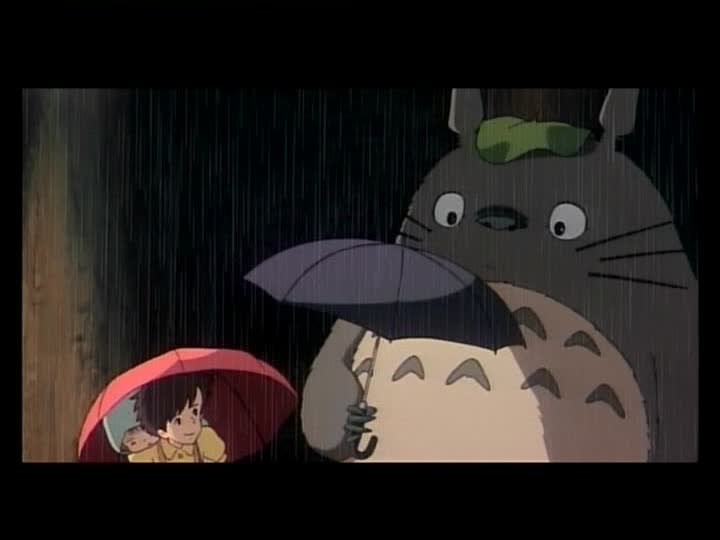

Its an umbrella
On another occassion we will discuss
the issues of trying to make a 3D character from one designed for 2D
and review all the reasons that is hard, using two characters from
this movie: the dust spirits and Totoro himself. Here are some
images of these characters which I hope will set you thinking about
why doing them in some sense in 3D (as in modelled in geometry) would
be very difficult if you wanted to keep the essence and charm of the
characters. And if you would not want to keep their charm, then why
oh why would you even bother?


My Neighbor Totoro on IMDB
Miyazaki on Wikipedia
____________________________________________________
1. Most animated films, indeed most
films, made in the Far East never see formal distribution in this
country or North America. There have been a few exceptions and some
of them are quite notable, e.g. many Kurosawa films would find some
independent distribution here. This is especially true for
animation made in the Far East, where many of their best and most
successful films traditionally never made it over here, except in a
very limited form marketed directly to fans of the various genres.
By way of counterexample, Bruno Bozzetto's Allegro Non Troppo did get distribution of some sort in this country. I am not sure how that happened, but that does show that it is possible.
By way of counterexample, Bruno Bozzetto's Allegro Non Troppo did get distribution of some sort in this country. I am not sure how that happened, but that does show that it is possible.
Subscribe to:
Posts (Atom)