Showing posts with label history of los angeles. Show all posts

Sunday, October 12, 2025

Ellison Wonderland


How could I have lived in Los Angeles so long and not know that Harlan Ellison's old house is a landmark.  Not open to the public, it is nevertheless maintained and listed/marked on Google maps.  Good for you Harlan, rest in peace or in hell as desired.

https://www.instagram.com/p/DIuUgh9T0PJ/?hl=en


I came across Harlan's house on Google Maps when I was researching Fossil Ridge Park.


Fossil Ridge Park and Corruption in Los Angeles


In researching places within striking distance where I can walk at high speed and get good aerobic activity and yet minimize toxic waste input.  As you might imagine this can be difficult in the greater Los Angeles area unless you are in a few well understood regions: for example near the beach or in the Santa Monica mountains.  There are some other regions too, often mediated or enabled by so-called micro-climates.  

So one obvious general area is south of here in Van Nuys in or near Mulholland Drive.  I came across a park I had never heard of before: Fossil Ridge Park.  What I did not realize is that this park, although difficult to visit and use, features one of the great attributes of Los Angeles: corruption in the service of real estate development.

But be careful, what you read on the always useful and informative Internet may be nothing more than self serving bullshit.  See for example:


Saturday, October 15, 2016

The Standard Disclaimer


At various times when I write about topics far outside my recognized areas of expertise, such as the decline of the American Republic, I will make reference to this post, the idea being that it is a "standard disclaimer". Your mileage may differ.  CAVEAT EMPTOR.  That sort of thing.

One of the purposes of this blog is to express my opinion on a variety of topics, many of which are outside my formal areas of expertise. I recommend that you see these comments as the sincere, if sarcastic, statements either of belief, or disbelief, or anger, or dismay, and consider it warmup for a standup comedy routine that will probably never exist. Standup comedy, it would seem, is one profession where a layperson can express their rage about events in the world far beyond their ability to control or influence and far outside their recognized area of formal expertise.

Readers may notice that I fail to adhere to the rules of Standard Marketing and Self-Promotion in early twenty-first century America. I am somewhat self-deprecating on occasion. What I say about myself, my self-deprecating sense of humor, is certain to be used against me by some friends and acquaintances. It is a nasty world we live in.

I am a college educated (BS and some graduate work) American from the South, a third-generation agnostic Reform Jewish Democrat from Virginia, who has a (some will think) inflated opinion of himself. I have some credibility in the areas of visualization, synthetic imagery, computer animation both real time and otherwise, digital production, photography (computational or analog), simulation, visual effects, the history of computing and the Internet, and certain aspects about the history and circumstances of the Southern United States. I worked at the RAND Corporation when I was too young to know any better. I started using computers when I was very young long before that was common. I also come from that period when people did not have formal training in their field because very often the field was still being invented.

I had something to do with the invention of computer animation and its applications in the motion picture industry.  I have a technical achievement award from the Academy of Motion Pictures Arts and Sciences. There will be some primary source material scattered in these pages for those who are interested in the history of computer animation and the history of Los Angeles in the 1970s and 1980s.

This is my standard disclaimer, or one of them. I hope you find whatever I write here to be entertaining, humorous, whatever.

Thank you.

Tuesday, December 1, 2015

The Uses of History at the LA Car Show


For the first time ever I attended the Los Angeles Car Show, a show I will discuss in a later post in more detail.

The car show provided me a useful example of why I believe that history is so important and why I think we make a mistake when we, specifically Los Angeles, pay so little attention to our own history. Many people tell me that this lack of history is what they like about Los Angeles, and of course I do not agree. One of these people happened to be my host at the car show, and was the most knowledgeable about what we were seeing.

Pretty much all exhibits at the Car Show, not every one but most of them, also had some sort of interesting example from the history of that manufacturer. If the exhibit had 20 new cars and models, it might have one car off on the side from the 1960s or some other period. One manufacturer might have several such cars, some might have none. Those who had such cars might not always explain its context enough for me, were I alone, but I was with someone who knew his cars and car history and so could explain the context.

This show was an excellent example of what I mean about how History can be used to help us understand our present and where we might go in the future. It is a homage to the successes of the past and where we came from. It helps us to remember who we are and why this company came into existence. It does not have to dominate the present or the future, but it can add color and reinforce loyalty. Its fun. I think its useful.

Off the top of my head, and without proper photographic documentation, I recall that we had a Mazda Cosmo, a very cute little sports car, we had several examples from Alfa Romeo in their classic period, we had a completely bizarre multiengine race car from that brief time period where apparently adding engines was the thing to do. And of course, in honor of the new James Bond movie we had a classic Aston Martin DB6 and I had my one moment of car history glory by explaining that one subtext of the performance cars of that period was that they were so damn hard to drive, you had to be James Bond or someone of that skill to be able to drive it at all.

So there it is, nothing too complicated.

History adds color. History memorializes where we came from and some of our better moments. It does not need to be a straight jacket on the present or the future, but I think it makes our present and our future all the more interesting because we remember who we are.

For me, it was the historical part of the show that was the most worthwhile.


Saturday, March 14, 2015

270 Million People and the History of Religion in Los Angeles


[Apparently there may be 80 million Methodists worldwide, but about 10 million in the USA.  See other thoughts at the end of the post].

The point of this essay is not to run down Los Angeles, or call Los Angeles or the people who live here bad people.  But it is to support the thesis that Los Angeles is a different place, different from what people who have not lived here think it is.  And also that LA may very well be different from what the people who do live here think it is because they just do not notice.

Now, it is true that this particular issue, indifference to history, annoys me a lot.  But that is just me and if I dont like it I should not live here.  Which is correct, I should not live here.

There is also a potential perceptual error in this post.  I assume that because I did not know something, that no one did, and in fact I have asked around, and no one I have talked to seems to have known this story.  But maybe everyone else does, and I am just wrong.   Lets see what you think when I finally get around to telling the story at the end.

But before we begin, why should we care about history?

History is how we know what happened in the past, good things, bad things, great things and small things. It allows us to memorialize places and events in a way that can be inspirational to all our people.  But LA is not at all interested or sentimental about its history.  You can live here all your life and not realize how much of the history of aerospace, or the history of contemporary architecture, or the history of broadcasting,  to name just three fields, happened in this town.

I, on the other hand, am very sentimental. I think that there should be signs around the city to indicate points of interest.   For example, I think there should be signs where James Dean crashed his Porsche, where Jim Morrison lived when attending UCLA Film School, where Tom Mix had his log cabin, where Harry Houdini had his mansion and where Howard Hughes crashed his jet. If it were up to me, that is what I would do.

But LA would have none of that. Their eyes are always on the horizon, looking to the future, not the past. They care about what is happening now. What important landmark can they destroy now to build a new mini-mall? What innocent can they exploit today? Who can they steal from now, not who did they steal from back thenThe citizens of our fair city of the angels have priorities and keep their eyes firmly on their goals.

This particular story is about the history of religion in Los Angeles, and no, I am not talking about hippies or the love generation or Transcendental Meditation.  This is about the creation of a new denomination of Christianity that has done very well for itself over the last century.

Most people believe that religion is something that was started long ago, and that is of course somewhat true. This country is primarily a Christian country of one type or another and obviously Christianity started roughly 2,000 years ago. Most of the notable religions around the world started over 1,000 years ago, but there are some exceptions. There are some aspects of modern Hinduism that are more recent, also the same with certain sects of Buddhism. Marxism is certainly a religion and that is much more recent. Shinto is very ancient in certain ways, but it has also been reinvented and reinterpreted much more recently as well.

And of course, the history of this nation and its religion is very much tied into the history of Great Britain from 400 years ago, in particular, the history of the Protestant Reformation. New England was founded by people who were radical Calvinists, Virginia by the children of the Anglican gentry. The descendants of the Virginians' became what we call Episcopalians when the American Revolution happened. And of course there are various other denominations, Presbyterians, (ana) Baptists and so forth. The Methodists came into existence before and during the American Revolution, and John Wesley came to America to speak about his ideas at the invitation of the people of Savannah, Georgia. You can not be in Savannah for longer than about fifteen minutes before they proudly tell you about this.

Some of the history of religion in this country is not so pretty. Most people know of the Church of Jesus Christ of Latter Day Saints (e.g. the Mormons) and know that it was founded by Joseph Smith. What most Americans do not seem to know is that Mr. Smith was murdered in Illinois while in jail on a trumped up charge and his murder was sanctioned by the government. No due process of course. No one was punished for his murder although they knew who did it. Another proud moment in American history swept under the rug.

So now, I am going to propose a metric to indicate whether a religion, or denomination, is important. There are about 15 million members of the Church of LDS and about 10 million Methodists in this country (said to be 80 million worldwide) as counted by the churches themselves (and thus are taken to be approximate).

So I hope you will agree with me that a denomination of Christianity that has about 270 million members and which is arguably the fastest growing denomination of Christianity is worthy of notice. And perhaps you would be as surprised as I was to learn that this denomination(s) was founded here, in downtown LA, a little over a century ago in 1906.

The story, somewhat simplified, goes like this.

In the year of 1906 a preacher from Texas was invited to come to Los Angeles and preach to a congregation in downtown LA for a month. He was a poor man, and lived at the home of a member of this congregation as a guest while he did so. The congregation decided that they did not like what he had to say for various reasons so they asked him to stop coming around, so he did. But he continued to live as a guest at that address on N. Bonnie Brae Street and somewhere around April 9, 1906, he started preaching out of the house to the people of the neighborhood and the people who came around to listen. The word got around and more and more people dropped by to hear what he had to say. After a while, they rented a space upstairs nearby on Azuza Street and he continued preaching from there.


The house on N. Bonnie Brae Street


The prayer meetings were exciting and eventful, supposedly.  The true religion was in the air for those people and the word spread.   People of all races and from all over the country came to hear William Seymore and his associates speak.  It became a phenomenon which lasted about four years and is now called the Azuza Street Revival.


The space on Azuza Street


I have of course oversimplified this story. There is more back story and many more people involved as the movement grew and evolved, as you would expect from a movement that in a century has hundreds of millions of members all around the world. But it is the case that the Pentecostal movement is really that large today and is the fastest growing Christian denomination in the world. And it started here, in that poor neighborhood of Los Angeles, that day in 1906 when William Seymore started preaching out of that house on N. Bonnie Brae Street.


Wm Seymore and his wife, Jennie


Now, I will be first to admit that I do not understand the Pentecostal movement. Speaking in Tongues seems off the wall to me, but that is fine.  There are lots of strange things in religion, and also strange things in our society, and I am not going to make judgments.

How is it possible that a major religious movement could start in the city of Los Angeles and yet no one here seems to know about it?   Is it because this movement was started by a poor black man and had beliefs outside that of the religious orthodoxy?  Is it because there is no particular way to cash in on the story and make money?  Perhaps.  I really don't know. I do know that the LA Times wrote nasty articles about the movement back in the day and the LA Times has always been the voice of the people who run Los Angeles.

But I also know that a denomination of 270 million people is worthy of notice and if it started in my city I would want to know about it.

So again, remember, I am not saying LA is bad.  Just that LA really is indifferent to history of any type, and certainly does not care about its own history.   Seriously, does not care.

I think its a little weird, ok?

[Further reading has suggested other explanations for the apparent neglect.   Although all the Pentecostal organizations and independent churches do, apparently, trace their origins to the Azuza Street Revival and William Seymore, these organizations and churches are not at all united and have various differences between them.  Of course that is true in many different denominations in Christianity and all other religions I am aware of.  But it would help to explain why there is not one important voice calling for recognition and acknowledgement in Los Angeles.  Furthermore, I was not aware of the extent of the hostility between the more established Christian churches and Pentecostalism.   Only recently has Pentecostalism been acknowledged or partially acknowledged as a legitimate part of Christianity.  Whether I have that right or not, the extent of the outsider status of these Church(es) could also help to explain the anonymity in this, its home city.]


___________________________________________________

Mormon Statistics

Methodist Statistics

The Churches of Richmond Virginia

Pentecostalism

Azuza Street Revival


Wednesday, March 11, 2015

The Miracle of Light Rail to Santa Monica and Other Transit News


Watching a city build a transit system is like watching the grass grow. Not much seems to be happening on any given day but things are happening nevertheless. In the case of Los Angeles, we have a decades long process which is distinguished by world class obstructionism, stupidity, failure, self-destructive behavior and progress.

For those of you just joining us, Los Angeles has been slowly building a light rail system to various communities in the greater Los Angeles area and much more slowly and expensively building an underground heavy rail system, e.g. a subway.  The latter, the so-called Red and Purple lines, have been notable for their dysfunctional politics at the local and national level.

But its no big deal. I mean, its not really important. Why should it be important?   Los Angeles claims its a major city, but every street has potholes, except in Beverly Hills, of course. The traffic, as predicted, collapsed into a puddle of congealed shit two decades ago, and the smog caused by the automobile, the Port of Los Angeles, and the refineries results in an air quality which damages the life of everyone who lives here.

But slowly but surely things are starting to improve, and remarkably we are about to achieve a transit milestone I did not believe I would ever see. The light rail from downtown, through USC, and ending in Culver City is in the final stages of being extended to 6 th Street in Santa Monica. This extension is not sometime in the far distant future (see below) but is actually nearing completion and will be in test within 12 months.

Now 12 months is a reasonable time frame.


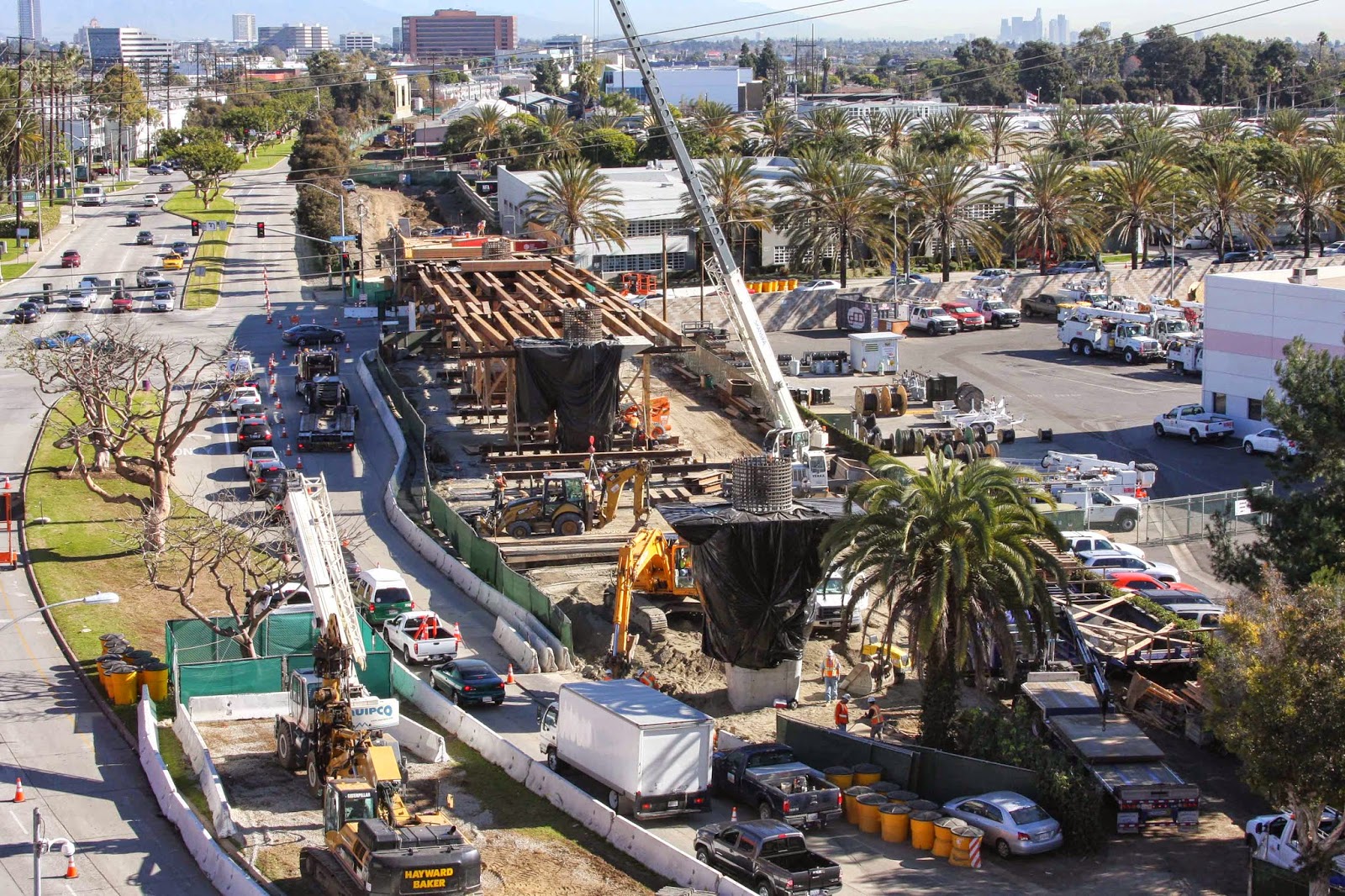
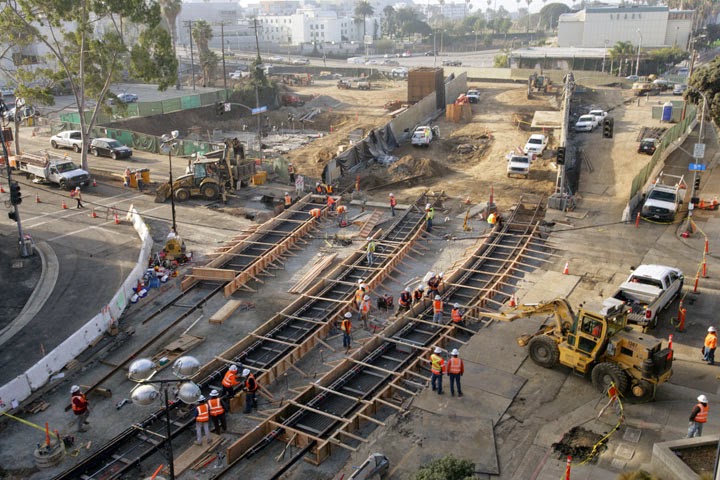
Expo Line extension being built out to Santa Monica


Furthermore, another extension to the Expo line will turn left at Crenshaw, pass through some of the worst parts of town, but then arrive at a new LAX combined transit center (i.e. where the shuttle buses meet the train and the rental cars).  And this is scheduled for completion in four years or about 2019.

Now four years is a little longer than we might like, but is still in the foreseeable future. And at that point we will have a light rail system that serves downtown, Pasadena, Long Beach, USC, Culver City, Santa Monica, the airport and several other communities.

But lets give credit where credit is due.  I am proud to say that all through this, citizens of Santa Monica have done everything in their power to destroy the extension of the transit system. True to their values. Pure and unspoiled.   They will fight a transit system to their last day.   Yes, they are that .... oh I don't know..... how about selfish and fucked up?

It is 2015 already.  We are 15 years into the new century.  Traffic collapsed in Los Angeles, repeat that word, collapsed, over 20 years ago.  As we all knew it would.   That means the city became unlivable, not that the city was becoming unlivable.  No.  20 years ago (or so) it became unlivable.  To oppose something as simple as light rail to Santa Monica for any reason other than something really serious, such as it destroyed an important historical monument, for example, is more than merely weird, it is insane.  Light rail could only help.  Opposing it is not just a sortof bad idea, it is nutty-boy crazy

So much for the positive news, now lets talk about the weird expensive heavy rail system. It stops right where it ought to stop, naturally, and sensibly at Wilshire and Western. Oh. Yes, I suppose that is a stupid place for it to stop, but hey, that was only 20 years ago. They plan to extend it all the way down to La Cienega and Wilshire!  And they will have that done in a mere 8 years, or 2023.

I can barely catch my breathe!   Those animals!  So speedy!   And then to Century City and finally all the way to Westwood in a mere 20 years or roughly 2035.


Planned Westside Extensions to the Transit System


If heavy rail is so expensive and slow, maybe they should put in light rail in the interim?  It would be no trouble installing light rail on Wilshire Blvd because you could just shut down the street while you were building it.  I mean why not?   The traffic is already fucked.

This should all have been started in 1980 and completed by 2005, a mere 25 years.  But not Los Angeles, no.   No one would describe the people and government of Los Angeles as far sighted and progressive.

In case you wondered who was paying for this, it is not the people of Los Angeles.  As far as I can tell, it is the Federal government, at least for the Purple Line extension.

Still, it is amazing that a working system from downtown to Santa Monica is nearly there .... that in and of itself is a miracle.

________________________________________________


Exposition Transit Corridor, Phase 2 to Santa Monica
http://www.metro.net/projects/expo-santa-monica/

Metro Breaks Ground on Purple Line Subway Extension
http://la.streetsblog.org/2014/11/07/metro-breaks-ground-on-purple-line-subway-extension/


Saturday, September 27, 2014

The Palm Restaurant and the Music Industry in the 1970s


The Palm is a famous “steak and lobster” place on Santa Monica Blvd which is known for many things, including the illustrations and caricatures of famous Hollywood actors, producers, directors. It is also well known as a music industry hang out, or it was, as it is closing at the end of September and moving to Beverly Hills. The illustrations will be taken down and given to the people who are represented, to the extent that they can be found and want them.  The building it is in is one of those cheap Los Angeles buildings of no particular interest except perhaps for the fact that this restaurant was there for so many years.  I presume the building will be torn down.

For some reason, I never ate there that I can recall. I don't know why, to tell you the truth. I certainly lived and worked in the neighborhood and went past it a billion times. Maybe I just thought it was too expensive, or I thought it was steak and lobster only, which it may have been. Not my aesthetic.


But the Palm was famous for its Hollywood and rock and roll associations and I have a story from the 1970s that I heard from a friend.  This story should help describe Los Angeles in the 1970s and the role the Palm played in that period.

Now I dont know if you are aware of it, but Los Angeles in the 1960s and the 1970s was famous for being an epicenter of the rock and roll music industry as well as having a reputation for having lots of sex and drugs.   I know this may be a surprise to you given how chaste Los Angeles is today but its true, that was its reputation back then.

I am personally a big fan of infrastructure and procedure.  How did people get from place to place, how did they get those drugs we famously hear about?  Further, how did they get their companies to pay for them and still be able to write them off on their taxes.   So this little story is intended to explain some of that.   The story comes from a friend who was in the music business at the time and everyone will remain nameless in order to protect the guilty.  This all comes second hand to me, I was no where near what is described here.

My friend was at the time a music industry A&R guy for a major record label. You have heard of this record label, and we are going to keep things anonymous here, so I am not going to name it. A&R starnds for “Artists & Repetoire” and it refers to the people who discover bands for the record label, sponsor them inside the company, work with them to develop their careers, and of course help them produce and release their albums. In many ways, an A&R person might be analogous to a “case officer” in the intelligence business. This friend of mine was certainly a member of a very select and powerful team. He lasted a certain number of years in this business which is famous for churning through people and he had a measure of success in his tenure at this company.


The 1970s were the days of the major expense accounts and when you could still write off liquor from your taxes when entertaining for business. So my friend, who at the time was quite overweight from his lifestyle of eating steak and lobster or whatever every day and drinking and going to clubs every night until they closed to listen to bands, would go to the Palms several times a week for lunch.

It was part of his job to entertain people in the music business.  These people could be other executives, producers, managers, and of course the bands themselves.   As part of his job as host he also provided cocaine for the bands in the normal course of business.  Apparently back in the 1970s when you were a known person in the industry this was not so hard to do.   He would just go to lunch with the band or whomever at the Palm and order several bottles of $600.00 champagne and of course when the bill came he would pick it up and expense it to the company as he was expected to. Except some of those bottles of champagne would not be bottles of champagne at all but 1/4 ounces of coke, or whatever $600 would buy back then, as provided by the bar.    It was not clear to me whether this was an independent service of the bartender or whether it was actually a service the restaurant sponsored in an unofficial manner, but it doesn't really matter as long as he could get the proper receipts so that deductions could be made and properly accounted for.  Supposedly he had an (unofficial) $20,000 / month budget from the record company for entertainment purposes.


But as I say, those were more civilized times. It was convenient, the record company could write it off, entertainment was provided and presumably one had a nice if not too healthy lunch at the same time.

But that was in the glory days of the 1970s in the Los Angeles music industry. In general it is said that if they were doing cocaine in the 70s or the 80s, they were doing Prozac in the 90s.

Alas those days of the glamourous music industry are no more.


An article on the closing of The Palm is at 

Monday, July 7, 2014

Remembering the Ancient Celebration of the 4th of July in Santa Monica


How should Americans celebrate the Fourth of July? Should it be in comfortable, respectable, middle-class suburbs with tepid, but safe, fireworks shows? Or should it be an exuberant recreation of that famous artillery barrage from long ago when the enemy cannon fire illuminated the battlefield with explosions at night and revealed to all sides that we stood defiant? Should it be boring, safe, sane, and white, with only people like us participating, or should it be filled with immigrants of every type who have come to this country to try to have a better life in this uncaring and corrupt world?

Santa Monica, a notorious “beach city” as Raymond Chandler related in his various works of fiction [My friend Nick reminds me that it was called "Bay City" in the Chandler novels], and the City of Los Angeles participated for many years in what they planned to be a respectable Fourth of July show.  To their amazement, and with absolutely no intention or planning, the celebration took on a life of its own, and became a day at the beach for hundreds of thousands of people from all over the city, of all colors and financial means.  Although they could barely speak English, if they could speak English at all, they somehow found their way from East LA, South LA, the east and west ends of the valley, Pomona, Compton, and even Watts to celebrate America's birthday.   I suspect that this tradition built up over decades until when I witnessed it, in the late 1970s, it had become a phenomenal street festival.   The estimates for the number of people who attended each year are fairly mind-boggling, but lets just say that many hundreds of thousands would be an estimate on the low end.   Kids came with their friends, or parents brought their children, to spend the day at the beach and then, when darkness fell, to set off, ignite, explode, and hurl through the air vast numbers of legal but mostly illegal fireworks.


A picture of the Santa Monica Pier with lots of people.

Packed nearly shoulder to shoulder on the Promenade in the darkness, barefooted and in shorts, an observer would hear languages and laughter in all the world's languages as he or she tried to navigate the masses of apparently very happy people who threw exploding and illegal M80s and cherry bombs, Picolo Petes and roman candles at and around each other. One friend of mine from the RAND Corporation described it as similar to being in Vietnam in which one moved in darkness and smoke while the native populations jabbered in languages you did not understand while throwing or firing munitions in all directions in some sort of wild frenzy.  The smell, not of napalm, but of black snakes and expended roman candles filled the air. Sparklers were lit, waved around, and thrown at random into the air or through the crowd.  Broken glass and the expended munitions, used sparklers and any other type of portable, hand held, fireworks and some firearms littered the beach and yet barefoot participants of all ages seemed to navigate the broken glass and expended sparkler field without concern or apparent harm.

At 9 PM the main fireworks show was detonated from the Santa Monica pier and presented the usual community fireworks show as one might see in many places in this country, with the added value of having a nice Pacific Ocean to reflect off of when, that is, the evil Santa Monica fog did not obscure everything which it usually did about half the time.  When that was over, the crowd gradually dispersed, many of them having been there all day, and being out of ammunition, went to their homes in every part of the city, somehow.


This is the new-style Santa Monica Pier.  The pier in the 1970s was much more tacky and authentic.


The next day the City of Santa Monica would awaken to the unenviable task of trying to clean the beach of massive amounts of broken glass, unbroken glass, sparklers, expended cartridges and generic trash of all possible types.   Recall that when walking barefoot on the beach, a former sparkler resembles nothing so much as a nearly invisible spike of dirty metal ready to puncture the unwary foot.  It would take all the next day and often the day after that to clean the sand and beach of dangerous, sharp objects.

Every year would come reports of wounds, burns, broken bones and unhappy and damaged children of all ages, some of whom had been actively hurling fireworks at each other at the time, and some of whom were just hanging with the family and became collateral damage.   Of course, every year, there was a call for someone to arrange a Fourth of July celebration that did not have so many injuries involved.

Finally the Cities of Los Angeles and Santa Monica decided to put a stop to this very unhealthy but entertaining situation and made fireworks of any type illegal on the beach.  They encouraged people to attend fireworks shows in their own neighborhoods and told everyone that if they were found with fireworks on their person that they would go to jail.

Some of us, more conspiracy minded, wondered if they woke up to the realization that they had created the potential for a serious civil disturbance.  Lets say on a very hot Fourth of July some Latino got hassled by the incredibly racist and violent LAPD and did not fall to his knees in abject submission as all minority groups are supposed to do.  The LAPD would naturally beat the miscreant into bloody unconsciousness which is their standard procedure in such circumstances (see, for example, Rodney King).    And suddenly you might have a riot on your hands with the minority groups already in the wealthy parts of the city and armed with M80s and other minor explosives.

But probably those who mismanage LA are actually not smart enough to come up with a reason like that, and simply wanted to lower their costs and minimize the injuries to try and prevent the otherwise inevitable lawsuit.

I am glad that I was able to observe this celebration on several years running and regret that it no longer exists in spite of the undeniable fact that it was insanely dangerous and out of control.  It was, in retrospect, a lot of fun for everyone involved.

_______________________________________


Wikipedia Page on M80s

Monday, January 13, 2014

Los Angeles and the Wages of Sin

El Pueblo de Nuestra Senora la Reina de Los Angeles, the Pueblo of our Lady, the Queen of the Angels, born in lies and raised in crime, inequity and hypocrisy, known throughout the world for its glamour and its beaches and its women and its economic opportunity, but remember, always remember: the wages of sin is death.

Serious business people could understand the failure to enforce the fire detector laws in buildings whose designs were known to be deathtraps, even though it resulted in the fiery deaths of so many of your citizens. The deaths were only of poor people and minorities, so who really cared, it might affect the profits of the landlords. When freeways destroyed entire communities and you did nothing, you could take comfort in the thought that your actions and inactions had destroyed any chance of a minimal mass transit system to alleviate the traffic that existed and the even worse traffic that was known to be coming. When Beverly Hills sued to keep the subway from coming west of Highland, you bent over in submission to the rich, with barely a whimper. You knew very well who was really going to get fucked, the people you represented, or failed to represent.

Case after case, example after example. Oh you need more? LAX is an ugly nightmare, known throughout the world as one of the most unpleasant airports to arrive at. Dirty, undesigned, stupid. And totally under your control. The Port of Los Angeles, famous for permitting the worst environmental violation, in order to keep prices down, throw people out of work due to globalization, and yet cause a huge percentage of the smog in the area which affects the health and total lifespan of those exposed to it: particularly the children who are raised in it. To damage the lives of innocent children, children in your care, without them even knowing it, can we not call that a sin? The Port of Los Angeles, one of the busiest ports in the world, is totally under your control. Let us look no where else for who to blame, the people to blame are right here, in the administration and government of Los Angeles.

Now the 2020 Commission on Economic Development in Los Angeles, or something like that, has issued a report on some of the problems facing Los Angeles. It is filled with interesting material, the way the City Council knowingly lied about Fire Department statistics for years, and many other tidbits. But it also exudes an unmerited optimism. It thinks it is possible for LA to work its way through the problems. I am not so sure of that. But I do think and encourage everyone who lives here or who might live here to read the report. It is at the bottom of the following link in PDF form. After you have read it, I will continue with some thoughts on how to proceed.


Hope lies only in radical change. You see, Los Angeles, it takes time and very serious money to fix the problems you have created for yourself. You kicked the can down the road and the road ended. To fix things now will be 10 times more expensive than it might have been before. Where will the money come from, well I have some ideas. But where will the strength of character come from? I dont know. I see no reason to think that it exists here in El Pueblo.


Ugly as sin, they pump around the clock for their anonymous masters

But here are some thoughts, humble thoughts, for your consideration. First, nationalize the oil wells, and use the profits taken from the ground and people of Los Angeles and apply it to saving the lives of the people who live here. How many active wells are there in the Los Angeles area? 10,000 wells? More? The obscene oil sucking insects pump around the clock in Baldwin Hills without even a veil of trees to hide their obscenities. Second, nationalize the Getty that does precious little for the culture of Los Angeles, and use its assets to pay for reform. Turn the so-called Museum in Brentwood into a magnet school, for example. Third, tax every car driven in Los Angeles that is worth more than $50,000 an extra $5K/year and an extra $1.00 per gallon.  Charge the container ships waiting at the Port of Los Angeles an extra 100K / day (or something) that they sit in the harbor blasting out fumes and use the money to pay for an offshore electrical system, more efficient in terms of power generation than just running their engines and fouling the air.   Won't that encourage ships to go to other ports?  Yes, I certainly hope so.   For once, use price theory to help the world instead of just as an excuse to exalt the rich. (1)

But please, please, please don't tell me that any of these suggestions are illegal. Everyone knows LA is built on violating the law and you should know that best of all. If you say these are illegal, I will say you are a lying hypocrite, which you are. The difference is that these illegalities will help the poor instead of your masters, the rich.

These are just a few ideas, simple and just, to generate income for your rehabilitation. After you have done these, come back, and I will have more ideas for you.

You are very welcome.

________________________________________

1. People have wanted to know if I was actually serious in any way about these proposals, and the answer is "of course".  LA is not going to do anything to deal with the problems at hand, so why not make silly proposals.   Nihilistic?  Sure.


Sunday, September 22, 2013

Evidence of Vast Improvement in Los Angeles Mass Transit


I have recently been shown evidence that we are on the verge of a vast change in the way we do mass transit in this country. Well maybe that is a little bold and overreaching.   The evidence relates to Los Angeles specifically, not very well known for being progressive in this area.

In order to understand this evidence we first have to discuss certain techniques used to predict the future and also certain aspects of the history of the topic as it relates to the evidence. But don't worry we will get there.

It is a theme of this blog that predicting the future is sometimes easy and sometimes very hard if not completely impossible, but that it is always entertaining. One complicating factor in predicting the future of course is predicting when it will happen. Predicting what will happen is not enough. When is just as important as what.

One technique used is a concept known as the "indicator". The indicator, stolen from the fields of National Security and Economics, is nothing more than a carefully chosen event or trend that is used as a signal that something of greater scope is happening. The price of corn, the temperature of sea water, and whether a nation's troops are mobilized are all examples of indicators.

Recently I have come across solid evidence that we may be on the verge of a genuine revolution in how we do mass transit in urban areas. I suspect that this might be autonomous vehicles, which I discuss briefly below, but it might be something else. The evidence is not too specific although it is clear that something is coming.


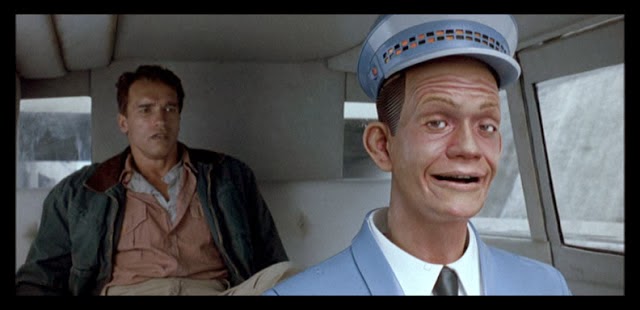
Autonomous Taxicab, the JohnnyCab, from the original Total Recall.  If its good enough for Arnold, it should be good enough for us.


I am a firm believer that autonomous vehicles are in our future and that this is a good thing. I think that they have the potential of changing many things about how we deal with transit in an urban and non-urban environment and that many of these changes will be somewhat unexpected. Maybe we will not own cars, maybe we will just call one up from a pool when we need one. People may never have to worry about parking again and a host of other possible changes.

But being certain when this change will happen is less clear. There have been a lot of promising technologies in the past that have never been deployed in real life: people movers, monorails, levitating trains, not to mention personal airplanes and jet packs. And there are many obstacles in the way of deploying autonomous vehicles beyond the merely technical ones. I will mention just two which are daunting: the greed of the insurance industry and the stupidity of local city governments. Just navigating those two barriers will require more skill and probably more money than solving the technological issues.

Consider the following evidence of imminent change.

Slowly, and without a lot of fanfare, Los Angeles is in the process of building two mass transit systems that will reach the west side of Los Angeles. One is light rail, the Exposition Line, and it is well along and already reaches Robertson near Culver City. The other is a subway down Wilshire and it is in the early stages of construction. The estimated completion of all this work is a date well beyond 20 years from now. But there will be incremental deliverables and parts of the system will be in production sooner than other parts.


The Expo Line actually runs to Culver City.  Its like a Miracle from God that they built this thing.  


To understand why this matters you have to realize that mass transit in Los Angeles is different from other places. In other places, mass transit may be controversial, it may be a compromise, it may be expensive, it may be bankrupt, but it proceeds. But in Los Angeles, you literally have world class crime, political malfeasance, and fraud not to mention racism and major lawsuits. Volumes have been written about the stupidity, short-sightedness and corruption (e.g. bribery).  But most of all, this is an area where the politicians and the civic community failed together to find a solution to a problem that was clearly going to get worse.  In other words, they "kicked the can down the road" and hoped that others would solve it.

The problem is that in this area, as in others as well but this is an excellent test case, solving the problems require capital investment, tremendous political will, short-term grief, and a lot of time to execute.   It is an excellent example where naive, one might say, stupid, reliance on "free market solutions" is obviously a failure.   The benefits of mass transit take many forms, but several of them require the system to be planned and executed and in place for a period of time so that things can be built around it and make it all the more useful.   In other words, the transit system may have to be there for 20 years before all the benefits accrue to the investment (through the placement of hotels, universities, theatres, etc).

To ask politicians and citizens in LA to face a problem 20 years in the future and a benefit also 20 years or so in the future is so far beyond their limited intelligence and wisdom as to be beyond funny into farce.   Los Angeles was built for a reason, and that reason resounds in every decision that the civic body makes.  Los Angeles is built on a desire to steal money and fuck people right now, not on stealing money and fucking people in some future day.   This is obvious in the cheap architecture, the lack of zoning to control cheap real estate development, the dumping of wastes into the water system, the failure to control pollution generated by container ships at the Port of LA that causes a substantial percentage of the air pollution in the LA basin (is it 30% ? 40% ? No one knows).

The point is this:  it isn't possible or plausible that LA would just get around to fixing this problem, or at least some of this problem, by building a transit system, eventually.  I don't buy it.  If something like this is happening, it is an indicator, as previously described, of a larger process that is taking place behind the scenes, even if the people executing this idea are not aware of it.  I think that the will of the people and the force of shame and the collapse of the transit system in Los Angeles over the last 15 years or so has finally caused the City of LA and related areas to finally move in an area that should have been addressed 50 years ago and therefore there is no possibility of this being a wise move.  By the time it is done, something will have happened to expose why this was at best a very late decision for LA to make.

Therefore I am very optimistic that we will see a sea-change in urban transit technology in the near future, as these things are measured.  Its about time.

In a later post I will discuss why I am holding back my real feelings here about Los Angeles and their failure to deal with fundamental issues.

I grew up here.  I know where some of the bodies are buried.

Monday, July 15, 2013

Joni Mitchell and the Perception of Small Differences in Musical Performance

[being written 7/16/2013]

This will be part of the Los Angeles in the 60s, 70s, and 80s topic, when that gets organzied]

It seems to be a human capability to listen to music and perceive tiny differences in performance. We are able to do this even on music they have not heard recently and even on music of considerable length. Who has not had the experience of hearing a song they knew well on the radio and then suddenly realize that this version is slightly different, it turns out to be a different version of the song never released, or from a demo made by the band, or for the European release, perhaps a live performance somewhere.

This fabulous demonstration of signal processing and memory storage and acquisition must have a purpose, the sincere but naive Darwinist, exclaims. Perhaps. But it could also be the accidental result of some other capability or capabilities that evolved and was selected because it was useful for some other reason or reasons entirely. Perhaps it is part of how we recognize when we are home, audio being such an important sense. Perhaps it is part of the amazing "friend or foe" recognition circuitry that lets us know if someone is of the tribe or not of the tribe, or whether the ritual is being performed correctly. Whatever it is, it seems remarkable how well it works.

For whatever reason, if there is a reason, that we have this capability, I have a story about it from when I lived at the beach and worked at the RAND Corporation.

In the 1970s I lived at the ocean in a rent-controlled apartment complex called the Seacastle Apartments. The building is famous for being a well known hotel built in the 1920s (I think), then a run-down dive near the beach during the 1940s and 1950s, and finally received a million dollar grant from HUD (Housing and Urban Development) to fix it up and turn it into low-income housing in the 1960s. The owner took the $1,000,000 and went to Mexico and HUD ended up owning the building by default. This being Los Angeles, I am pretty sure they tore it down to put up something so the rich could enjoy the view and get rid of the worthless poor and middle class people who were there before.[Correction... it is still there, sortof.  It has been turned into something called blusantamonica.com, which are expensive townhouses for rich people.  They must have gutted the place to rebuild it].  I lived there in a cave, very inexpensively, and worked at RAND.


A Google Earth view of the Seacastle Apartments now turned into Townhouses for Rich People

There were apartments in the front that faced the Pacific ocean. Not fancy, and very tiny for the most part, their view was unbelievable. Very, very difficult to get one of those apartments, and when you had one you did not want to give it up. This is in Santa Monica 1/2 block south of the Santa Monica Pier and on the Promenade, the real Promenade, not the shopping center, the walk path in front of the beach.

There were many colorful stories about this building some of which might even have been true. Of course the HUD story above is one of them, but there are also stories of the period when "ladies of the night" worked the building in the 1950s, of famous surfers who had lived there, and famous musicians and writers who could not afford even the low rent, and so forth. One story was that Joni Mitchell still had an apartment there, on the 2nd floor, in the front, or perhaps a boyfriend did, or perhaps she kept a poor boyfriend there who was also a musician, a starving one. The stories differed. I never believed any of them. It was all just local color to me, worth repeating, but very little chance of being true. Or maybe it was true once, long ago, but no longer.

I don't remember why I was able to be in front of the Seacastle to watch a sunset, as I usually worked at RAND from noon to 2AM or so. So this was probably on a weekend as I had started to take one day a week off, as I noticed that seemed to help my work in the long run. Whatever the reason, I was sitting on the wall between the promenade and the beach and watching a spectacular sunset, which probably meant that the Santa Monica mountains were burning down. A fire was always good for enhancing sunsets, adding all that debris from the burned houses of Malibu millionaires would always contribute to our sunset quality. They should burn Malibu houses down regularly as it would improve our quality of life.

It is the nature of apartment buildings of this type that you can hear everything, and I could hear that someone in the front was playing music. It was a Joni Mitchell album and I could hear it in the background and I did not pay any attention. It was not very loud, you could barely hear it above the sound of the ocean. I knew her albums well and I had seen her perform live on several occassions and I was very familiar with her music.


Joni Mitchell live on the Johnny Cash Show 1969

I was watching the sunset and not paying any attention when I realized that something was wrong. The music was different somehow, not much, but different. It was definitely Joni Mitchell, and it was one of her songs, but this was a performance I had never heard before. I am not sure if it was the phrasing, or the pacing, or something about the guitar accompaniment, or what it was. Her voice was very soft in the background and the sound of the ocean intermittantly overwhelmed her singing.   Whatever this was, I thought, it was very well done, her voice sounded wonderful, completely alive, as well as I had ever heard it.

I don't recall what songs she played, but it was early Joni Mitchell and to my memory it sounded similar to this one from the premiere of the Johnny Cash Show in 1969.

The music stopped in mid-stanza. She played guitar and seemed to be talking to someone. I couldn't really hear. The music started again in mid verse, then stopped, then switched to another song and she played for a few more minutes, pretty much just playing around, and then she stopped.

Joni Mitchell was upstairs, behind me, on the 2nd floor somewhere, watching the sunset with someone and the window was open and she was just practicing or more likely just goofing off.   The reason she sounded so good, of course, was that it wasn't a recording.

I listened for a few minutes and then it stopped and I never heard her again.

So you see, sometimes the crazy stories you hear are true.

Sunday, July 14, 2013

Tarkovsky Was A True Friend of Socialism! His Films Weigh Many Kilograms!


[I have had two comments from friends.  Tom Barron saw some version in 1973 as a student at CalArts thus proving that whatever I saw in 1976 was certainly not the premiere in Los Angeles, or maybe they just claimed it was as a way of selling tickets.   

[Josh Pines of Technicolor tells me that Solaris in the 3.5 hour version is a masterpiece of the cinematic form and that I do not know what I am talking about.  Well, he may be right.  Or it may be that the difference between 3.5 and 8 hours is the difference between heaven and hell.  Film editing, you know, a part of the cinematic art form?  I stand by what I saw, which was complete fucking torture to the 23 or 24 year old who saw it.  That said, I volunteer to watch it again, an approved version of some length, particularly if it is on DVD or otherwise digital so I can skip around to the good parts].

[Josh also tells me that he can find no evidence of an 8 hour version of Solaris. This is very odd, and requires more research.   I will either have to find a library with the monthly Nuart notices back to 1976 or find a film expert online, or a relevant web site to post my question.  This is not a retraction, but it is a notice that there has been some doubt expressed that an 8 hour version existed.  I think I saw it but it was a hideously painful experience of unbelievable and unrestricted boredom, and very long ago.  I do not usually misremember things, but I sometimes misunderstand what I am seeing and thus remember something that did not happen as I recall it, a subtle point.  I have been known to confuse when something happened, e.g. what year it happened.  It may take a while, but the story of whatever it is I think I saw will become clear eventually and when I find out I will update this post.  ]   

I remember hearing in college that in a socialist society, there will be no racism, sexism or poverty. Even at the tender age of 17 I had a feeling that what I was hearing was total bullshit. But had that idealist speaking at that event said that "Under socialism, and with Marxist Leninist thought, the dialectic process will result in films that are devoted to the class consciousness of the proletariat, therefore the only judgement of a film that will be possible or necessary will be a quantitative measure. The film will by definition be "good", the only question is how much good, and that can be objectively measured by its length or weight".

This is an argument that clearly has merit and we are forced to consider it.

In the world of Science Fiction cinema, for many years there were only a few films that could be taken seriously by an elitist film snob, and I promise you that did not include "It Came From Outer Space", even though that worthy 1953 film was released in 3D which as we all know is a very essential quality of any important film made today, or in *any* period of the history of the cinema.

No, there were only a handful of films that could be taken seriously by an elitist and that could also be labelled science fiction, which was and to some extent still is a ghetto devoid of "serious" art as that is judged by those who judge. For example very few, almost no films, which were science fiction could expect to be written up in Cahiers du Cinema. But first among those would be Solaris (1972) by Andrei Tarkovsky.


Was Tarkovsky inspired by the great film "It Came From Outer Space"?

Solaris (1972) was the instant darling of the intelligentsia. Anything by Tarkovsky was, of course, but Solaris was acknowledged to be a world class masterpiece by all who saw it.  Sadly, very few outside Moscow, Berlin or Paris were able to see it.   In only a few years, a very short period of time by the standard of the day, this film did show in two cities in the United States, New York and Los Angeles.  I attended what was either the Los Angeles premiere or within a few days of that in its first run at the Nuart Theatre in West Los Angeles.

And yet, I can tell you that many people who think they have seen this landmark film have not done so. They have been fooled, fed an inferior product by well-meaning but fundamentally misguided individuals who have fallen from the Sociallist path. Many who think they have seen Solaris have actually seen the George Clooney remake. Yes, the film is so fabulous that it has earned its own remake, a true Hollywood compliment.

But no, you say, you actually saw the Tarkovsky original. Perhaps. How do you know that you really saw the Tarkovsky original? Can you objectively judge whether you saw the original, or some degraded lesser form designed for the corrupt American market which is so very concerned with the number of showings they can get of the film in a day?


I am just going to walk around in a big circle until I die !

Perhaps instead of seeing the original Tarkovsky film, you instead saw the pathetic worthless 2.5 hour version. No? I am glad to hear that, it would not be possible to squeeze Tarkovsky into 2.5 hours any more than we could squeeze our consciousness into 800 polygons.

Well, then perhaps you saw the appalling travesty that was the 4 hour version that toured the United States, that center of artistic compromise? And you think you should be proud of yourself for seeing this? Don't be so proud; what you saw was a very shortened version made for the kiddie market and others of short attention span.

I see, you perhaps saw the very limited run of the 6 hour version of this ultimate masterpiece? I am sorry to break this to you, but essential, even fundamental elements of the actual film were left out, to accomodate the need for Capitalist pacing and to compete with action adventure films starring Bruce Willis.


Can you say boring?   Ok, now say boring for 8 hours.


Sadly, we must laugh at the futility of those who saw these shortened versions, for they have not truly seen Tarkovsky's vision. What those of us present in Los Angeles and New York saw was the full, complete masterwork of 8 hours, untouched, unbroken, perfect, not a single frame of film removed which would have immediately and completely destroyed the aesthetics of this Socialist masterpiece!

What an experience it was.  Yes, even though it was in 1976 I can remember every moment of it. Totally captivated by the filmmakers mastery of technique, I was spellbound in tingly anticipation that at any moment something might happen, something, anything, might happen.   Please, could something please happen?   Perhaps some wild action such as an actor making a cup of coffee?  Anything, please, I don't care, please God make something happen in this movie!  Solaris had not less than 10, perhaps as much as 15 minutes of action jam packed into those 8 hours.   Compared to Tarkovsky, I thought, an Ingmar Bergman film would seem like one mad car chase after another.

I thought I was going to die of boredom.  This is your great intellectual Science Fiction masterpiece?, I thought to myself in the lobby, slamming down bad liquid caffeine and chocolate brownie units, trying desperately to stay awake.   Give me a one-eyed slime monster any day of the week, at least it isn't pretentious, just cheap.    

In terms of quantitative social realism, although I do not have the official numbers, we can say that this 8 hour masterpiece of the proletarian dialectic was so good that it measured not less than 13,167 meters in length and weighed not less than 97.956 kilograms thus proving Tarkovsky was a true friend of socialism!

I now have the exciting news that online friends of socialism and Tarkovsky may watch this masterpiece online: 

Solaris (1972) on IMDB
It Came From Outer Space (1953) on IMDB