I
have always wanted to be able to design and build my own house. Well
thats not quite true. Of course what I really want to do is to specify the big
ideas and have an architect and various craftsmen build the house.
How else am I going to get a minimum required number of secret
passages? If you want something done right, you have to do it
yourself, it seems.
It
is a common film school aphorism that everyone's first film is about
sex. I think that everyone's first house is about themselves. The
house reveals something about who they are, their values, their
beliefs, their interests all brought into physical reality in some
form. It is a statement about how they want to live their lives and
what they believe is important.
Houses
are often designed to be very boring in order to maintain resell
value. What a terrible idea that is! I would hope that all my
readers would strive against this horrible constraint on their
creativity and not worry too much about resale value. You must have
faith. It also helps to have money, of course.
A
friend of mine is able to build her own house in a very nice part of
Santa Barbara and in the hope that some of these ideas might be in
any way useful or interesting, I have compiled here some notes collected over the years, ideas I would consider if I ever built my house. None of these ideas are particularly original, in general they are ideas I have seen and liked, or read about, etc.
But
what is appealing to one person is not at all interesting to another.
And this is not my house, it is the house she is building for herself and presumably her partner who I have not even met. So this list may not be at all valuable to her. But maybe, I mean, who knows.
This
particular list is oriented towards ideas that have been around since
about the 4th century BC through the mid 19th
century or so.
Everything
old may yet be new again.
The following is in no particular order.
1.
All upper class Roman houses were built around one of several water
collection designs, that would automatically collect the rainwater
from the room in an underground space, or
impluvium. We would
probably call such a thing a cistern. In drought stricken
California, this would be an excellent way to get water for your
landscaping, for example.
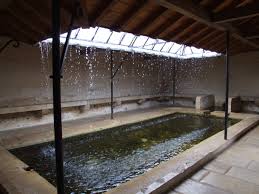
This is a modern architects's interpretation of an impluvium. Although a pool is nice, I was thinking more about just storing the water underground in a cistern.
2.
The Romans built their homes to have layers of public and private
space. Any upper class Roman was a patron and would greet clients
every day in their home. So a big part of the Roman home was
designed to admit the clients into an outer part of the house where
they were formally greeted and often received a gift. This might be the first atrium of the house, a rather large space. Then there
would be other social spaces further in the house for those few
admitted within. Beyond that would be private places for the house
where the owners and family slept. Then above or below would be
cubicles for the servants and slaves. The idea I want to emphasize
was that even the public spaces had a hierarchy to them.
3.
My father used to struggle heating a home in Virginia that was
designed to be wasteful of energy. We put in insulation in the attic and a heat barrier (basically a door) to the basement and reduced our heating bill by half. This is a well
understood topic in America today, that there are much better ways to
heat and/or cool our homes.
I spent one winter at 8000
feet in Colorado in a large house that was entirely heated by one
freestanding wood fireplace with an exhaust chimney made of metal
that extended through the air
for 10 feet on its way to the outside. There are particulate (e.g.
smog) issues if everyone burns wood, but there are ways to mitigate
this problem if one wants to. Am
I suggesting that you heat your house with wood? I dont know, I am
just pointing out how well it worked in a really cold environment and
how economical it was.
On
another occasion, I spent
some time in the traditional
adobe house of a friend of mine in Taos, NM. It
was about 1/3 underground and the walls were very thick and
made of some sort of compressed earth and straw, I think, and then covered with plaster. It was
completely astonishing how
well it kept the house cool during the very hot days and warm during
the very cold nights.
The point here is not that one should heat ones house with a wooden stove or build an adobe or even that one might build the main level of the house such that 1/3 of it is below the ground, although one might do any of these things. The point is that these ideas have real merit and are not hard to implement if one wanted to and designed it in from the beginning.
4. Not only is building underground a good use of the available space, it is especially well suited for things that should remain relatively cool and with a stable temperature. Which is why most older American homes in the east coast and the midwest would have a basement for storage. We would expect to use the basement for food storage, wine storage, but also computer media, storage of film, and possibly also the location of other types of house infrastructure that does not have to be upstairs in the main living, entertainment or working spaces, such as computer servers.
5. I have always tried to keep a spare bedroom or
at least a couch and made it available to friends from out of town.
In Manhattan, I was very well set up for that, which is very unusual
there and I wish more friends had taken advantage of it. One of the lessons of that space is that one can accommodate guests in a way that is completely unintrusive into the rest of one's life. When one reads novels or sees plays set in England, one often reads about families that extended hospitality to friends and family for long periods of time, years at a time. You might have a distant cousin or the son or nephew of an old friend who graduated from Cambridge and has no way to make a living. So you put him up in a guest house and he tutors your daughter in mathematics. That sort of thing. (Arcadia).
6.
Castles in parts of Europe were built with access passages such that
fireplaces in guest rooms could be lit without actually going into
the room. There was a whole infrastructure behind the scenes for the
servants which allowed them to come and go without disturbing the
rest of the house. This also provided storage spaces for artwork
that was not currently being used. The big idea is to consider
building such passages, whether overt or covert, into your house for
a variety of reasons and purposes. This might be special access from
the kitchen to the outside entertainment area. Or it might be
dumbwaiters between levels for various functional rooms of the house.
7.
I recently spent the night at
a hotel where I was given a room that was built to ADA standards. I
loved it. The bathroom was one huge shower stall, nothing to trip
over, and a nice seat to sit on while showering. There was nothing
to trip over in the entire room.
8.
A variety of techniques can be used to blur the outside with the
inside. A good skylight or series of mezzanines can completely open
up a space. A projection system designed for
screenings in the house could perhaps also be designed to be
redirected to project on an outside screen for those parties and
events on a warm evening. In this way one can also entertain the
whole neighborhood in the same way drive in movies used to. A friend
of friends has built their master bedroom in Telluride such that the
bed is mounted on rails and can be easily be moved outside to sleep
under the stars or pushed inside out of the rain.
9.
Wherever possible, combine functionality with character. The classic
door knocker is of course a lion or some other creature. I always
thought gargoyles were just decorative, but no, they are used to
redirect water away from the stone cathedrals.
10.
The Romans often built interior design into the s tructure of their
homes. A painting might be implemented as a fresco and last for
much longer than merely being painted. A floor was usually a mosaic
made of stone.
11.
The British and the Italians were particularly active in building
formal gardens. There are some great books on this.
12.
All Roman houses in the country were really working farms. I am not
sure you want to go that far, but a nice greenhouse or container
garden would be useful. Maybe make your own olive oil?
13.
All homes should have an observatory of some sort to check out the
countryside for hostile forces or perhaps to observe the universe.
14.
All homes should have major built in bookcases, perhaps used as
entrance ways into storage or corridor areas.
15.
Of course we have to consider how to hide the computer infrastructure
so it is not intrusive.
16.
And it would be only sensible in 21
st century America to
consider how we house the slaves. No need to go overboard here, a
little cubicle with a stone bed was enough for the Romans and it
should be enough for us.
17. One of the odd triumphs of S. California was the Arts and Crafts Movement of the early 20th century. One might consider recreating some of their designs or setting up a workshop to do so on site or in some way to feed into your house construction.
18. One might research current artists and workshops capable of creating decorative stone or bronze work. And select an artist or two to work from their workshop or at a workshop you create to feed decorative elements into the house. If one did create frescos one would need to find artists capable of working under those very wonderful and strange constraints (the key to a fresco is to paint it while the plaster is wet, and essentially without making any mistakes).
20. One could set up to do bronzes with the lost wax method but use 3D printing (there I go with these modern techniques again) to create the molds.
21. One might want to create and store spare parts for the house from the very beginning. It would be easier to make spare parts, tiles, sculptures, etc while the workshops that are creating them are building things for the house and just put them underground and wait the 10 or 20 or 50 years until they need replacement.
22. If you do use concrete, recall that Roman concrete is better than Portland cement and that there should be a discussion here.
23. If you do build mosaics, consider designing them with a computer and using some sort of automatic stone cutter or even 3D printer to create elements. Remember a key to a mosaic is longevity, so it might be better to automatically cut stone or tile than to print with modern materials.
24. When working at Robert Abel & Associates, I would often walk down Romaine to visit Opamp books, which is now out of business after a long decline. On the way there I would pass a building that was a ruin, uninhabited, that fascinated me. At some point I noticed some sort of ironwork railings, and older leaden glass in the windows. I eventually discovered that this was the old Hollywood headquarters of Howard Hughes in the period when he made movies. The older glass was fascinating. Consider using handmade or leaden glass, even consider stained glass. Glass does not have to be boring.
and finally,
25 A carillon is a series of bells, usually played by a kind of keyboard that is below it, that has at least 24 bells or three octaves. A chime is the same sort of thing but with at least one octave or 8 bells, but not as many as a carillon. There is a famous chime at Hollywood Forever but it is not playable and would need restoration. Maybe you can buy it? I have always wanted a carillon! See
https://en.wikipedia.org/wiki/Carillon
The carillon in St. Petersburg, Russia.
[By the way, if you look closely at the bells above, you will see that there is type extruded on the surface. Do you have any idea how hard that is to do? Its amazingly difficult if it was put there as part of the pouring process, which I think it must have been. This was an aside.]
That
is enough for now.
This
needs to be rewritten.
UC
Berkely article on Research into Roman Concrete
Cistern
on Wikipedia
Moat
on Wikipedia
Fresco
on Wikipedia
Sunset
Magazine reprint on making your own olive oil
An
entertaining narrative by someone who ended up with an olive grove in
New Zealand