Monday, July 28, 2014

(REDACTED) Advice for Directors of Alien Invasion Films


This post has been redacted.

Summary of redacted post:

I have been reviewing two alien invasion films side by side: Edge of Tomorrow and Pacific Rim.

There is no comparison.   I strongly advise everyone reading this to think twice before doing a movie on the topic of the alien invasion of earth, with or without giant robots, to have a script before wasting everyone's time with a movie.

Memo to file: have a script before production.

Tuesday, July 22, 2014

Pacific Grim


Warning: This essay contains spoilers for the film Pacific Rim (2013).


Some are born great and some have the mantle of greatness put upon them.

In our world there is mere craftsmanship, then art, then great art, then movies with giant robots.

But not everyone who is called to the altar of greatness is up to the challenge or in some way evil or circumstance interferes with its realization, and we experience the tragedy of a movie that could have been important but that fails and lives down to our worst expectations.

Such is the case with Pacific Rim (2013).  I had seen the effects reel at the Academy Bake Off and I was looking forward to the director's take on the critically important sub-genre of fiction: giant robots beating the shit out of alien and hostile ocean monsters.  But the great concept for the movie was let down by a truly puerile script and shallow characters. The humans were so stereotyped and uninteresting that even the giant alien monsters seemed more richly drawn, realistic and authentic in comparison.

Lucas claims that a movie is binary, that it either works for the audience and they ignore the flaws, or it does not work for them and the flaws are completely annoying.   I think that this principle of all or nothing has merit.   For example, I did not notice many of the flaws in Edge of Tomorrow (2014) when watching the film and when they eventually did occur to me it did not really bother me.

The flaws were made less important because the film was so entertaining.


A mashup between a German scientist and a Cambridge University mathematician, or something.


But not so for Pacific Rim, at least not for me.  There were so many problems and all of them attached to a very obvious and banal plot.   Not even giant robots could save this movie from its plot.   Here is a short list of just some of the problems in no particular order of importance:  1. If you are dying of radiation poisoning, you don't just get a nose bleed, or rather if you do, its because you are bleeding at all your orifices.   But none of that really matters because the radiation has probably killed all your blood stem cells and you will be dead in less than a week, horribly, and wont have the time to lead a group of desperate men and women in a last chance struggle to save humanity.   2. I found the cultural stereotypes of the German/Cambridge scientist to be offensive, although it was supposed to be funny, 3. The mind melt with the alien thing, aside from being improbable, is just confusing. Do the bad aliens read the stupid little scientist mind or not?  4. Umbilical cords are generally for mammals, as I understand it. Are the filmmakers saying that these hideous underwater alien monsters are descended from mammals? That doesn't seem very likely from what we know of them.  5. This may sound silly, but what is the motivation of our alien menace and the big fellows on the other side of the breach?   I mean what is going on?   Are they just attacking because they think its fun? Are they after our women?  What?  6. These big aliens although they are impressive looking seem rather average in terms of construction.   If they can be filleted with (for example) giant spinning sushi knives or a sock to the jaw then it seems logical that they would respond well to a couple of dozen standard, stand-off, air-to-air missiles, not to mention MK48 torpedoes.   7. Its all very well to throw around words like "analog" in regards to EMP, but for that to work that would mean that all the control systems of the adorable Gypsy Danger would have to be analog computers, etc, and I kind of doubt it.


Open wide and stick out your tongue... 


Ok, enough.

It is a principle of visual effects that great visual effects will not save a bad movie.   That is certainly true in this case, but there are some things to note about the film that are positive, in terms of cost reduction, costume design, production design and, of course, visual effects.   

1. They probably saved a lot of money on the writer.

Many people feel that having a script in a visual effects movie is just throwing good money after bad. Certainly, Michael Bay has never been held back by not having a writer on his films.  They probably saved several hundred thousand dollars on this one item, which would leave them more money for visual effects. 

2. The female lead was given an excellent costume.

Movies of this type are often calculated to appeal to adolescent boys of all ages, and one way to get their attention is to put your female lead, suitably cast, into a skintight and/or polyethylene outfit. Actress Rinko Kikuchi plays the role of Mako Mori, the spunky and strong female technocrat and martial arts specialist. I think that the rubber/latex outfit that they have her wear while controlling the giant robot in partnership with our hero is very practical and shows off her intelligence among other attributes very well.   I am still looking for the right single frame to show you what I mean, this image is a standin for now.


The properly sexist still of Mako in her latex jumpsuit has eluded me so far.  


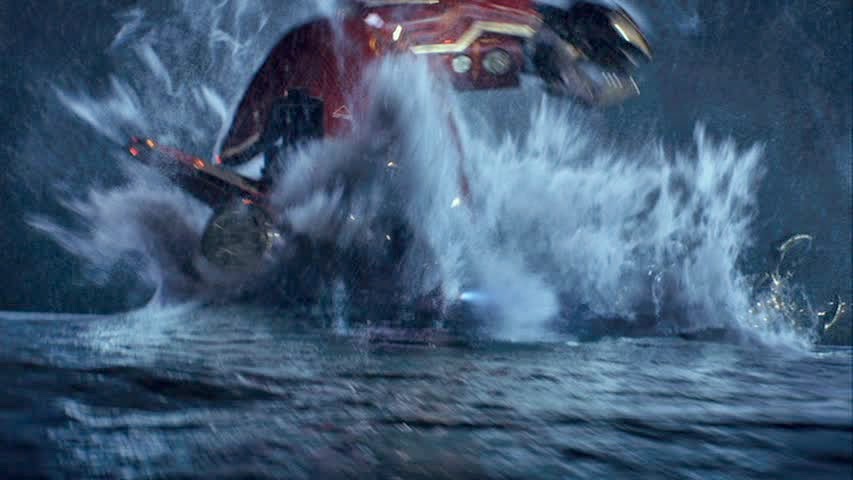
3. In visual effects, objects interacting with water is very difficult to achieve in a realistic manner.

4. One reason that water generally looks fake in earlier visual effects (see WW2 movies or pirate movies with ships generated with model photography on a pond or swimming pool) is how off the sense of scale is, no matter what the visual effects people did.   We get an excellent sensation of scale for most of the important fight scenes of the film which either take place in shallow water or under water.

5. Finally, it is a non-trivial thing to give these 3D models a sense of scale while they are beating the shit out of each other.   And most of the shots, although often ridiculous, were also dramatic and did have good scale to them.   I was very impressed.  

ILM did all these things very well.   Have a look at some of these stills and remember that IMHO the only way to really judge the work is in motion and on a big screen.


6. Very few movies get to show what it is like on the other side: to show the unspeakable and unknowable alien world. This movie did that acceptably I thought, the pacing was good and the reveal of the horror that is the vast and evil alien intelligence is suspensful... Of course the implacable menace is just beginning to understand that they are doomed as disaster overwhelms them.


Pleasantly abstract, the alien menace sees their doom approach.


Its the stories and the characters and the details that let them down. The movie feels like it was written for 10 year olds, and maybe it was. Only a 10 year old could go with the hackneyed characterizations and the stupid plot points. And of course the whole premise is ridiculous. Although it would be moderately expensive (1) and messy to turn these monsters into shredded fish food, it would be straightforward to do so with the weapons at hand in any modern air force or navy.  I mean they are big and ugly and spray acid and look pretty mean, but it seems to me that they blowup pretty much like normal flesh and blood, alien though they may be.


The other scientist stupidly visits the alien fishbait abortion.  Nice eyes.


But I prefer to emphasize the positive about this movie and hope that something better will happen next time. Good art direction and creature animation does not a good monster movie make. del Toro has the capability of doing great work, I hope we will see better and more moving, plausible, end of the world implacable monster movies from him in the future.

________________________________________________

Notes:

1. The cost of a Hellfire missile is roughly $70K but I think that is a little underpowered for this activity.  A Tomahawk missile from Raytheon is about $600K - $1M depending on how you look at the accounting. A Mark 48 torpedo is roughly a million a pop, I think.   Delivering these munitions is not cheap either.  We are talking about flying F-18 Super Hornets off of aircraft carriers or of attack submarines delivering many torpedoes as suitably modified for this application.   So it would be completely plausible for the destruction of one giant alien sea monster to cost at least $50M and probably more like $100M  if not more per critter.   Not cheap, but immensely cheaper than what is portrayed in the movie as the last hope of mankind.  No nuclear weapons would be necessary.

Tomahawk Missile
http://en.wikipedia.org/wiki/Tomahawk_(missile)

Mark 48 Torpedo
Pacific Rim on IMDB


Monday, July 21, 2014

A Modest Proposal for Restricting the Use of Computers to Only Those Who Are Worthy


It seems certain that a mistake has been made on the public policy issue of who uses computers and what they are permitted to use them for. The naive egalitarianism that so many of us espoused may have been foolish in retrospect. We seem to have unleashed a vast madness of unthinking and even puerile consumers whose only thought is to text about underage sex partners, vapid consumerism and the next iPhone. The mistake, I believe, was to allow just anyone to use computers. That idea, that openness, was surely noble, but look where it has led.

Just for discussion, I want to propose the idea of limiting the use of computers and computing to an elite. This elite would have had to study and learn something about the history and philosophy of computing and perhaps also have their moral character evaluated by a qualified board. The requirements would not necessarily be much, what I have in mind could easily be learned by pretty much anyone of average intelligence in a few years, certainly less than five. And a background check could determine if the potential computer user was a rapist, a member of an organized crime syndicate, an abuser of children, or a potential computer company or entertainment industry executive.

Given the moral hazards involved in certain professions, members of those professions would no doubt have to be vetted with special care. These would be fields where the risk of criminal involvement and contempt for the law has resulted in the overt and appalling exploitation of innocent people in order to enrich the wealthy at the expense of the poor. These fields would certainly include parts of the finance industry, politicians at the local and national level, and of course computer animation executives of any rank.  

What would they study? Oh this and that, about where computers came from, what the ideas are, that sort of thing. Here is one potential paper on the reading list: its the report that Dr. John von Neumann wrote about what may be the first stored program computer at the U of Pennsylvania for his client, the US Army, that paid for the work. I can't imagine that anyone who used computers would not be fascinated by this paper. Here is one paragraph from the introduction.


You see, its not just all boring capacitors and resistors, there are, or at least were, some ideas behind these devices. Unlike today, of course, where the only ideas that can be discerned is to steal money from the consumer and annoy them with advertisements while collecting personal data without their knowledge or consent. What a dismal fate for such a high-minded invention!

If the requirements up front seem a little stiff to people, perhaps we could find a more incremental solution. Perhaps every toaster oven and smart phone or other device could come with a paper from the reading list that the consumer would have to read before the device could be activated. Different devices could come with different papers, perhaps. Given the obsolescence built into most of these devices, such that they are worthless within 18 months or so, over a short number of years the consumer would have certainly read a couple of dozen relevant papers or texts. I do not like this idea as much as simply having an elite, I think any effort to let just anyone use computers is doomed to failure and will ultimately just bring us right back to where we are.

The entire paper can be found at this location.

I have included the title page and table of contents below.


Sunday, July 20, 2014

When Uverse Goes Down I Shall Not Frown


A first draft of a poem I have written about my Internet Service Provider.  I am sorry the rhythm is off so for now lets just pretend this is blank verse.


      When Uverse Goes Down I Shall Not Frown 
      For to do so would be immature
      But I would be lying if I was denying
      That Uverse is a puddle of manure


The Self-Illuminated Eileen O'Neill

OK, we are getting a lot of corrections here.  Eileen's name is probably O'Neill, well I am sorry it has been a long time.   Everyone please accept my apologies.  I also hear I am confusing Digital Effects with another early company, so that will have to be corrected as well.  Fine!

Please find attached a picture of computer animation pioneer Eileen O'Neill, a veteran of  Kleiser Walczak, and Walt Disney Feature Animation, among other computer animation companies of note.

This picture of Eileen I think reveals her intelligence and beauty in spite of the lack of color timing. It was taken by the pool at the Figueroa Hotel in Los Angeles, one SIGGRAPH long ago.


I have been unable to contact Eileen to get her permission to use this photograph.


Thursday, July 17, 2014

Blood Transfusions and Anti-Alien Bias in Edge of Tomorrow (2014)


The following post contains a not too outrageous spoiler for Edge of Tomorrow (2014) so if spoilers are not your thing, you should see this movie and then possibly read this.

In a moment, we will discuss the importance and semiotics of blood transfusions in Edge of Tomorrow (2014) that epic alien invasion Groundhog Day film.   But first, I must protest Hollywood's endless hate-filled diatribes against peace loving alien invasion species.   How do we know that these aliens are not actually our friends?  Why do we always have to fight a war against something that looks like about 100,000,000 gigantic, mutated metallic spiders on crack?  Can't we just love each other while they are eating us?

So getting back to Edge of Tomorrow (2014), it is a fundamental plot point that it was the intermixing of alien and human blood that causes the plot device that the hero can now use the time reset ability of the alien with some loose ends left loose, but thats ok. What is made explicit is that the human must not receive a blood transfusion because if you do then the spell, I mean the plot device, is broken. And you are really dead the next time things happen.

So two things, first.

A lesser spoiler must be that when one receives a transfusion, that the recipient must really know that the spell is broken in some intrinsic way otherwise they are just going to get themselves dead but this time it really is game over. And the situations that our hero or heroine are in are so dire that it is very, very easy to get yourself dead.


No blood, please.


But, and I hate to pick nits, but why not, everyone who goes into battle these days, at least any human that goes into battle, contains a hard to remove tag to indicate blood type and any special instructions to the attending physician while the patient is unconscious (and possibly having limbs removed, etc).  Most transfusions in battlefield conditions are often plasma-only transfusions which still require knowing the ABO blood type, but not RHD. Thus, it would be perfectly possible to have a dogtag that indicated that it was the patients wish to receive no transfusion even to the point of death. It would not be normal, but it would be possible. What would be less clear is whether the technician or doctor would follow the instructions on the tag given the death of the patient from blood loss and shock.

But maybe that would not have been as fun.

It may be also worthwhile pointing out that a film that depends so heavily on the issue of blood shows you so little of it, and what you do see is obviously alien blood and therefore on some level does not count.  Yes selfishly we do not seem to care about the vast suffering on the part of the misunderstood aliens in this film.

It is implicit in this spoiler that I would care enough about the film to even think of or worry about such a thing in contrast to most films, for example, Pacific Rim (2014), where it is not even worthwhile to find plot issues, its just not worth your time.


Wednesday, July 16, 2014

Snowden and Ellsberg Compared


The following essay may have to be read with a “sarcasm alert”.

I am sorry, I just could not resist.  Back when Ed Snowden was newsworthy and before he disappeared off the media radar, I was hearing him compared to Dr. Ellsberg of Pentagon Papers' fame.  Now Danny Ellsberg used to smoke dope on the beach with a good friend of mine who was at RAND at the same time, so I feel a certain, close, personal relationship.   And even though Danny has publicly congratulated Snowden, as all truly committed lefties are required to do, I just had to write this post comparing the two people and events because ... well you will see.

None of this particularly addresses the issue of whether the various materials should have been leaked.  That is a topic for another day.

So I am now going to compare the two men in the areas of education, experience, knowledge in the domain, and so forth.   Lets see where it goes.  

1. Education.

Dr. Ellsberg was scholarship to Harvard in Economics where he was summa cum laude, went to Cambridge University on a Woodrow Wilson scholarship and completed his PhD in Economics at Harvard. Ed Snowden dropped out of Arundel High School in Maryland.

2. Prior Experience.

In 1959, Dr. Ellsberg became a strategic analyst at the RAND Corporation, and consultant to the Defense Department and the White House, specializing in problems of the command and control of nuclear weapons, nuclear war plans, and crisis decision-making. In 1961 he drafted the guidance from Secretary of Defense Robert McNamara to the Joint Chiefs of Staff on the operational plans for general nuclear war. He was a member of two of the three working groups reporting to the Executive Committee of the National Security Council (EXCOM) during the Cuban Missile Crisis in 1962. Ellsberg joined the Defense Department in 1964 as Special Assistant to Assistant Secretary of Defense (International Security Affairs) John McNaughton, working on the escalation of the war in Vietnam. He transferred to the State Department in 1965 to serve two years at the U.S. Embassy in Saigon. On return to the RAND Corporation in 1967, Ellsberg worked on the top secret McNamara study of U.S. decision-making in Vietnam, 1945-68, which later came to be known as the Pentagon Papers. Ed Snowden dropped out of high school to be a sysadmin for the CIA and later for the NSA through a contracting agency. The CIA identified Snowden as a security risk and terminated his involvement but failed to communicate that information to the NSA.

3. Depth of Knowledge in the Area

Dr. Ellsberg was a recognized member of the national security apparatus and co-author of the report in question. Ed Snowden simply vacuumed up everything he could get his hands on, including stealing security keys from other people, and dumped the material in the public domain. He has no credentials in any of the areas where he released material.

4. Role That They Played in Creating the Material

Dr. Ellsberg was one of the authors of the report that became known as the Pentagon Papers. Ed Snowden had no role whatsoever in the materials he copied without permission and released.

5. The Process By Which the Material Was Released

Ellsberg approach various members of congress to try and get them to both read and release in the Congressional Record the report (thus making it difficult to prosecute anyone). Whoever Ellsberg approached would not do it. Eventually he gave a copy to a NY Times reporter with the (supposed) intent that it not be published, more as background, I suppose. Well the NY Times decided to publish it. I dont know the truth of the matter, but I suspect hairs are / were being split on who could legally be prosecuted. Snowden fled the country before releasing anything and found someone who in my opinion is highly motivated to release material no matter how much it hurts this country, Greenwald. That Greenwald received the Pulitzer prize for this is a disgrace and lowers the credibility of the Pulitzer, IMHO. In any case, Snowden was no where near as clever or responsible as Ellsberg. He leaked everything and then fled to the most oppressive surveillance state on the planet. Many knowledgable people believe that he was working for Russian intelligence more or less all along. Dismiss that as paranoia if you will, that is what they believe, and the people who believe it have access to much more information than you or I do.

6. The Nature of the Material Released

Dr. Ellsberg released a report that was primarily about the history of the Vietnam war and the decision making that led to our involvement. Because the report had information from very secret sources it did compromise sources that were directly involved with this area and (supposedly) led to the death of many people (possibly a few hundred) of people who risked their lives to help us. Ed Snowden released information on a vast number of current operations and activities, activities for which he should not have had access, and released them indiscriminately. The full impact will not be known for years, but it is likely that the death toll will be huge. The impact on foreign policy and international relationships is far afield from what Snowden claimed he was interested in, which is to say domestic surveillance, will also be huge. In fact, very little of the Snowden material released pertains to domestic surveillance and no one could seriously take that as a motivation for his activities. In other words, Ellsberg's leaked information about the past in order to demonstrate that the POTUS was not completely honest with the American people. Snowden released information about the present, in a vast number of areas, completely unrelated to his announced motivation for the release.

7. Actions after the Release of the Material

Dr. Ellsberg stayed in the United States and said he would take responsibility for his actions. His trial was thrown out of court by the judge due to the famous misdeeds of the Nixon Administration and his Plumbers. Arguably this was one aspect of the Watergate scandal that led ultimately to Nixon's resignation. Snowden fled the country and, demonstrating his unique hypocrisy, took asylum in a country with the most oppressive internal surveillance in the world. He regularly states that he can not get a fair trial in the USA but I think his real concern is that he is likely to get a fair trial in the USA.

8. Other Service

Ellsberg had been ROTC to Harvard and spent two years in the USMC as an officer. Snowden has no service to his country other than as a consultant where he violated his oath.

So as you can see and, in summary, the two cases are very, very similar.

Actually, that was a lie.  The two cases are about as dissimilar as they could be.   So you can conclude at least that anyone who claims to you that they are similar is just an idiot.  From top to bottom, soup to nuts, materials released, credibility of the person who released them, impact on our country, and so forth and so on, they are completely and utterly different.   About the only thing you can say that they had in common is that they both involved the unauthorized release of highly classified material.

Of course, this discussion does not go into the more interesting question, about whether they were right to release the material they did.  My short answer to that question, which is of course of very little interest to the world, will be the subject of another post.

Sunday, July 13, 2014

No Weapon, No Motive, No Body


Today's post could be accused of being a little macabre but I hope you will look beyond that to the potentially useful information contained within.

One week, I was staying at a friends' apartment in Chelsea while she was out of town. And, being bored, I went to a local bar and ordered a drink, and ended up in a conversation with someone who claimed to be a former officer in the NYPD. Now maybe he was, and maybe he wasn't, but the bartender who knew him did not contradict him, for what that may be worth. There are times when I can talk to anyone and get them to talk about themselves and their work and this was one of those nights.

Somehow we got on the subject of crime, whether the so-called mafia were as noble as that portrayed in The Godfather (1972), and finally on how to commit murder, or rather, what the attributes of a perfect murder are from the point of view of someone formerly of the NYPD.

The point of this post is to document what I learned that evening so that the information might not be forgotten but can instead be available to my loyal readers should the occasion present itself.  I suppose you never know when you might have to knock someone off, and this information would be good to have at that time.

On the subject of the mafia, nobility and idealism, the bartender, a youngish man, claimed some personal knowledge. I guess he was of appropriate descent, and had friends or possibly relatives who worked in that profession in one way or another. I told him the story from WW2 that when we invaded Sicily, that one of the American Don's was there on the beach to meet his old patron, one of the Sicilian Don's to help ease the way for the Americans. My friend the bartender, laughed at my naivete. Well, maybe, he said, if it was part of a plea bargain, but patriotism for their new country aside, he said, the right way to think of the mafia is as pure capitalists. What they care about is money. Beginning and ending with money.

On the subject of the perfect murder, the interesting person who may indeed have been a former NYPD police officer had this to say. “No weapon, No motive, No body”. He then went on to explain what this cute little saying meant.


The missing Jimmy Hoffa in happier days.


“No weapon” means that the murder weapon no longer exists, and can not be found, for one reason or another (like it is at the bottom of the Atlantic ocean). Thus no weapon can be introduced in court by the prosecution and without a murder weapon, establishing guilt in a murder case is very difficult, he said.

“No motive” means that the person or people who commit the crime are in fact not the people who had a reason to commit the crime. This is the big advantage, if you can swing it, of a larger organization of loyal and trustworthy people. In other words, you may hate Joe and want to kill him and have good reason to kill him, at least from your point of view. But on that evening you were home with your family eating a spaghetti dinner and had a foolproof and even legitimate alibi. On the other hand, Pete may barely know Joe or not know him at all, has no motive, and he commits the murder. But the police have no particular reason to suspect Pete, he has no motive for the crime. Nor would the prosecution be able to show why Pete should commit such a crime in court. Even if they know Pete did the deed, they would still have to establish motive, and being a distant friend of someone who hates Joe is not a strong connection.

“No body” means the body disappears. It may not even be certain that Joe was murdered (although I suppose a lot of blood on his apartment floor would be a clue). But if Joe simply disappears, and there is no sign of violence, then for all anyone knows, Joe may be in Rio de Janiero fucking little boys. Think Jimmy Hoffa. Now how do you reliably get rid of the body? Well, there are a variety of ways and again this is where having a larger organization comes in handy. But butchering Joe into component parts and depositing them on the bottom of the Atlantic Ocean is one thought.  According to one informant, Mr. Hoffa was put into a trunk of a car, compressed, and sent to Japan as scrap.  Another thought is that nice new Javits Center where, it is said, Jimmy Hoffa rests in peace, or in pieces.

I hope you have found this post educational and useful in your work.

Cowardice, Network Television and the Affair of the Three Missing Words


Those of you youngsters who are reading this may never have heard of network television, so I will endeavor to explain it to you. Once upon a time, the new technology of broadcast television was invented, so the government decided to award a franchise to their friends so they could make a lot of money. Three different networks were created, the red network, the blue network and the eye network (NBC, ABC and CBS respectively). Ok, this is not exactly what happened, but it is close enough for our discussion.


The first thing that would happen if you became a television executive, apparently, is that, symbolically at least, your backbone was removed. Network executives became known the world over for lacking a spine, in other words, they regressed to invertebrates. Hundreds and then thousands of cowardly decisions were made to keep television lily-white and inoffensive.

But there was one moment that symbolized for me the lack of backbone, one decision that was so cowardly that it seemed to encapsulate all the other cowardly moments and coalesce them into one brilliant and insane cowardly moment.

Once upon a time, when movies were first shown on broadcast television, this was considered to be an Event. But since just anyone could switch on the TV and watch, the networks felt that they had to protect the morality of Americans, that this was their responsibility. And so, the infamous warning “edited for television” came into existence, announcing to the world that the creative work about to be shown had been castrated for your safety. Artistic Integrity is not a term much used by television executives.

In the premiere that was the penultimate nadir of integrity that I refer to, in editing for television all that changed was to remove three words out of a full-length movie. Three little words, how bad could that be? I mean what could you lose with three words, for goodness sake?!

Well, in this case, it changed the meaning of the film, and its impact, significantly. The movie was Cabaret (1972) and the scene was as follows:


And the three words that were removed? It was Brian saying “So do I” ... in other words, confessing to a homosexual relationship with Lothar. This was considered so shocking that it was removed. But removing it changes everything.

I have a copy of this film online but I am brilliantly unable to find this scene no matter how I look. Of course, one way to look, to start at the beginning and go to the end, would not be possible.


I am still looking for the date of this Event and the network.  The Internet is great for research up to a point but at the end of the day it is not a reference library, exactly, but something more amorphous.  And so finding this information will take a little digging.   


Cabaret (1972) on IMDB

Wednesday, July 9, 2014

In Response to an Anonymous Comment on my Review of Android


I wrote a scathing review of Android many months ago, intentionally being sarcastic and demeaning to what is clearly a very successful operating system. I am resisting looking up the numbers of users of Android (not necessarily programmers, end users) because I am sure they will be stunning, however much they may have been inflated by marketing scum. The reality is that whatever the numbers are, this is a very successful operating system by any measure. But all the more reason therefore to have expectations regarding the quality and the way potential developers are treated.


The point of the current post is to reply to a comment, anonymous, that I just received that suggested, tersely, that I should revisit my review of Android. The implication being either that it has changed, which I doubt, or that I am stupid or that I am wrong.

But before I begin, let me respond to a potential criticism, that I simply want new technology to be the same as old technology which I already know. No, I don't, but thank you for insulting my intelligence and motivation.

I doubt very much if Android has changed. The kind of things I was responding to are fundamental to the system and could only be changed if the people at Google wanted to change them. But it is the nature of such things that they are not changed, at least not willingly. How many psychiatrists does it take to change a lightbulb? Only one but the lightbulb must sincerely want to change. Either they do not give a fuck, or they think it is great, or they dont know any better, or it was a design goal to make Android completely incompatible with everything else and have not considered what is involved for a non-Google person to do development on the device.  It may be that they are only interested in the participation of organizations with a lot of resources, and the lone developer has only marginal value.  (1)

Second, I do not think I was being unfair. I think that I got a good sense of what the design philosophy behind Android was and what Google thinks of their users (which is that they are going to do things their way and spend the time and energy and money to get up to speed, no matter what that costs). Remember this project has essentially infinite money compared to most projects in this world. If they wanted to do a good job, they could, but to do so would require that they want to do a good job and that they hire someone with the aesthetic and design sense who was capable of doing so.

It is my opinion that computers are first and foremost about aesthetics. There is very little about computing that is not about aesthetics in one way or another. Yes, there are other criteria as well which are more mundane, some obvious, some not obvious. But generally speaking, the values of those who have written or designed (if there was a design) the hardware or software have been implicitly expressed in their design and implementation.

There is nothing new in the above paragraph. This insight has been common knowledge in computing since at least the 1970s and probably before and in the other arts for much longer, centuries at least.  It is one of the reasons, perhaps the primary one, that Macintosh consistantly has a good user interface and Microsoft does not.  The author of a work necessarily reveals who they are and what their values are in that creative work whether it be a sonnet, a novel, a short story or a computer program.  One of the scary things about doing creative work is that it always reveals something about you.   (2)

Like all creative works, one can work at many levels, and one can also employ irony, sarcasm and so forth. Thus one may have to have two neurons to rub together to realize when reading Jonathan Swift's “A Modest Proposal...” that he does not actually think that people should eat Irish babies to deal with the overpopulation problem. Similarly one may write bad software to make a point, or simply because the client wanted it to be bad, as they so often do.

Now we have one more point to make. Those who are not lucky enough to have been rewarded for their work and have to get a new career in todays “great recession” have an overwhelming number of new, but not altogether well designed, frameworks, operating systems, languages and so forth to learn. When they get a job, the problem becomes much easier as long as they hold that job. Android is certainly one of those things one might learn to try and be employable. Thus when it is badly designed or deliberately difficult to use, it is particularly frustrating to those of us who are not being paid.

So my response to the anonymous commenter who tells me that I had better revisit the subject but doesn't have the guts to sign his opinion nor the time to explain why this might be so is that I would be happy to. My rate is $4K/day with a 10 day minimum due up front.

Let me know when you want to start.

________________________________________________

1. Which may, unfortunately, be the case.

2. There are two jokes related to this "the work reflects the personality of the author".  The first is a film school joke: everyone's first film is about sex, whether they know it or not.   The second is a joke from the field of industrial organization: that an organizations building (headquarters, usually) tells us something about the company.   Thus the Pentagon tells us something about how the DOD works, and the building of the American Museum of Natural History tells us something about how the museum organizes itself.  This is one of those jokes that has an awesome amount of truth to it.