[I just got back on the internet after 36 hours for failing to pay my 30.89 $US to the rich conglomerate that owns my access to the world. Thanks to my many friends who are lending me money to get me through this insanely excruciating period. I am for similar reasons going to be off my meds for the next few weeks, see if you can tell the difference! I certainly can. ]
[This post is being written in place, online, today and will become more detailed as the day goes by].
My friend Steve Speer has pointed out to me an immense and under recognized cultural resource, Frank Zappa's 200 Motels (1971).
It is very low quality youtube, which is what I would expect, and it has subtitles, whatever that means in this case. Low quality Youtube is an abomination but we are lucky to have this work of genius in any form so we have to put up with it.
See it at:
http://www.youtube.com/watch?v=uL63MuKDyIg
Frank Zappa was the acknowledged genius of the generation before my own, the man we recognized as having the sense of humor and talent and accomplishment that we all wanted. 1971 was the year I went away to college and I remember listening to Zappa albums over and over again as a freshman in my dorm.
The IMDB page for 200 Motels is at:
http://www.imdb.com/title/tt0066732/
Friday, March 1, 2013
Wednesday, February 27, 2013
Update 2/27/2013
For those of you who are reading this blog regularly, this is a non-post post to let you know that there will be a brief delay while I recalibrate after a hectic few days. We are going through another one of those crazy periods and it is difficult to concentrate.
The shock of going from what seemed to be a reasonable career to no career at all is very traumatic. I hear a lot of idealistic chit chat about the future on Facebook as many other people start to come to grips with the train wreck that is computer animation.
We will return to writing the blog shortly.
Tuesday, February 26, 2013
Apology, Academy, When?
So I presume that the Academy is going to apologize to Bill Westenhofer and the Computer Graphics community in general for cutting Bill off at the awards. In their apology, they should include a statement from Bill which has what it is he was going to say, which was presumably to thank R&H and wish them the best outcome of their current crisis.
And Ang Lee will apologize for not thanking R&H and the artists who made his award possible.
I must say that they are to be congratulated for taking a bad situation and making it worse for themselves. I have seen this once or twice before. Its as if the people with the power want to make sure that the little people organize, because they really don't care if they do or they don't. I think they are correct, nothing will change. But it is fun to see the effects people wake up and see how screwed they are. Its only taken them 20 years or so.
[draft, I have to run go apply for food stamps to eat, so I will return to this later]
Monday, February 25, 2013
Anecdotes about Unions from the Early Days of Computer Graphics
The recent disturbances in the force
involving visual effects and computer animation people protesting
their lot in life is a good thing I think. I may feel that some of
it is misdirected, and some of the goals and beliefs are incorrect or
unachievable, but I have no doubt that the workers must organize in
order to look after their interests. Even if they do not achieve
their goals, they are guaranteed to not achieve them if they do not
organize.
Many of us, myself included, have
strong mixed feelings about unions. There are several reasons for
this in my case, including coming from a white collar, intellectual
family where unions were seen as good things, but for the blue collar
worker. I am not sure that that association (union with blue collar)
is either fair or correct, however, but it is something for me to
overcome.
The second reason I never appreciated
the need for a workers union or force is because I was treated so
damned well early on in my career. The University of California at
first and the RAND Corporation second, were very fair and good to me.
Thus I had false expectations for the future.
I want to describe two events from the
Robert Abel period, because I think they are relevant to this whole
discussion.
Although I was only involved in
computer graphics R&D, I deliberately chose working at Abel's in
order to pick up what I could of other special effects filmmaking
technique. So, I would hang around the camera department, and talk
to Tom Barron over at Image G and so forth. From time to time,
Abel's would have a big shoot on a stage and one day they were
shooting a 7UP job with Bob Abel directing and Randy Roberts the art
director. It was a big front projection shoot, Bob was on a crane
and I was watching. I remember hearing an assistant whisper into
Bob's ear "Meal penalties, Bob! Meal penalties!"
I later figured out that this meant
something along the lines of "if you don't stop and let people
have a lunch break by 4PM in the afternoon, then the production will
have to pay everyone extra". In other words, Bob, the
obsessive perfectionist, would not have stopped for lunch unless
someone put a gun to his head, or his wallet.
The second thing that I saw, as we
moved raster graphics into production at Robert Abel &
Associates was how producers would move elements that could have been
produced any number of ways into the 3D department. Why? Because if
people worked 12 or 16 hour days in 3D, it did not cost them any
more. 3D was on a fixed hourly rate, a certain number of hours a
week. But if they did it in a department that was involved with a
union (even if there were special deals with the union as there
were), then people had to get paid more.
Oh, I thought as I watched. That's
interesting. You
mean you are willing to burn people out and damage their lives to
save a few bucks? And the answer to that question, was "Yes,
absolutely, we have no ethics whatsoever". Oh. Ok. Thanks.
Sunday, February 24, 2013
Hollywood's Most Sacred Day of the Year
Tonight is Hollywood's most holy night
of the year. It is the day when our people come from all over the
world to virtually or literally celebrate themselves in a giant, ugly
display of sheer power, whimsy, boredom, and oh so rarely, class.
There are a number of things to know about this important day from my point of view.
This post is mostly general background, intended for people who have never attended or had the pleasure of working extensively in the glamourous and rewarding motion picture industry. Another post will go over some of the nuances of this year in particular, as it affects computer animation and visual effects.
The first thing to know is that it is
important to start practicing your acceptance speech now, wherever you are, however early in your career it may be. Because
when you actually work in the industry and are up for an award you
will be too busy to have the time. And God forbid you should make a
fool of yourself in front of a billion people.
Second it is so important to remember
to thank all the little people who have contributed to your award.
You know and we know that they are not really important, that all the
ideas came from you, of course, but they do like to be thanked, its
human nature after all, and it makes you look like a better person
who is willing to give credit to the unworthy.
Third, when you get out of your car,
your limo, or hybrid Prius, be sure to wave to your fans who have
waited so patiently to see you and only you. It is such a courteous
thing to do. I always wave to them when I get out of my car at the
awards.
Fourth, depending on the year, they
often have members enter the Academy behind whichever star is being
interviewed at the moment. One year, the first time I attended with
my friend Lisa Goldman, we happened to enter when they were
interviewing Jodi Foster. The trick is to pass behind the star, then
turn around and go back, and then of course reverse direction and go
back in. That way you get three passes in front of the TV camera
(admittedly in the background, of course). (1)
Fifth, do not be concerned about
getting a date. If you are a single member of the Academy, or if you
happen to wrangle a pair of tickets to the nosebleed section, which
is possible but difficult, it does not matter who you are, what your
gender preference is, or how much you are hated and despised the rest
of the year, you will be able to get a date to the Academy Awards
(tm). Trust me. (2)
Sixth, probably if you attend, you will
be up in the nosebleed section. In fact, although it does make
things a little less convenient, you will be watching television
monitors mostly even though you can see the stage, you are much
better off than if you are in the more prestigious orchestra section.
Because you will be able to move around, you see, and those in the orchestra section can not
move around if the camera is there to witness it. And when you do
leave your seat down there, they have someone ready to occupy it when
the camera is back on so that there are no empty seats. But in the nosebleed section you can wander around, talk to people, get a soda water, and go to the bathroom. This is much more convenient.
Everyone has stories about when they
went to the awards and who they saw and so forth and so on. I want
to mention one here, although it does not involve a famous movie
star. About five years ago I went to the awards as the last-minute
stand-in for the date of my friend David Coons (no reason to waste
the ticket after all), and as we entered, I saw a receiving line of
amazingly lovely young women from a local Catholic School in perfect Catholic School regalia, the dresses, the gloves, the knee socks. About 30 of them
in a line, all about 17 years old. Why they were there, one can only speculate.
This picture makes me wonder if the Catholic School girls were part of a special security squad to protect Academy Members. I did not notice any any weapons, but maybe they were concealed.
Exactly who is a member and why can be
a little complicated. But it is fair to say that most of the members
have a good reason for being members. Not everyone, not by any
means. I know many, many people who are not members who are
plausibly more deserving as members than some I know who are. But
that is the case in many things in life, and it is not so surprising
here. (3)
And yes, it is a little squirrelly who
gets nominated and who wins. We all know some major gaffes in the
Best Picture, Actor, Actress categories. But it is true in the
technical areas as well, as you would expect. I will just mention
one case because I think it is unfortunate. Without
doubt, two of the most important visual effects films in the history
of film are Close Encounters of the Third Kind and Bladerunner.
Those two films were both nominated for visual effects but did not
win either year. Admittedly those were tough years. But it happens
that those two films were the two times that Trumbull and Yuricich
were nominated, and they should have received an award for their work.
In my humble opinion. If this world were fair, which it clearly is
not. (4)
Finally, one last thing, and since this
is Hollywood, it is appropriate that it be about money. Because at
the end of the day, whatever you may think or believe, and whatever else Hollywood may be about, Hollywood is
about money.
This single night which may be the
single most viewed event each year on television, with an
international audience, also finances everything the Academy does for the
year. They have major expenses and run some expensive infrastructure
involving theatres, film archives, libraries, some restoration, and
presumably some other worthy activities I know nothing about. And
this single evening of the year finances all their work and
activities, and that is probably a good thing, as they, from time to
time, do good work.
Not always of course, but from time to
time.
And the winner is ...
__________________________________________
1. That year ILM was up for an award,
was videotaping the event, saw me and very kindly sent me a copy of
myself behind Jodie Foster. That was very nice of them! I think it
was Doug Kay who arranged that. I wish I knew where that tape was.
2. The only two events that come close
as far as I know is the Presidential Inauguration parties (which I
have been invited to, by the way, ahem), and/or if your country has a
King or Queen, and they get coronated or married in your lifetime.
3. Each area (e.g. subsection) has its
own story here. I am particularly amazed that Nancy St. John does
not appear to be a member of the visual effects subsection, but it
may have to do with the problem of admitting producers in certain areas,
particularly visual effects, and some not-so-amusing history. None
of this should, by rights, affect someone like Nancy, but apparently
it does, or at least I presume so since Nancy does not seem to be a member of the subsection. Probably if Nancy really wanted to be a member she could be, is
my guess.
4. The work was done at the Entertainment Effects Group, an important early visual effects company owned by Douglas Trumbull and Richard Yuricich, ASC. Many interesting and talented people worked there, and many of them went on to do other things in the field.
Friday, February 22, 2013
The Inspirational Work of Sally Cruikshank and Quasi at the Quackadero
Once upon a time, a long time ago,
there was something called independent animation. To see it, a
friend had to have the secret stash of 16 mm film or you had to go to
a university screening, or a screening of an animation collection at
a repertoire theatre. You couldn't just bring up a low quality
version on Youtube but actually had to go somewhere to see it, on film at the correct frame rate and the actual colors. At first you would have to see it on film, then later on as time passed, you could see it on video with weird interlace and wrong color, and then, finally, today, the lowest of the low, on the Internet. In this way, the artform is degraded by the decadence of the society it is embedded in.
Oh well, quality doesn't matter, we all
know that. Not when it comes to making money!
But making money was not the purpose of
independent animation. Far from it. In fact, Gawd only knows what
the point was, or is, or might be, but not money. A labor of love,
perhaps? A struggle for acceptance amongst ones' biped peers?
Perhaps just a hint of obsession or even obsessive compulsive
behavior? There has to be some organic cause of the willingness to
sit over a hot animation stand and draw frame after frame, each one
just slightly different from the other, inflicting paper cuts and the
smell of powdered graphite on your long-suffering body.
One day, perhaps at Filmex, perhaps at LACMA,
I saw "Quasi at the Quackadero" by Sally Cruikshank.
I was stunned and amazed to see the
Quackadero, some sort of deranged midway of amusements, with "Your
Shining Moment", the "Hall of Time Mirrors", "Roll
Back Time", "Think Blink Paints Pictures of Your Thoughts",
"See Last Night's Dreams", "9 Lives 2 Live", and
last but not least, "Time Holes"! Each of these would make
a fabulous theme park / carnival attraction. And all of them drawn
perfectly in Sally's very distinctive semi-psychedelic style.
Out on the town!
Our Master of Ceremonies
But as they say in another theme park
attraction, "Its a small world after all, its a small, small
world". A friend Rene Daalder, artist and filmmaker,
introduced me to his friend, Jon Davison, a really nice man, graduate
of the Roger Corman school of filmmaking, and the originator /
producer of the Robocop movies. Jon, of all people, was married to
none other than the lovely and talented Sally Cruikshank. For some
reason they invited me to a benefit event at Jeff Bridges' house in
the Palisades so I got to meet my hero, Sally. I don't remember what
I said, I probably made a total fool of myself.
Recently I came across Sally's page on
Youtube. Quasi was just as brilliant as I had remembered it, or
more so. I wish the "youtube" quality was higher, but this is probably
deliberate on her part.
I am out of touch with Jon and Sally
but I hope they are doing very well.
Sally, your films are an inspiration.
Sally's page on Youtube:
Quasi at the Quackadero
Make Me Psychic
Thursday, February 21, 2013
Procrastination Secrets Revealed: The Decipherment of Linear B
I realize that one should not brag, but I believe that I am the best procrastinator that I have ever met or heard about by at least one order of magnitude if not more. I feel confident that I could compete against just about anyone in the world in this area and be victorious. But it isn't just raw talent, as with anything in order to be the best, you have to work at it, you have to practice, and you have to learn technique.
In this essay I am going to discuss one of several topics I have used to waste weeks if not longer of my time, and they can be used to waste your time as well, if you choose. The specific subject matter may not work for everyone but they will work for some of you. I hope you will try them and that they will be as productive in producing non-productivity for you as they have been for me.
The trick is to find a topic or story
that is sufficiently complex that it will naturally lead to other
interesting topics, which will lead to other interesting topics and
so forth. It helps if there is some sense of romance involved, of
mystery, or of controversy. By the time you are through, six months
or a year or more can be spent becoming your local expert on the
otherwise useless subject.
Michael Ventris, the architect who deciphered Linear B, and an example of part of a tablet
In this post we discuss our first example of such a topic: the decipherment of Linear B.
Once upon a time, a famous
archaeologist proved that the Minoan and Greek civilizations were
literate long before the classical period. But no one could read
what they said. There was no Rosetta stone and it was not believed
that the language would turn out to be a known one. But a young
architect, with a talent for languages, had heard the famous
archaeologist speak when he was a teenager and determined to decipher
the tablets. And after many years, he did and he did it in such a way that the scholars in the field accepted the correctness of this outsider's work even though it revealed things that proved many of their theories wrong.
I can not express to you in this brief post how unusual and how important this was. First, it is very difficult for an outsider to participate in current academic research in a field as obscure as ancient history because to really do it well you need to spend years learning things that have no utility outside of the field. In this case, this includes such things as not only knowing Greek, but having an idea of what the field of philology thinks ancient greek might have been like. Or know a lot about what we think we know about the economies of Greece and Crete at the time in order to help judge whether a translation might be reasonable in context. But more than that, this is an area where some very good people in the field had tried for 50 years to find a solution and none had been found, although some progress had been made. And it was important to know about this work, this progress, because it ultimately opened the door for Ventris's solution. And last but not least, there is something about ancient languages that attracts the nutty people, John Chadwich at one point had three file boxes of lunatic slush from people who thought they had translated Linear A or the Phaistos Disk.
So not only did Ventris have to solve the problem where others had tried and failed, but he had to do so in a way that this very elitist and closed community of scholars could accept and pay him serious attention. Ventris knew all this of course, and he had some good fortune. Part of the story is how he happened to be able to present his ideas on the BBC as part of a discussion of the problem and how a scholar at Cambridge, an expert in ancient Greek languages, heard him speak. The scholar, John Chadwick, checked into Ventris and tried his proposed solution and, to his amazement, was able to decipher about 20 or so plausible Greek words in a few days of effort that made sense in the context of the tablets. Then as a team, Ventris and Chadwick published the paper that presented the ideas, and that worked very well for academia: a lead author who is an outsider, but a reputable and known scholar as second author. Perhaps Ventris alone, although he found the solution mostly on his own, would not have been as strong as the two of them together.
Here is the way John Chadwick begins the story of the decipherment:
So at this point in our story, an outsider has come to the field and presented a solution to a very difficult problem. But now you have to get people to accept the idea. And the story just keeps getting better. Chadwick and Ventris knew that new tablets had been found but had not seen them. But the archaeologist whose dig had found the new tablets had a copy of an early draft of the decipherment paper and tried the system on several tablets. But one tablet, a very famous tablet if a tablet can be said to be famous, was particularly useful. It was an inventory of various things that looked like tripods and cups/vases with a number of handles. And the translation listed "tripods" for things with three legs, and vases with four handles said "four ears" (an ear was a term for handle of a vase used in Homer) and one with three handles, said "three ears", and so forth. As the archaeologist who sent it to them said, "This is all too good to be true, is coincidence excluded"?
But here is where the procrastination comes in, the part where things start expanding into other areas that are related and also fascinating. It turns out that these are not just any old tablets of an ancient and lost civilization. No. Whatever may be historical about Homer, most scholars who study Homer believe that it is an authentic transmission or memory of an early period of Greece, however much it may have been distorted or romanticised. And these tablets are almost certainly the accounting records of the civilization that Homer wrote/talked about. And this civilization happens to also be the one which at that period, participated in the catastrophe of about 1200 BC which archaeologists refer to in various ways, but generally as "the end of the late bronze age in the eastern mediterranean". At this time, most of the civilizations of this area, were either destroyed or attacked, by people who have not been identified but whom the Egyptians called the "Sea Peoples".
And it turns out that we have these tablets at all because they were in cities that were burned to the ground. These clay tablets are almost certainly the temporary records, recorded in unfired clay, which got fired by accident when the cities were destroyed, and left where they fell in the ruins, where no one was left to clean things up, and rebuild.
I can not express to you in this brief post how unusual and how important this was. First, it is very difficult for an outsider to participate in current academic research in a field as obscure as ancient history because to really do it well you need to spend years learning things that have no utility outside of the field. In this case, this includes such things as not only knowing Greek, but having an idea of what the field of philology thinks ancient greek might have been like. Or know a lot about what we think we know about the economies of Greece and Crete at the time in order to help judge whether a translation might be reasonable in context. But more than that, this is an area where some very good people in the field had tried for 50 years to find a solution and none had been found, although some progress had been made. And it was important to know about this work, this progress, because it ultimately opened the door for Ventris's solution. And last but not least, there is something about ancient languages that attracts the nutty people, John Chadwich at one point had three file boxes of lunatic slush from people who thought they had translated Linear A or the Phaistos Disk.
So not only did Ventris have to solve the problem where others had tried and failed, but he had to do so in a way that this very elitist and closed community of scholars could accept and pay him serious attention. Ventris knew all this of course, and he had some good fortune. Part of the story is how he happened to be able to present his ideas on the BBC as part of a discussion of the problem and how a scholar at Cambridge, an expert in ancient Greek languages, heard him speak. The scholar, John Chadwick, checked into Ventris and tried his proposed solution and, to his amazement, was able to decipher about 20 or so plausible Greek words in a few days of effort that made sense in the context of the tablets. Then as a team, Ventris and Chadwick published the paper that presented the ideas, and that worked very well for academia: a lead author who is an outsider, but a reputable and known scholar as second author. Perhaps Ventris alone, although he found the solution mostly on his own, would not have been as strong as the two of them together.
Here is the way John Chadwick begins the story of the decipherment:
So at this point in our story, an outsider has come to the field and presented a solution to a very difficult problem. But now you have to get people to accept the idea. And the story just keeps getting better. Chadwick and Ventris knew that new tablets had been found but had not seen them. But the archaeologist whose dig had found the new tablets had a copy of an early draft of the decipherment paper and tried the system on several tablets. But one tablet, a very famous tablet if a tablet can be said to be famous, was particularly useful. It was an inventory of various things that looked like tripods and cups/vases with a number of handles. And the translation listed "tripods" for things with three legs, and vases with four handles said "four ears" (an ear was a term for handle of a vase used in Homer) and one with three handles, said "three ears", and so forth. As the archaeologist who sent it to them said, "This is all too good to be true, is coincidence excluded"?
But here is where the procrastination comes in, the part where things start expanding into other areas that are related and also fascinating. It turns out that these are not just any old tablets of an ancient and lost civilization. No. Whatever may be historical about Homer, most scholars who study Homer believe that it is an authentic transmission or memory of an early period of Greece, however much it may have been distorted or romanticised. And these tablets are almost certainly the accounting records of the civilization that Homer wrote/talked about. And this civilization happens to also be the one which at that period, participated in the catastrophe of about 1200 BC which archaeologists refer to in various ways, but generally as "the end of the late bronze age in the eastern mediterranean". At this time, most of the civilizations of this area, were either destroyed or attacked, by people who have not been identified but whom the Egyptians called the "Sea Peoples".
And it turns out that we have these tablets at all because they were in cities that were burned to the ground. These clay tablets are almost certainly the temporary records, recorded in unfired clay, which got fired by accident when the cities were destroyed, and left where they fell in the ruins, where no one was left to clean things up, and rebuild.
How interesting could the accounting
records of a lost civilization be? One of the first tablets they decoded said, and I quote:
At Pylos. Slaves of the Priestess on account of the sacred gold. 14 women.
L. Ryder Haggard would have been proud
to write such a sentence.
www.ancientscripts.com has a good summary introduction to Linear B
http://www.ancientscripts.com/linearb.html
Begin researching this topic by reading the following book by John Chadwick:
Amazon.com will let you read about 1/4 of the book online.
A conference on the decipherment of Linear B after 60 years
http://www.cam.ac.uk/research/news/cracking-the-code-the-decipherment-of-linear-b-60-years-on
Its Greek to me.
In later posts we will discuss other
topics which have the potential of wasting a huge amount of your
time.
Tuesday, February 19, 2013
Totoro and the Absence of Traditional Story Structure
As anyone who has tried to finance a
film knows, Hollywood has very clear ideas about what sort of film is
marketable in this country. And very, very clear ideas of what sort
of ANIMATED film makes money in this country. And since they are
very specifically in that business to make money, they attach a lot
of importance to these rules.
Among the rules are these: (a) an
animated film will have frequent breaks with music for the small
children in the audience, (b) an animated film will not be over a
certain length, and (c) an animated film will rarely if ever have a
female protagonist, and if it does, she shares center stage with a
male protagonist. From there, Hollywood goes on and applies a
number of other rules and requirements about story structure, most of
these ae applicable to other types of films as well, and includes
certain things about the types of conflict in the film, the pacing,
the reversals, the climax, etc. Hollywood has a strong opinion on
these matters. It is one reason so many Hollywood films seem the
same, one giant robot or alien invasion after another. That is
because they are the same at one level of abstraction.
My favorite animated film however
follows none of those rules. It has no happy songs, it is much
longer than average, and the protagonists are two little girls, one
about three years old. It goes on from there in its eccentricity.
It is not clear that there is a villain in the film, except perhaps
whatever it is that is making their mother sick such that she must
stay in a hospital. There is one homage to standard story
structure: the climax of the film involves the youngest girl running
away to see her mother, and the effort to find her. This could be seen as a classic 3rd act rescue mission.
What's up in the scary attic?
The film did not do well at first in
the Far East, where it was made. But eventually the toys got
marketed and that fed back to the film until it became successful
there. The film found no distribution in this country (1) until,
unusually, a firm with no experience in this genre picked it up,
added English subtitles and tried a theatrical release in N. America.
I believe it did not do well, and the film disappeared, except to
the few who knew of it and loved it, until Disney, at John Lasseter's
urging, picked up all the films of this director and started
marketing them in this country.
The director of course is Hayao
Miyizaki and the film is My Neighbor Totoro (1988).
This is my corn and you are not going to take it from me
The company that attempted the
distribution was Troma, a firm better known for making and
distributing films such as "Surf Nazis Must Die" and "The
Toxic Avenger". But in this case, they spent their own money
bringing Totoro to the notice of Americans and, I think, lost their
money. I happened to see it because my friend Chris Casady, owner of
Roto Efx of America, had worked for Troma in the past and was invited
to the screening at the DGA and invited me along.
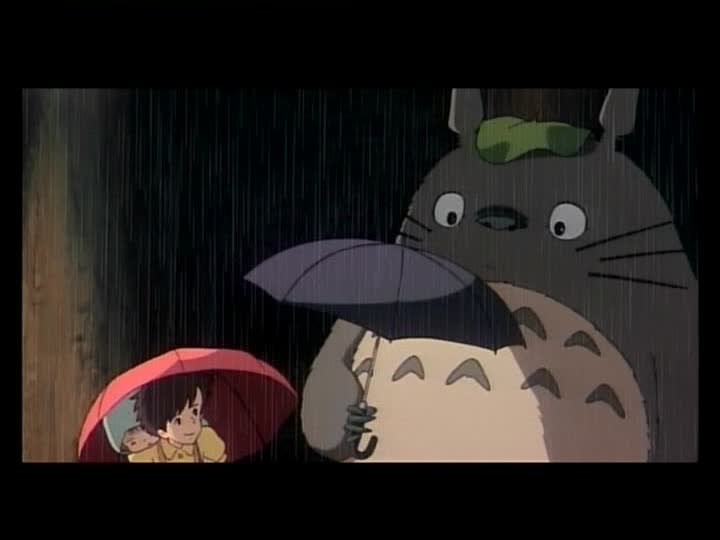
I have excerpted my favorite scene from
this film and put it at Youtube. Well, I had put it on Youtube but it seems that someone is blocking it. So you will have to review the pictures below, or of course, rent the video, which is what they want you to do which is fine with me.
Its an umbrella
On another occassion we will discuss
the issues of trying to make a 3D character from one designed for 2D
and review all the reasons that is hard, using two characters from
this movie: the dust spirits and Totoro himself. Here are some
images of these characters which I hope will set you thinking about
why doing them in some sense in 3D (as in modelled in geometry) would
be very difficult if you wanted to keep the essence and charm of the
characters. And if you would not want to keep their charm, then why
oh why would you even bother?
My Neighbor Totoro on IMDB
Miyazaki on Wikipedia
____________________________________________________
1. Most animated films, indeed most
films, made in the Far East never see formal distribution in this
country or North America. There have been a few exceptions and some
of them are quite notable, e.g. many Kurosawa films would find some
independent distribution here. This is especially true for
animation made in the Far East, where many of their best and most
successful films traditionally never made it over here, except in a
very limited form marketed directly to fans of the various genres.
By way of counterexample, Bruno Bozzetto's Allegro Non Troppo did get distribution of some sort in this country. I am not sure how that happened, but that does show that it is possible.
Monday, February 18, 2013
Computer Graphics and the Doctrines of Original and Derivative Sin
[Substantially revised 2/19/2013]
Anyone who looks at the field of Computer Graphics and Animation today sees vast misery, incredible and increasing unemployment, despair and uncertainty. (3) The political actions of other nations have made it impossible to do computer animation in this country and compete thus increasing the offshoring and outsourcing of 3D animation. Our people are driven to the four corners of the earth; parents are forced to work in slave-like conditions and separated from their families in order to earn what is barely a living, starving to increase the profits of the rich. And the rich are very rich indeed, privileged and ruthless at maintaining their privileges and laugh at the misery of the poor. Unemployment everywhere, despair everywhere, injustice everywhere.
Many years ago I heard a talk by computer artist William Latham (1) in which he proposed that computer graphics imagery was different from other forms of imagery because, by its nature of being computed, it was thus free of the Original Sin, when Adam and Eve disobeyed God, eating from the forbidden tree of knowledge and then expelled from Paradise.
But since we are clearly not in Paradise, but are being punished daily, then it is likely that whether we are guilty of Original Sin or, even more likely, an unoriginal sin, a "derivative sin", but definitely a sin of one type or another, or so one might reasonably judge from the reality of the punishment that we are receiving. (7)
Anyone who looks at the field of Computer Graphics and Animation today sees vast misery, incredible and increasing unemployment, despair and uncertainty. (3) The political actions of other nations have made it impossible to do computer animation in this country and compete thus increasing the offshoring and outsourcing of 3D animation. Our people are driven to the four corners of the earth; parents are forced to work in slave-like conditions and separated from their families in order to earn what is barely a living, starving to increase the profits of the rich. And the rich are very rich indeed, privileged and ruthless at maintaining their privileges and laugh at the misery of the poor. Unemployment everywhere, despair everywhere, injustice everywhere.
Many years ago I heard a talk by computer artist William Latham (1) in which he proposed that computer graphics imagery was different from other forms of imagery because, by its nature of being computed, it was thus free of the Original Sin, when Adam and Eve disobeyed God, eating from the forbidden tree of knowledge and then expelled from Paradise.
But since we are clearly not in Paradise, but are being punished daily, then it is likely that whether we are guilty of Original Sin or, even more likely, an unoriginal sin, a "derivative sin", but definitely a sin of one type or another, or so one might reasonably judge from the reality of the punishment that we are receiving. (7)
3D animators being laid off from a CG studio
Although this may seem superstitious to us, for large parts of history, people of all types believed in the concept of divine punishment so, for a moment, lets ask ourselves how people of the 1st Century AD might have looked at these things. How would they have perceived these disasters and calamities?
Ancient people believed that plagues, famines, war and so forth was God punishing a wicked people or evil nation for their sins. They would look at a fallen meteor and see a sign from God that he or she was displeased. They would look at our misery and say that God (or the Gods) were punishing us and that what we had to do was to ask ourselves in what way we have sinned, that we may sacrifice to the appropriate God(s), and change our ways, and repent.
If one were sincere, a number of cattle might be sacrificed, or if really sincere, in some cultures, a good human sacrifice or two was required. (4)
So let us review the many ways that the field of Computer Animation has sinned.
First and foremost, 3D animation has utterly destroyed the commercial basis of the traditional arts of 2D animation and visual effects. Thus we are so very guilty of putting many innocent and talented people out of work, forcing them to put down their pencil or their optical printer and get a job as a day laborer for slave wages. You may call it progress, but I say that we caused a lot misery, however unintentionally.
What other sins are we guilty of?
Pride, arrogance, a failure to help our fellow biped, greed, indifference to poverty, to unfair practices, guilty of setting up and worshiping false gods, competitiveness without mercy, driven by self-interest, ignorance of our effects on the other arts, ignorance of our own history. Not to mention the sins of making bad movies and creating very bad animation.
Without doubt, we are guilty of all of these.
And the Gods have responded to our wickedness by providing subsidies to foreign nations to uplift our enemies and cause great misery through divinely-sanctioned unfair trade practices! Heaven has sent the Angels of Unemployment to strike down Sinners even as they type at their Workstations!
As a prophet of doom, I suggest that things will only get worse unless the people repent of their sins and return to the path of righteousness.
God only knows that our misery could not possibly be the result of our own actions, our failure to act, our cowardice, or the inevitable result of our own corrupt practices and stupidity. It must be a result of divine displeasure. Because if it was a result of playing it safe, of failing to protest foreign subsidies as a way of keeping quiet and "minding our own business" (2), of rewriting our own history whenever it was convenient to do so (or simply being ignorant of our own history), then we would have no one to blame but ourselves. If we are guilty of transferring our technology to foreign venues as a way of making a fast buck, then who is at fault other than us? If we thought the studios that finance films cared about the computer animation community in this country, from whence their current riches originate, then that would be particularly stupid and indicate a complete failure to face reality of how these things work. No, the answer must not lie here, among ourselves, the answer must lie in the realm of divine displeasure.
I recommend sacrificing at least one goat or maybe two at once. (6)
Ancient people believed that plagues, famines, war and so forth was God punishing a wicked people or evil nation for their sins. They would look at a fallen meteor and see a sign from God that he or she was displeased. They would look at our misery and say that God (or the Gods) were punishing us and that what we had to do was to ask ourselves in what way we have sinned, that we may sacrifice to the appropriate God(s), and change our ways, and repent.
If one were sincere, a number of cattle might be sacrificed, or if really sincere, in some cultures, a good human sacrifice or two was required. (4)
So let us review the many ways that the field of Computer Animation has sinned.
First and foremost, 3D animation has utterly destroyed the commercial basis of the traditional arts of 2D animation and visual effects. Thus we are so very guilty of putting many innocent and talented people out of work, forcing them to put down their pencil or their optical printer and get a job as a day laborer for slave wages. You may call it progress, but I say that we caused a lot misery, however unintentionally.
What other sins are we guilty of?
Pride, arrogance, a failure to help our fellow biped, greed, indifference to poverty, to unfair practices, guilty of setting up and worshiping false gods, competitiveness without mercy, driven by self-interest, ignorance of our effects on the other arts, ignorance of our own history. Not to mention the sins of making bad movies and creating very bad animation.
Without doubt, we are guilty of all of these.
And the Gods have responded to our wickedness by providing subsidies to foreign nations to uplift our enemies and cause great misery through divinely-sanctioned unfair trade practices! Heaven has sent the Angels of Unemployment to strike down Sinners even as they type at their Workstations!
As a prophet of doom, I suggest that things will only get worse unless the people repent of their sins and return to the path of righteousness.
God only knows that our misery could not possibly be the result of our own actions, our failure to act, our cowardice, or the inevitable result of our own corrupt practices and stupidity. It must be a result of divine displeasure. Because if it was a result of playing it safe, of failing to protest foreign subsidies as a way of keeping quiet and "minding our own business" (2), of rewriting our own history whenever it was convenient to do so (or simply being ignorant of our own history), then we would have no one to blame but ourselves. If we are guilty of transferring our technology to foreign venues as a way of making a fast buck, then who is at fault other than us? If we thought the studios that finance films cared about the computer animation community in this country, from whence their current riches originate, then that would be particularly stupid and indicate a complete failure to face reality of how these things work. No, the answer must not lie here, among ourselves, the answer must lie in the realm of divine displeasure.
I recommend sacrificing at least one goat or maybe two at once. (6)
Doctrine of Original Sin on Wikipedia
___________________________________________________
1.I http://www.nemeton.com/static/nemeton/axis-mutatis/latham.html
2. Ironically, of course, it is our business. But it would mean making waves and possibly offending the rich and powerful.
3. Of course this does not apply to some people. I believe, for example, that my friends at Pixar are treated quite well. But if they could not work at Pixar for some reason, and were thus like the rest of us, and had to find employment outside of that special reality, they would very much not be happy.
4. Human sacrifice is in most cultures past whether or not they admit it. But there was quite a diversity in how many humans, who they were (e.g. captured prisoners or citizens) and when they eliminated the practice. Other than hating Christians, the Romans were tolerant of nearly everything among their multitudes of incorporated cultures other than human sacrifice. They had no trouble with the death penalty, but that was completely different in their eyes from killing people for religious reasons which they considered barbaric.
5. Most Prophets of Doom are not volunteers, but claim to have been chosen by God more or less against their will. Also prophets of doom normally do not make a good living but have to live as hermits in caves and so forth. Much better to be a prophet of hope and joy if you want to make a profit, so to speak.
6. A little off topic, but the best political cartoon found on the topic of human sacrifice is:
7. This is of course circular logic, and proudly so.
2. Ironically, of course, it is our business. But it would mean making waves and possibly offending the rich and powerful.
3. Of course this does not apply to some people. I believe, for example, that my friends at Pixar are treated quite well. But if they could not work at Pixar for some reason, and were thus like the rest of us, and had to find employment outside of that special reality, they would very much not be happy.
4. Human sacrifice is in most cultures past whether or not they admit it. But there was quite a diversity in how many humans, who they were (e.g. captured prisoners or citizens) and when they eliminated the practice. Other than hating Christians, the Romans were tolerant of nearly everything among their multitudes of incorporated cultures other than human sacrifice. They had no trouble with the death penalty, but that was completely different in their eyes from killing people for religious reasons which they considered barbaric.
5. Most Prophets of Doom are not volunteers, but claim to have been chosen by God more or less against their will. Also prophets of doom normally do not make a good living but have to live as hermits in caves and so forth. Much better to be a prophet of hope and joy if you want to make a profit, so to speak.
6. A little off topic, but the best political cartoon found on the topic of human sacrifice is:
7. This is of course circular logic, and proudly so.
Thursday, February 14, 2013
I Was a Limo Driver for Bruno Bozzetto
Once upon a time, back when I was a fan
of animation, animation meant 2D animation for the most part. Certainly not 3D animation. And in those
days, perhaps 1977, I used to attend various international animation film
festivals, or at least, would see collections of animation from those
festivals. And although I was not
working in animation (1), I was a member of ASIFA. I remember
having posters about animation festivals from Zagreb and Sofia on my
wall at RAND. People must have thought I used to go there to visit
Soviet Intelligence and pass secrets or something.
As a member of ASIFA, I heard that
Bruno Bozetto of Milan, Italy was coming to this country to speak at UC Santa Barbara and needed a ride from Los Angeles to Santa Barbara and back again. As an alumnus of UCSB, and a fan of Mr.
Bozzetto, I volunteered to be his escort both ways in my old, red,
un-air-conditioned, Chevy Impala.
Mr. Bozzetto having his picture taken with his limo driver. Just kidding!
This was a very long time ago. It
must have been sometime between 1977 and 1978. I am pretty sure his film Allegro non Troppo (1976) was out by then.
I remember driving him both ways, I
have an image of him in my head. I remember a few things from his
talk. That he had a small animation studio in Milan, Italy, and that
they mostly made a living doing commercials. I remember him
describing a system whereby the Italian government would sponsor
short animated films, but that one of the requirements was that they
had to be about 11 minutes long no matter how well the idea fit into
that length. These films showed as short subjects at movie theatres
in front of the main feature, I think. Just like we used to do in
this country in the early days of film. I think he went on to say that this is how his film Allegro non Troppo got made.
A portion of Allegro non Troppo on Youtube:
http://www.youtube.com/watch?v=aSEJC-cVPuA
A portion of Allegro non Troppo on Youtube:
http://www.youtube.com/watch?v=aSEJC-cVPuA
An alien spacecraft litters an alien planet with a soda pop bottle and starts off a whole cascade of evolutionary doom.
Then one day, somehow, I saw his name
on a post that Tom Sito, now a professor at USC, had done. So I
gathered up my courage, and sent him a friend request
Bruno Bozzetto 3:59am Feb 14
Hi Michael! I remember your driving and my friend Roberto, the music composer, trying to tell you a joke in english:) Nice to hear you again!
Yea!
Allegro non Troppo at IMDB
Article about Mr. Bozzetto in an
Italian magazine (in English)
Bruno Bozzetto at IMDB
Allegro_Non_Troppo
________________________________________
1. Of course essentially no one was
working in 3D animation back then.
Subscribe to:
Comments (Atom)