Sunday, January 19, 2014

Arlene Schloss in Hospital


My friend and performance artist Arlene Schloss (see http://en.wikipedia.org/wiki/Arleen_Schloss) has had an accident and is in intensive care in a hospital in NY.

Since Arlene has MS and does not get around well, we speculate that she fell, but no one really knows. She has had brain surgery and the doctors seem to be quite optimistic.

This is all unfortunate, Arlene had more than enough problems as it was.

She does seem to be blessed with very good friends who are visiting her every day and looking after her.


Arlene in Berlin 


Saturday, January 18, 2014

You Could Upload an Image from WEBGL or You Could Just Go Shoot Yourself


Lets say that you embrace the WebGL world and write some nifty graphics application in it.   Now lets suppose you want to save an image or two from your interactive application and doing a screengrab is not appropriate. Perhaps this is because you wish to save many images, such as an animation.   Maybe you are debugging a complicated problem and wish to save snapshots in various parts of a process.

Maybe you are iterating through a space and need to make a record of each step.  I do this all the time in animation production to do what is called a "wedge", which is a way of making choices among many parameters.  

But this is WEBGL and the bold new Internet paradigm, so things are not so easy.

In fact, its a really annoying process to save an image under program control and the reason for this has less to do with WebGL than it does to do with Internet architecture and the awful state of documentation in our bold new Internet based reality.

I present here one solution to the "save an image" problem.  Here are choices that had to be made to get to this solution:

1. In order to save an image, you must upload it to a server.
2. In order to upload anything you must use "Ajax", which really means XMHHttpRequest.
3. The server side is written in node.js
4. We are going to use POST.
5. We are going to use base64.
6. We are not going to use FORMS or BLOBS.
7. Our server is going to do nothing but receive an image and save it out.
8. You may save as many images as you like, the filename will be incremented by 1 each time.
9. All images are saved in PNG format.
10. We are going to use getDataURL() directly from the canvas and not use gl.readPixels at all.
11. Therefore we do not have to set any special flags when we acquire the 3D canvas.
12. If a file already exists of the same name, it will be written over without comment.
13. The images are put in the directory that you run the node server out of.

If you are new to this, these choices made above eliminate a billion or so other possible solutions and therefore makes the problem solvable (instead of iterating through an infinite search space getting half baked quasi solutions on the internet).

When it is all said and done, the result is about 1/2 page of code on the browser/client side and about 1 page or a little more on the server side.  Everything is written in Javascript, with the server side making use of node.js.

Here is the code that works for me.  If you try it and it does not work for you, please let me know.   

Uploading An Image (Client/Browser Side)

When the 3D canvas has an image you wish to save, do the following: 

// generate "dataURL" for the image on the screen
// "canvas" is what is returned from document.getElementById on your webgl canvas

   var newimg_dataurl = canvas.toDataURL("image/png"); 

// NB  The server is going to be looking on socket 8080 and a path of  /imagehandler.  
// But these are arbitrary and can be whatever you like 

   s_postimage(newimg_dataurl, "image/png", "http://localhost:8080/imagehandler"); 

// the function that actually posts the image 

var s_postimage = function(dataurl, imagetype, dest_url) {

    var xr = XMLHttpRequest(); 
    xr.addEventListener("error", xfer_error, false); 
    xr.addEventListener("load", xfer_complete, false); 

    xr.open("POST", dest_url); 
    xr.send(dataurl);

    return;
}; 

var xfer_complete = function(e) {
    // document.write("<br>xfer complete");
}; 

var xfer_error = function(e) {
    if (e) throw e; 
}; 


Uploading an Image (Server Side)

This is run with the command "node imageup.js" where the file imageup.js contains:

var http = require('http');
var url = require('url'); 
var querystring = require('querystring');
var util = require('util'); 
var fs = require('fs'); 

var img_seqno = 0; 

http.createServer(function (req, res) {

    switch(req.url) {

     // This is where you would put in handlers for situations/requests other than 
      // the request to upload an image

    case '/imagehandler':

if (req.method == 'POST') {
           console.log("[200] " + req.method + " to " + req.url);
           var fullBody = "'';
           var fname = "upimage_" + img_seqno.toString() + ".png"; 
           console.log(fname); 

           req.on('data', function(chunk) {
          // append the current chunk of data to the fullBody variable
              fullBody += chunk;
             console.log("data received"); 
});

        req.on('end', function() {
           // request ended -> do something with the data
           res.writeHead(200, "OK", {'Content-Type': 'text/html'});
           console.log("end received"); 

           var base64Data = fullBody.replace(/^data:image\/png;base64,/,"");
           fs.writeFile(fname, base64Data, 'base64', function(err) { 
              if (err) throw err; 
             console.log("image saved " + fname); 
             img_seqno ++; 
}); 
        res.end();
});
} else if (req.method == 'OPTIONS') {

            var headers = {};
            headers["Access-Control-Allow-Origin"] = "*"; 
            headers["Access-Control-Allow-Methods"] = "PUT, POST, GET, DELETE, OPTIONS"; 
             headers["Access-Control-Allow-Credentials"] = false;
             headers["Access-Control-Max-Age"] = '86400'; // 24 hours
             headers["Access-Control-Allow-Headers"] = 
                 "X-Requested-With, X-HTTP-Method-Override, Content-Type, Accept";
            res.writeHead(200, headers); 
            res.end(); 
            console.log("OPTIONS received"); 

        } else {
            console.log("[405] " + req.method + " to " + req.url);
            res.writeHead(405, "Method not supported", {'Content-Type': 'text/html'});
            res.end('<html><body>Method not supported</body></html>');
}
break;


    default:
        res.writeHead(404, "Not found", {'Content-Type': 'text/html'});
      res.end('<html><body>Not found</body></html>');
console.log("[404] " + req.method + " to " + req.url);
    };
}).listen(8080, "127.0.0.1"); // listen on tcp port 8080 on the localhost

// end of server code


Friday, January 17, 2014

The Goddess Phoebe in Manhattan

the rewrite

The following essay does NOT contain any spoilers beyond a throw-away joke at the beginning of a play.

Once upon a time, a long time ago, I used to live in NY and only went to see plays when visitors came in from out of town and forced me to go. One such occassion involved a very distant friend (1) who bought us tickets to see the play Communicating Doors (1994) by Alan Ayckbourne. This would have been about 1998.

To avoid spoilers, I must tell only a very minimum version of this joke.

An attractive young woman in an outrageous skin-tight leather outfit is invited to a hotel room in London. She is a "specialist" she says, a dominatrix, no sex. Her nickname is "Poopay" which is not an appropriate stage name for her specialization so she is looking for a more dignified name, perhaps "Severa". This name should connote the idea of a goddess and inspire awe and fear in her customers.

Our Goddess in human form from the San Francisco Production

Another character, a respectable older woman, asks her what her real name is. "Phoebe", she replies, in total disgust at the outrageous fortune that has assigned her such a wimpy first name.

The whole audience laughs.  What's so funny, I thought. Why is everybody laughing?

Then I remembered my classical mythology and realized, of course, Phoebe is the name of a Goddess. Well, OK, technically she is a Titan, one of the sets of children of Uranus and Gaia, and traditionally associated with the moon. But I think that from this distance a Titan can be considered to be goddess for all theatrical purposes.


I was entertained by the notion that the playwright would write a throw-away joke that required knowledge of Greek mythology/religion (4) and expect the audience to get it.  And of course, I thought it was amusing that in fact the audience in NY did in fact get it.  I would not expect that to be the case in most of the country, but hey, maybe I am wrong.  Maybe on the East coast this kind of knowledge of classical civilization is part of the standard kit of people who go to the theatre. 

Out here in Hollywood, I do not think we would make this kind of assumption.   No one would be assumed to know Greek religion/mythology unless it happened to be featured in a recent graphic novel. Perhaps if some underage pop star or ingenue called herself "Phoebe the Goddess" on television or the internet only then could one be expected to know this bit of cultural information.

It is this understanding and appreciation of the American audience and, by extension, the world audience, that makes American films so popular and approachable, I think.  (3) In other words, we dumb it down or in some cases, don't bother to hire writers that would know this kind of stuff to begin with.  That is the best way: ignorance is good for commerce.   

_________________________________________________

1. Bill Joy, one of the founders of Sun Microsystems.

2. By prompting I mean, there was nothing that would indicate a reference to Greek religion was about to occur. Had this been a performance of a play by Euripides, for example, then that would be a different matter.

3. How do we know for certain that American films are the best? By that one key attribute by which all American cultural works are judged: the amount of money it generates, possibly adjusted for inflation and exchange rate. That one criteria above all else condenses all the vague and subjective qualities of a creative work into a single, objective index of excellence. And it is the genius of our culture and civilization to recognize this and put all our energies and resources into this one overarching goal: make more money.

4. Greek religion was always presented to me as "mythology" which implied some sort of fictional folk belief.  Actually, what we call mythology is a form of deprecation, the Greek's thought of it as religion and were quite devout about it judging from some of the votive deposits that have been found and described in literature.   So where you see the term "mythology" applied to the Greeks, just substitute "religion" and you will be much closer to the reality.

_________________________________________________

See also:

Communicating Doors (1994)
David McCallum's Notes on Communicating Doors

Phoebe on Wikipedia


Thursday, January 16, 2014

The "Rhetoric of the Introduction" at the VFX Bakeoff


This is my report on the Academy VFX Bakeoff.  This year I was accompanied by Jon Snoddy and his friend Allison.  Their presence kept me in my seat for the whole affair, one of the first times that has ever happened.

Here are some notes.

A. Male to Female Ratio

Between Pam Hogarth, Rhonda Gunter, Phoebe Zerouni and the afore-mentioned Allison, all of whom sat close to each other, they substantially affected the M to F ratio at this screening.   I know that Nancy St. John and at least one other woman was also there in the audience, somewhere.  Yes, VFX is still nearly completely male.

B. Elitism

This is the first year that the subsection members had their own private reception, eliminating any unnecessary contact with people in the field who are not part of their group. 

C. Rhetoric

I paid particular attention this year to the rhetoric of the 3-5 minute introduction of each film. I have always noticed a pattern in the past but this year it became completely clear in my mind, probably because I was willing to listen to all 10 introductions (in the past I have gotten bored and gone to the lobby).

The structure seems to be this: (a) express humble gratitude that their film was worthy of consideration, (b) describe the genius and vision of the director and producer of the film and acknowledge that all ideas came from them, without them, there would be no visual effects nor any ideas of merit, (c) state the total number of shots and any special constraints such as deadline, (d) then, with the deadline and total shots in mind, discuss elements of the film that are featured in the effects reel that they believe gives them the best shot at being nominated. If they needed 43 special versions of the stupid talking dog, 3 of them physical, discuss this. If they had to put up 53 projectors in a helix or some other weirdness, mention it.   (e)  acknowledge the facilities that worked on the project, so they don't all kill you later. (f)  make a special last ditch desperate appeal for sympathy because of some horrible thing that happened during production that only other visual effects professionals will relate to (g) ignore the red light, (h) conclude that you really ought to have the nomination because of the brilliance and stamina demonstrated by this reel, and (i)  thank the audience and beg for votes.

D. Projection and Stereo

All films were projected digitally. Three were stereo, seven were flat. The Dolby 3D system was used.

E. Sound

The sound was not excessive this year, and there were less explosions over all.  This turns out to be a mistake.  The subsection has an apparent weakness for and love of the tradition of gratuitous loud noises as demonstrated by the nomination of Iron Man 3.

F. Scope of Work

Many of the films screened claimed to have 1600-1800 shots in their movie. A small effects film might have a mere 700-800 shots. Recall that Star Wars had approximately 300+ shots. The amount of work this represents is amazing.   Some people believe that there is an inverse relationship between the number of shots and the quality of the story.

G. The Year of Albert or Alfred or Something

More than any other year I can remember, the name of the renderer was dropped, and it was "Albert" / Alfred / Whatever. I doubt most of the people on stage would recognize a renderer if they tripped over one.  I believe that the choice of renderer is just as important to the quality of the visual effects as the choice of film stock is to a brilliant photographer: both very important and not important at all.

H. Water, Water Everywhere

But Pacific Rim's water looked much better than everyone else's. Go, ILM.

I. Its not the Effects that Stinks, its the Movie

Iron Man 3 was the canonical, too-stupid-to-live, visual effects for morons sort of movie. Come on everybody, lets hold hands because we can defeat gravity that way ! Well, you wont defeat Gravity or gravity, either one.   But it will get you nominated. 

J. Gravity... the triumph of Lights in Space

Did they composite, or did they rerender the face, only her effects company will know for sure.

K. Best Introduction

John Knoll's for Pacific Rim. Informative, interesting about scale, and within the time limit specified.

L. Dragons

Dragons are difficult and WETA's dragon was acceptable. I think people are confusing visual effects with animation. As an animated dragon it was fine, as a real visual effects dragon, not so much.

M. The Movie vs The Effects Reel

Gravity may be the classic case of where the movie is much more interesting than the effects reel.   The counter example for me was the case of Pearl Harbor, there the effects reel was better than the movie.

N. The Lone Ranger was out by itself

All by itself, The Lone Ranger maintained the traditions of models and physical effects.   The Subsection recognized their efforts with a nomination.   However, I can not understand nor forgive the travesty of the musical interpretation of Rossini's great finale.  Some things can not be randomly fucked with, even in Hollywood.

O.  The Nominees Are ...

Gravity,  Hobbitt/Smaug, Lone Ranger, Iron Man 3, Star Trek.

I will do a post on why I think this is weird.


Monday, January 13, 2014

Los Angeles and the Wages of Sin

El Pueblo de Nuestra Senora la Reina de Los Angeles, the Pueblo of our Lady, the Queen of the Angels, born in lies and raised in crime, inequity and hypocrisy, known throughout the world for its glamour and its beaches and its women and its economic opportunity, but remember, always remember: the wages of sin is death.

Serious business people could understand the failure to enforce the fire detector laws in buildings whose designs were known to be deathtraps, even though it resulted in the fiery deaths of so many of your citizens. The deaths were only of poor people and minorities, so who really cared, it might affect the profits of the landlords. When freeways destroyed entire communities and you did nothing, you could take comfort in the thought that your actions and inactions had destroyed any chance of a minimal mass transit system to alleviate the traffic that existed and the even worse traffic that was known to be coming. When Beverly Hills sued to keep the subway from coming west of Highland, you bent over in submission to the rich, with barely a whimper. You knew very well who was really going to get fucked, the people you represented, or failed to represent.

Case after case, example after example. Oh you need more? LAX is an ugly nightmare, known throughout the world as one of the most unpleasant airports to arrive at. Dirty, undesigned, stupid. And totally under your control. The Port of Los Angeles, famous for permitting the worst environmental violation, in order to keep prices down, throw people out of work due to globalization, and yet cause a huge percentage of the smog in the area which affects the health and total lifespan of those exposed to it: particularly the children who are raised in it. To damage the lives of innocent children, children in your care, without them even knowing it, can we not call that a sin? The Port of Los Angeles, one of the busiest ports in the world, is totally under your control. Let us look no where else for who to blame, the people to blame are right here, in the administration and government of Los Angeles.

Now the 2020 Commission on Economic Development in Los Angeles, or something like that, has issued a report on some of the problems facing Los Angeles. It is filled with interesting material, the way the City Council knowingly lied about Fire Department statistics for years, and many other tidbits. But it also exudes an unmerited optimism. It thinks it is possible for LA to work its way through the problems. I am not so sure of that. But I do think and encourage everyone who lives here or who might live here to read the report. It is at the bottom of the following link in PDF form. After you have read it, I will continue with some thoughts on how to proceed.


Hope lies only in radical change. You see, Los Angeles, it takes time and very serious money to fix the problems you have created for yourself. You kicked the can down the road and the road ended. To fix things now will be 10 times more expensive than it might have been before. Where will the money come from, well I have some ideas. But where will the strength of character come from? I dont know. I see no reason to think that it exists here in El Pueblo.


Ugly as sin, they pump around the clock for their anonymous masters

But here are some thoughts, humble thoughts, for your consideration. First, nationalize the oil wells, and use the profits taken from the ground and people of Los Angeles and apply it to saving the lives of the people who live here. How many active wells are there in the Los Angeles area? 10,000 wells? More? The obscene oil sucking insects pump around the clock in Baldwin Hills without even a veil of trees to hide their obscenities. Second, nationalize the Getty that does precious little for the culture of Los Angeles, and use its assets to pay for reform. Turn the so-called Museum in Brentwood into a magnet school, for example. Third, tax every car driven in Los Angeles that is worth more than $50,000 an extra $5K/year and an extra $1.00 per gallon.  Charge the container ships waiting at the Port of Los Angeles an extra 100K / day (or something) that they sit in the harbor blasting out fumes and use the money to pay for an offshore electrical system, more efficient in terms of power generation than just running their engines and fouling the air.   Won't that encourage ships to go to other ports?  Yes, I certainly hope so.   For once, use price theory to help the world instead of just as an excuse to exalt the rich. (1)

But please, please, please don't tell me that any of these suggestions are illegal. Everyone knows LA is built on violating the law and you should know that best of all. If you say these are illegal, I will say you are a lying hypocrite, which you are. The difference is that these illegalities will help the poor instead of your masters, the rich.

These are just a few ideas, simple and just, to generate income for your rehabilitation. After you have done these, come back, and I will have more ideas for you.

You are very welcome.

________________________________________

1. People have wanted to know if I was actually serious in any way about these proposals, and the answer is "of course".  LA is not going to do anything to deal with the problems at hand, so why not make silly proposals.   Nihilistic?  Sure.


Thursday, January 9, 2014

The Visual Effects Bakeoff for 2013


Tonight is the so-called Bakeoff  at the Academy for the Visual Effects nominations. The screening is for the Visual Effects subsection but anyone can attend, space permitting. Ten minutes of each film under consideration is shown, there is a question and answer period which guests can only listen to, and then the subsection members vote on which films will be nominated for visual effects.  This is a very long, very loud night.  I find it annoying but useful.

It is always nice to have an opportunity to see old friends.   And I don't really mind seeing the others as well.  

This year Gravity is going to win the Academy Award.   I have foreseen it with my tremendously expanded mental powers and the use of the esoteric knowledge.

The films which will be screened tonight, in no particular order, are

1. Gravity
2. The Hobbit: Desolation of Smaug
3. Pacific Rim
4. Star Trek Into Darkness
5. Iron Man 3
6. World War Z
7. Oblivion
8. Elysium
9. The Lone Ranger
10. Thor: The Dark World

This is an interesting list. Not necessarily any great films here, but certainly a few entertaining ones. I have seen worse years.

Obviously everyone wants to win. But winning is very difficult so getting a nomination is much more likely and is also incredibly valuable to one's career. If one is trying to be an effects supervisor, to be nominated for an Academy Award is a big deal and explains some of the politics around who gets to be one of the "four" who are selected by the producer to be in consideration.

There is almost always a surprise that comes from seeing ten minutes from all these films at one time, or perhaps from the questions and answers from the effects team. But in advance of the screening, here is my take on why this is a very important year.

1. This is the year of solid state lighting.

This is the first year that the revolution in solid state lighting completely takes over on stage production in visual effects. Its been coming for a while, and many of the ideas are quite old, but the availability of arrays of LED's at reasonable prices has enabled this in a major way. Using film as a projection map was never very flexible, and using normal wheat lights would generate too much heat to be very practical. But using arrays of solid state lights to project environments brings a whole new level of sophistication to the "blue screen" plate photography process.  Now we can integrate live action photography into the visual effects, and visual effects into live action photography, with a whole new level of sophistication and accuracy.

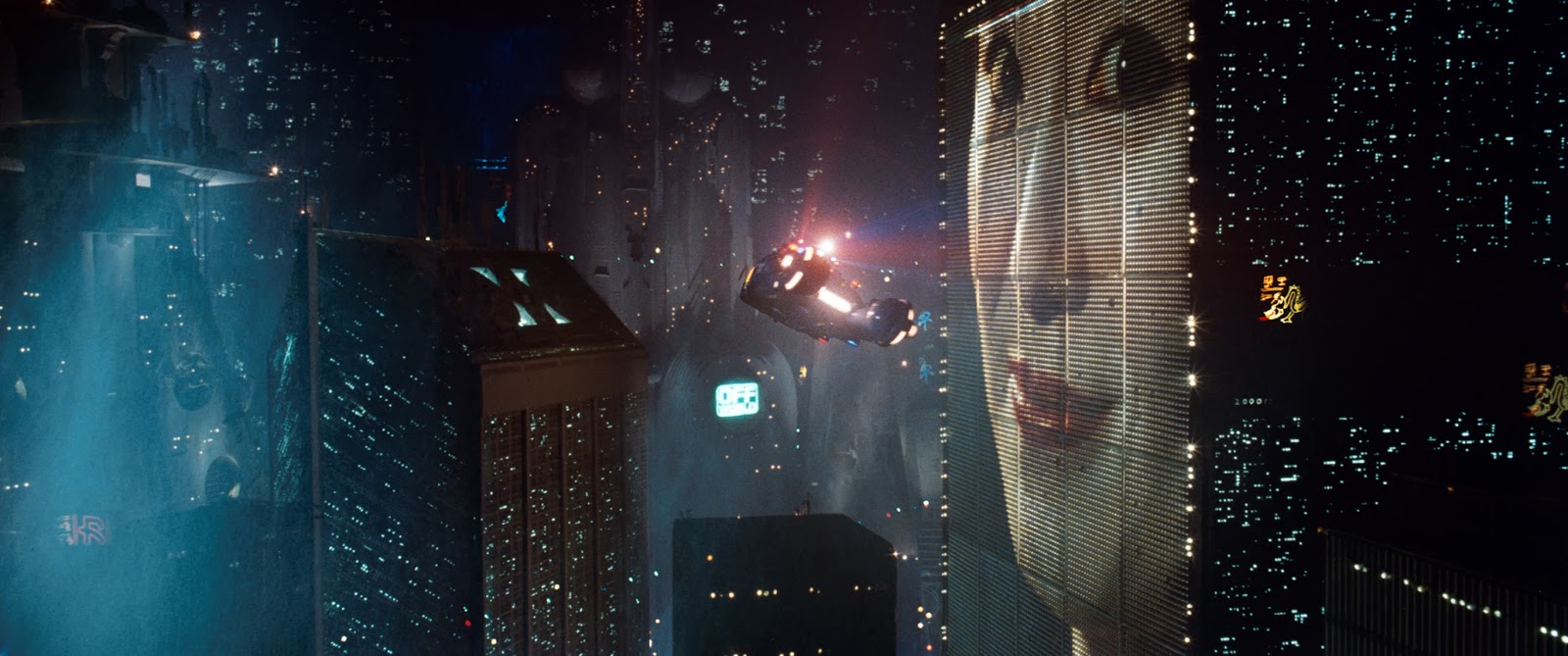
Historical footnote: wheat lights used to be a significant part of model creation. The Bladerunner pyramid buildings, such as the Tyrell Headquarters, were models made with a lot of wheat lights. I saw the famous Las Vegas model made for One From the Heart years ago. Supposedy the lights on the thing either used to blow out the power supplies or melt the thing down from all the heat that the lights emitted.   Although one could and did build grids of this thing, and one could control them with computers, I doubt it was done much.  It just wan't practical.   LED's are now practical and there are lots of good components around to control them.  And you wont have to wait all the time to replace the damn little lights as they burn out.

A selection of wheat lamps from Bladerunner and EEG


2. This is the second part of the synthetic human breakout

The first element of the breakout was "Benjamin Button". This is the second. There may have to be a third before the tsunami of shit emerges of computer generated lead actors, or this may be sufficient. I am not sure, perhaps I will have an opinion after tonight.

3. Gravity wins and was in part distinguished by its effects

The award is for the film where the visual effects most support the movie and the story.  It is not for the best visual effects per se.  The classic example of that, for me, was the first Matrix movie which was truly enhanced by the visual effects.

For the second year in a row, a movie is distinguished and made notable by its visual effects (last year was Life of Pi). I do not know if this is a good thing or not, but its probably not a bad thing. If visual effects is to be worth all the money, this is a useful thing to have happen. If visual effects people are to rise above being considered commodities, having work that distinguishes themselves and is not just like everyone else's is also helpful.

4. American dominance of this award is completely over

This has been coming for a while.  American companies no longer dominate this award.   No one else beyond ILM or Sony is left except for maybe Digital Domain (I do not understand their status).  This has been true for quite a while now, but this year sets the pattern, I think.   I am less certain what this means for the nationality of the effects supervisor, however.  The award goes to the four people identified by the producer, but the facility that did the work also gets credit in practice.  Every year some films will be done at ILM or SONY, but the vast majority of effects will be done at facilities in London, New Zealand and Canada.

5. The nominations are ...

I think that Gravity and The Hobbit will be nominated.   I am rooting for Pacific Rim to be nominated because I think it is important to have giant mutated sea monsters in cinema from a content point of view.    

I will report back what happens.


Cultural Diversity, the LAPD and my Uncle from Chicago


Cultural tolerance is a term that encompasses and encourages various forms of inter-cultural dialogue and respect for diversity. Thus, when a physicist is able to talk calmly and politely to a political scientist, this is an example of "cultural tolerance".

Cultural tolerance is understanding that there are different ways of doing things and that if we are to get along peacefully in this world that we must allow for these differences in spite of the fact that our way is always the best way. It would be better for all foreigners to learn to do things our way but it isn't practical to do so when they first arrive. Thus it is important to be patient and tolerant when dealing with visitors and new arrivals from other places. We must explain the way we do things around here and only then throw them in jail or beat them up if they do things differently.

I have a favorite anecdote demonstrating excellent cultural tolerance on the part of a representative of law and order here in Los Angeles, a member of the Los Angeles Police Department (LAPD) a fine institution noted throughout the world for its own special style of corruption and racism. This story demonstrates that they can act with tolerance towards visitors in an enlightened and possibly even humororous fashion. A visitor from a very far away place, the north side of Chicago, came to our fair city and with complete innocence and naivete got himself into serious trouble.

The person was my favorite uncle visiting us and his mother, my grandmother, from Chicago. The time period must have been the mid 1960's. There are many good things I can say about my uncle, he was one of my favorite people in the world: a successful businessman, an intellectual, the president of his reform temple in Highland Park, Illinois, and a very nice man, married to a classic jewish intellectual neurotic woman who was also one of my favorite people in the world.

We were coming back from somewhere, probably to visit my grandmother, when the problems began. He was driving and did so with an enthusiastic driving procedure which consisted of driving at high speeds on the freeway while moving from lane to lane at will and turning his head around to talk to us, his favorite nephews, cowering in the back seat of the car. We were saved from probable death or disfigurement by a police officer who pulled him over and asked to see his driver's license.

And then my uncle got himself into really big trouble.


You see, in Chicago when something like this happens, there is a standard procedure. And that is what my uncle proceeded to do: which was to hand the police officer his driver's license with $100 bill attached. My guess is that he did not give it a second thought. With his driving skills, I figured, he had probably done this many times before in Chicago.

The police officer looked at the driver's license and "honorarium" and said: "Ah, Mr. Hanig, I see you are from Chicago. Put your money away and never do that again and I won't put you in jail this time".

In retrospect, I think that was a very humorous thing for the police officer to say and that my uncle was very lucky. He could easily have spent the afternoon in LA County Jail.

You see, in this town, you do not try to bribe individual police officers. That would be an incredibly stupid thing to do. The way it works here, as I understand it, is that you bribe the top guy, the Chief of Police, or the Mayor or someone like that. Then they do what needs to be done.

I cherish the memory of the police officer recognizing that,  being from Chicago,  the driver thought that bribing a police officer was a normal thing to do and making allowances for this visitor from a distant place.   


Sunday, January 5, 2014

Repent! The End is Near!


Prophets of doom rarely made a good living in the old days. Prophets of happiness and so forth could count on buying that new goat, wagon, or slave from profits from grateful customers. But prophets of doom, never. They lived in caves and wore sackcloth and needed a bath.

I remember reading all the way through Hemingway's "For Whom the Bell Tolls" before I figured out what the title meant. (1)

As many of you know, I keep a variety of doctors employed and off the streets. Because of various regulations involving the illegal resale of certain attractive medications, I need to see them every month or so, as the prescriptions are kept on a tight leash. Since I am an outlyer in various ways, it can be problematic to find a suitable doctor and therefore, once found, I stay with them for a while. So I drove to LA to see one of these doctors whom I had been seeing for a decade and they channeled me to one of his assistants whom I knew and liked because, I assumed, my doctor was not available. Well, yes, but not the way I thought.

She opened the conversation with "So let me tell you why you are seeing me today instead of Dr. Friedman. Dr. Friedman died last week suddenly and unexpectedly of a heart attack. His funeral was a few days ago."

Excuse me? Bob Friedman was in perfect health when I saw him about 30 days ago. He looked about 65 years old (he was a few years older it turns out but so what), and was in great shape. Yes, he could have lost a few pounds and I doubt if he spent too much time doing aerobic exercise, but he had years and years to live, as far as anyone could tell.

But when the penalty flag goes down, death appears like a thief in the night and there is no appeal.

And he left some very confused people, including his many employees who would like to continue their practice and keep working together and probably will, but its all a little confused because, sensibly, Bob did not expect to be leaving anytime soon, so nothing had been arranged.

Therefore do not expect to be warned, or rather, take this as your warning. The bell could go off at any time, make good use of the day and see that your paperwork is in order.

This may be the only notice that you will receive.


______________________________________________

1. It comes from something John Donne wrote a few centuries ago. He wrote, 
"No man is an Iland, intire of it selfe; every man is a peece of the Continent, a part of the maine; if a Clod bee washed away by the Sea, Europe is the lesse, as well as if a Promontorie were, as well as if a Mannor of thy friends or of thine owne were; any mans death diminishes me, because I am involved in Mankinde; And therefore never send to know for whom the bell tolls; It tolls for thee."
The custom in Europe (or parts of Europe) was to ring a single bell very slowly to announce the death or funeral of someone in that parish. People would know to come to the church to find out who it was tolling for, if they did not already know.


Friday, January 3, 2014

The Old Religion at the End of the Year


The years go by faster and faster, it seems, and our fate is known and approaches swiftly and inevitably. Yet as horrifying as our reality may be, it is always fun for me to remember that they have put up an evergreen in the center of Manhattan and decorated it with toys and mistletoe again this year. I doubt very much if most of the people who view the tree are aware of the meaning these rituals had to some of our ancestors, but it is impressive that the tradition survives at all.

This is the story of an ancient state religion that survived disaster not once, but twice, and survives to this day in two different forms. And whose fundamental principles you recreate every time you look at a clock or tell the time. But first lets set the stage for what the French historians call the longue duree. (2), or the long view.  It has various other names, but it means to try and take a longer perspective.

So first I indicate how astronomy does not change much in our lifetimes, but does change over a longer period.... so ...


The earth spins on its axis in a somewhat eliptical orbit around the so-called Sun and while it does so, entropy inevitably increases and nothing you or I can do will change that. The universe is by no means static and will change on the scale of the solar orbits, but we won't notice because by that time the trillions of nanomachines partitioned into the various cellular entities that make up our so-called individual physical existence will have collapsed into a soup of decayed matter long before.

I know that is a little depressing, but read on, it picks up.

We call the circle of circles around the solar mass a "year", having picked a point on that ellipse to demark the beginning and the end for accounting purposes and because it corresponds to an inflection point on the curve. This subdivision of a year into 360 circles as the planet rotated and circled the sun was noticed by an ancient people "between the rivers" (== Meso Potamia) many years ago and they developed a "sacred mathematics" to explain what they observed in the sky and all around them and made this a central part of their religion and world view. In fact, it formed one of the pillars of their religion and the rituals that held up the state that they lived in.

Consider what it means for there to be a state religion in a country. It means that certain beliefs that are critical to the legitimacy of the government are built into the fabric of society in a very functional and specific set of ways that has evolved over time. When our constitution discusses "separation of church and state", they did not mean that it was unconstitutional to have religion in our government, it meant that the religious leaders would not be selected by the state, or paid for by the state, or that these religious leaders would be part of government by the very fact of their role in the religion. The specific counterexample for the American Revolution was that the Archbishop of Canterbury, the top bishop of the Church of England, was chosen by the King and acknowledged the authority of the King over the Bishop of Rome (e.g. the Pope).

In ancient times, this relationship was much stronger between religion and governance, though of course there was a huge amount of variation. To give some examples and to simplify to make the point, the heads of religion of the Roman Republic were all members of the leading familes of Rome. The rituals that were performed and how they were performed were considered of the utmost importance to the survival of Rome and its rule in the world. They did not care for the most part what people believed as long as those rituals were performed in the correct way and that whatever else you did or believed did not prevent you from doing those essential rituals.

In many ancient societies that we know of, the ruling class or monarch would consult with various religious leaders before starting a war, or fighting a battle. The Romans certainly did. It was believed that the gods that you worshipped had an opinion about what was the right thing to do in such a situation and by using certain technical arts that the gods would tell you and help you to choose wisely. Or possibly that you could influence the outcome of the situation with proper ritual and sacrifice. The ancient Romans were big on making deals with "god".... you do this and I will sacrifice 100 cows to you, etc.

Although there was huge variation in the ancient world, I think it is fair to say that aspects of the religion of a people was very tighly bound up into the legimacy and process of how they lived their lives, paid their taxes, went to war, and chose who ruled over them and in what way. The more formal a state, with a bureaucracy, taxes, and so forth, the more likely they were to have a formal state religion.

But if the state religion said that the rulers ruled by divine right and were in fact themselves gods, or Gods, whatever, then if they got deposed that was bad for the religion. To say the least. And that is what happened to the Neo Bablylonians when their boys lost the war and the Persians came in about 539 BC.

So what is a religion to do? Well, it adapts. Now instead of the gods being planets and stars and comets, they are more universal forces and archetypes. And you formalize some of the loose influences of the stellar bodies into their archetypal forms. And if you are lucky enough to have Alexander the Great around, you adapt all this to Hellenistic culture and become the dominant way of predicting the future with the cachet of being based on "old Babylonian religion" and there you have it: modern astrology. Based on the former state religion of NeoBabylon.

On top of that, and not entirely independently, part of that astrology branches off and without the prediction part and morphs into a science of Astronomy. Now the astronomers don't much believe in the influence of the Zodiac, for example, but they do take a lot of terminology and conventions and continue using them: like 360 degrees in a circle, to name one obvious example. And so, too, Astronomy maintains some fundamental beliefs that comes from the Old Religion.

We should only hope that some of our belief systems should be so resilient and last even half as long.


For a good bibliography of Babylonian Astronomy & Astrology, see:


Thursday, January 2, 2014

Pepper's Ghost and the Spirit Lodge at Expo 86


Once upon a time, a long time ago, I saw one of the best live / theatrical performances I have ever seen, which is the subject of this post. Like all great live performances, part of the impact that it has on you is that you are seeing something that will never be seen again. No matter how rehearsed, no matter how often they give the exact same performance, what you are seeing is live and those moments can never be recreated.

And what I saw was really well done. It was a story about the freedom of the people and of the tribe and about the love of a man for his family. The setting of the play is a native american lodge of some sort, at night, around a campfire.  Our narrator tells you the story his grandfather told him once, long ago.   We of course are not around a fire in native america, we are seeing this as part of a World's Fair and as part of the General Motors pavilion but, magically, it all still works.

I admit, it is hard to believe that what I saw was or could be as good as I remember it.  But as I have researched this post on the sometimes useful but always annoying Internet, I have come across other people who have a similar opinion about what they saw there in that pavilion.

Perhaps if one saw such events from time to time, then perhaps one could believe in the power of narrative, live theatre and the other theatrical arts to enrich our lives and maybe even improve the world.

But of course that is terribly naive and we know better today.

But in 1986 I was much younger and idealistic and made a last minute decision to attend the World's Fair (1) in Vancouver, Canada, Expo 86 (2), in the final week it was open. It was an impromptu trip and it was so long ago that I barely remember any of the practical details. I think a friend had rented a house so I had a couch to sleep on. I don't remember if I drove or flew to Canada, but somehow I remember having a car so maybe I flew and rented, it doesn't matter. But there I was at Expo 86 in its final week as they were basically wrapping up the park after a successful six month run.

If you have never been to a World's Fair before, as I had not,  it is a combination of theme park and international foreign affairs public relations and trade relations exposition. The park is filled with pavilions from various countries that want you to know about their history and what an attractive place it is to visit, to make investments in, or even perhaps to emigrate to. They will have a beautiful building that somehow represents their country, it is usually very open and large, so that you can walk in and get a passion fruit drink and watch films about diamond mining in S. Africa, or who knows what.

A world exposition is an opportunity for designers, architects, businesses and governments to show off how creative and positive they can be.  When things come together, these Fairs can have an impact for years or decades after their run.   In a few cases, such as Paris 1900,  they are recognized as important culturally for as long as a century or more.  So they spend a fair amount of money, which varies depending on how the world economy is doing and produce a result which serves many purposes, from the level of world government and business down to the individual and his or her family.

Expo 86 was "special format" heaven. Special format is the term we used to use in the world of theme parks to describe unusual film format and projection situations. The Hobbit at 48 fps is a modern example of what we used to call special format. At Expo 86 we had real Imax, stereo Imax, Showscan, Stereo Showscan, and on and on. These are all obsolete but esteemed film formats and terms-of-art from the days before digital projection. (5)

But everyone said that the "must see" pavilion was the General Motors exhibit, which had the odd name of "Spirit Lodge".

Spirit Lodge was very difficult to get in to see.  Apparently the theatre was quite small and could only handle a few people per show and maybe 4 shows an hour, so the show itself was short.   There were no reservations as I recall so you just had to get there early and wait in line.   So I did and thus was able to see Spirit Lodge in its first release and in its proper place.

You were in a small room that I think maybe held about 80 people arranged in a semi-circle around the stage. The stage was at the level of the lowest row of the audience, you shared the same space. Like good close-up magic, part of the appeal of what is about to happen comes from the fact you are so close and not more than a few feet away. There is only one performer, a single older man. No robots, no apparatus that you can see.   Just a small camp fire in the center of a dirt floor.   There were a few props around the stage to set the scene and to provide objects for dramatic shadows during the show.  There was nothing to keep you from walking the few feet from your chair to the center of the stage if that is what you wanted to do.

The lights go down and a man comes out. He is dressed in what I remember as a traditional native american outfit from someplace cold (e.g. like Canada).  He was there that night, he told us,  to tell us a story that his grandfather told him many years ago here in this lodge. It is clear from the context that he is addressing us as if we were his grandchildren.  He talked about his love for his grandfather who has been dead for many years now and he told the story of a magic canoe and how it took the men of the tribe wherever they wanted to go. The meaning of freedom, he said, was the freedom of the people to travel. Without the freedom to travel, whether in a magical canoe or otherwise, then there was no real freedom.

And as he spoke to you, live, right there, magically a few feet away, what appeared to be flames and smoke came out of the stage floor and hovered in the air. As he warmed his hands by this magical and impossible fire, images started to appear in the smoke to illustrate his story of his grandfather and the magic canoe from long ago that let the people go where they wanted. The images appeared to be there, live, in three dimensions, not projected in any way, but real.  He moved his hands above the fire and commanded his memories to appear and they did. They came and went in a dreamlike fashion. But it was right in front of you and a few feet away and it looked completely natural.

What I was seeing, of course, without realizing it, was Pepper's Ghost (3), that famous 17th century stage illusion which uses glass and half silvered mirrors to project a stage somewhere out of sight to the stage in front of the audience.   Using the magic of mirrors gives the perfect illusion of depth and substance like we only approximate with stereopsis. Somewhere in the back, or above me, was another stage that had some combination of film projection, perhaps projection on solid objects, perhaps projection on other transparent screens, and so forth.   Mirrors and glass were used to transmit the image to the center of that little stage with you not more than a few feet away from it.

How they managed to do this in a way that worked for all the different perspectives in the audience that day, and every day of its performance, is a mystery to me. Pepper's ghost is very tricky to execute and yet we had a lot of people sitting around the campfire. But it was perfect.

I have never seen Pepper's Ghost look so good.

I am not sure what this picture is, but it may be concept art associated with Spirit Lodge.

And of course, the context at the time, remember, is 1986 and the world is still divided by the Cold War and the Iron Curtain. And there are many nations where people are not allowed to travel outside their country for fear that they would defect to the West. So, Spirit Lodge, at this international exposition in the pavilion of General Motors was about the freedom to travel, in other words it was a subversive message, tastefully done. Very nice, and unusually well done for a company like General Motors, it seemed to me.  (4)  

It played for the length of the Exposition and, as is the nature of such things, disappeared.

I know that years later a version of Spirit Lodge opened at  Knott's Berry Farm. It may still be there for all I know. But I have never seen it there, and don't intend to, because I know it would only diminish it for me. Part of what made Spirit Lodge what it was, was when and where it was. In Vancouver, much closer to the reality of native america than Knott's could ever be. And it was performed then, during the Cold War, when the concept of transportation as a manifestation of freedom could have the subversive meaning that it had that day.

For more on Spirit Lodge see http://bobbea.com/expo-86/gm.html.

_____________________________________________________

Notes:

1. A world's fair or exhibition is an event that only happens a few times any generation and is controlled by an international body. In the history of America the 1938 and 1964 World's Fairs are particularly significant. Some believe that the 1964 Fair was the high point of our civilization in its purest most idealistic form. 

2. Expo '86 was held in Vancouver, Canada between May 2 and October 13, 1986.

4. Apparently General Motors is known for doing very nice pavilions at World's Fairs, although I do not know the details of this.  So this was not out of character at all and probably a good investment in their global identity.

5. Deleted paragraphs:

Expo 86 had fireworks every night. But in the final week, they did not just have a fireworks show, no, they had a fireworks show designed to use up their extra fireworks so it would all be gone when the last show was over. And they had a lot of fireworks. I mean hours of fireworks. All overwhelming and filling the sky. It went on and on and on. Fireworks need to be experienced and is not something you can store up and remember, unfortunately. But I have the memory of thinking that I will never see a fireworks show like this again.

There were dozens and dozens of pavilions representing countries from all over the world, and a very entertaining center "walkway" of the history of transportation that was many lifesize sculptures for kids to play on representing transportation through the ages, from horse drawn cart through jet airplane and submarines and space craft.